

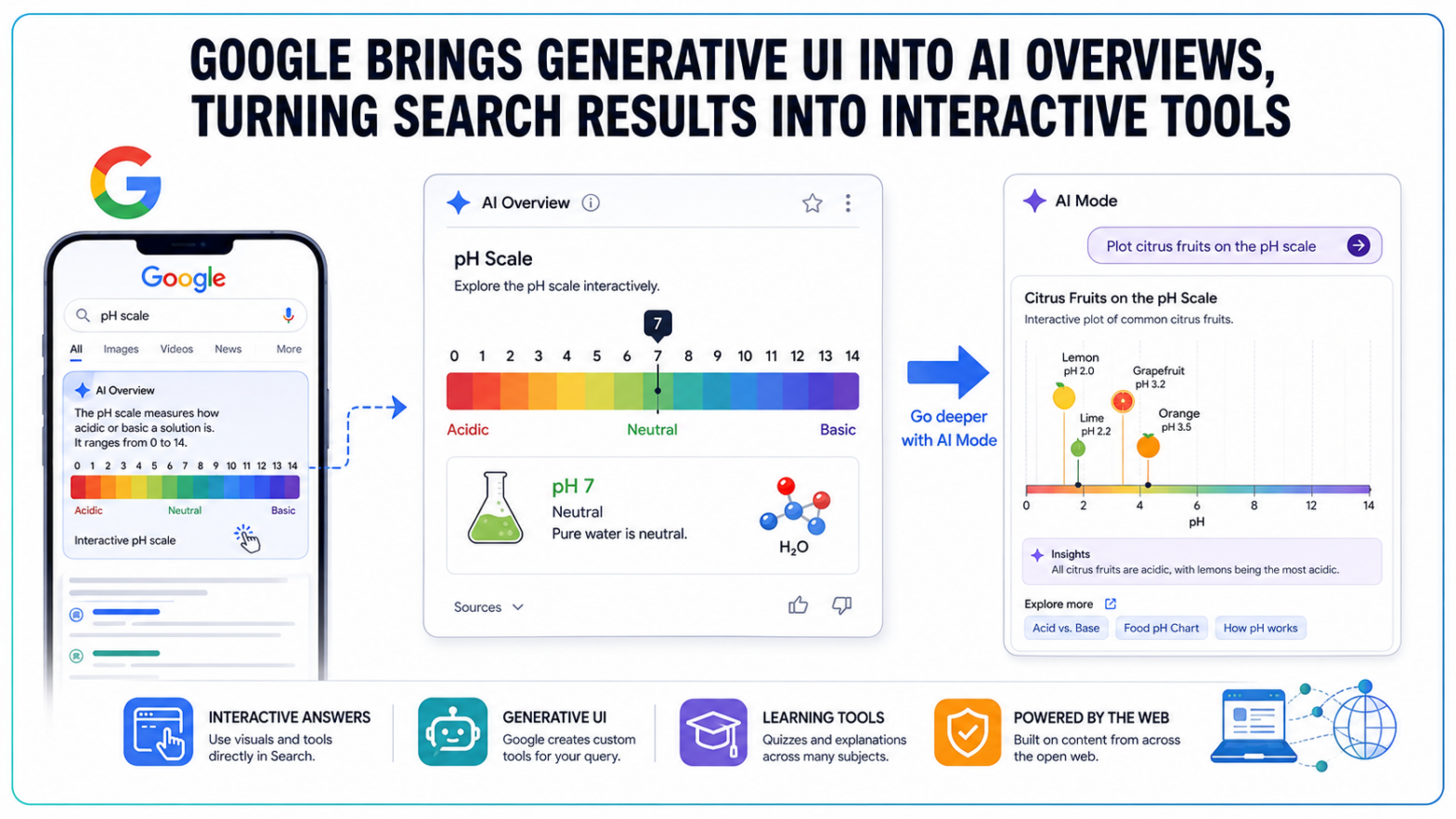
Google Search is starting to do more than answer the query. It can now build the interface needed to explore it.
Google has begun rolling Generative UI into AI Overviews, extending technology that can create interactive visuals, simulations and customized experiences on demand beyond AI Mode and deeper into the standard search experience. The shift gives searchers more ways to manipulate information without immediately leaving Google.
For publishers and marketers, that creates a different competitive problem. Ranking beside an AI-generated answer is one thing. Competing with an interactive tool that can satisfy part of the searcher's task directly on the results page is another.
AI Overviews Are Becoming Something Users Can Operate
Google confirmed the expansion on August 19 as part of a broader release of AI-powered learning features in Search.
The clearest example is simple: search for "pH scale," and Google can generate an interactive visual within an AI Overview rather than limiting the result to a written explanation. A user who wants something more specific can continue into AI Mode and ask Google to plot particular items, such as citrus fruits, against that scale.
Google says its Generative UI capabilities have launched globally in English in AI Mode and have now started rolling out in AI Overviews.
That distinction matters.
AI Overviews already changed how information is presented above traditional organic listings by generating answers from multiple web sources. Generative UI pushes the format further by making the result itself functional.
Instead of reading a block of generated text and deciding whether to click somewhere else, a searcher may be able to interact with the answer immediately.
Google is effectively adding another layer between the query and the publisher.
Generative UI Is Moving Beyond Generated Text
Generative AI in Search has largely been discussed as a content problem: Google summarizes information, cites sources and lets users ask follow-up questions.
An interface can absorb more of the task.
Google describes its new capabilities as custom tools and simulations generated around the user's request. Depending on the query, that could make a search result behave less like a document and more like a lightweight application.
The education rollout shows how broad that model can become. Google is also introducing customized practice quizzes directly in Search across subjects including science, mathematics, humanities and languages. Supported standardized tests include the ACT, AP, GRE, LSAT, MCAT and SAT, among others.
Those quizzes provide explanations for answers and links for further reading, and Google says they are now available globally in English at no charge across both AI Overviews and AI Mode.
The underlying direction is larger than education.
Google had already introduced Generative UI in AI Mode as Search developed more dynamic and agentic capabilities. Bringing those interfaces into AI Overviews places them closer to users who may never deliberately open an AI-specific search experience.
The Click Is No Longer the Only Useful Search Action
Traditional search economics depend heavily on a sequence that has barely changed in decades: query, results page, click.
AI search has been weakening that sequence by answering more questions on the SERP. Interactive interfaces introduce another possibility: query, interaction, refinement, then perhaps a click.
Or no click at all.
Google has not released data showing that Generative UI will cause a specific decline in organic click-through rates, so claims of dramatic CTR losses remain speculative. The structural pressure on clicks, however, is straightforward. If a searcher's objective can be completed through an interactive result, fewer external visits may be required for that particular task.
This does not eliminate the web from Google's AI search model. Google continues to surface links and has been modifying how citations and destinations appear across its AI experiences, including recent changes to links in AI Search.
Google's new quizzes also explicitly include links that let searchers explore material further. Its upcoming Lens learning experience will similarly allow users to move between AI-generated assistance and relevant sites on the web.
The change is therefore less binary than "Google versus publishers." The more immediate issue is how much of a user's task happens before an outbound click becomes necessary.
Search Visibility and Website Traffic Are Splitting Apart
That distinction makes conventional ranking metrics harder to interpret on their own.
A page could remain highly visible as a source behind an AI-generated experience while producing a different traffic pattern than an equivalent organic ranking once did. Google has already begun giving publishers more visibility into this transition through expanded generative AI reporting in Search Console, including reporting related to appearances across AI-powered Search experiences.
Generative UI adds another variable because the searcher's engagement can occur directly inside the interface Google creates.
For marketers and SEOs, the practical implication is not that text content suddenly stops working. Google's AI systems still require useful web content to retrieve, understand and support generated responses. The change is that informational content increasingly competes against an experience assembled from that information. Search performance therefore has to be evaluated across visibility, citations, qualified visits and downstream outcomes rather than CTR alone.
That is particularly relevant for queries that naturally lend themselves to calculators, comparisons, simulations, visual explainers, selectors and structured decision tools.
A conventional article may answer the question perfectly.
Google may now be able to turn that same answer into something the searcher can use.
AI Overviews Are Moving Closer to a Generated Application Layer
Google framed the August release around students, but its deployment model is significant well beyond education.
The company did not describe Generative UI in AI Overviews as a temporary experiment limited to a small test group. It said the capability has started rolling out there while AI Mode availability is already global in English.
That follows a broader progression in which Search has gained conversational follow-ups, more capable reasoning models, connected applications and agentic functions. TechWyse previously reported that Google is already allowing AI Mode to connect directly with third-party apps, moving some searches from information retrieval toward task completion.
Generative UI brings a similar idea to the presentation layer.
Google has not said how quickly the AI Overviews rollout will expand, which query categories will receive generated interfaces most frequently, or what measurable effect the feature is having on publisher traffic.
For now, the confirmed change is narrower but consequential: an AI Overview no longer has to be an overview at all. It can become an interactive tool built for the query itself.