

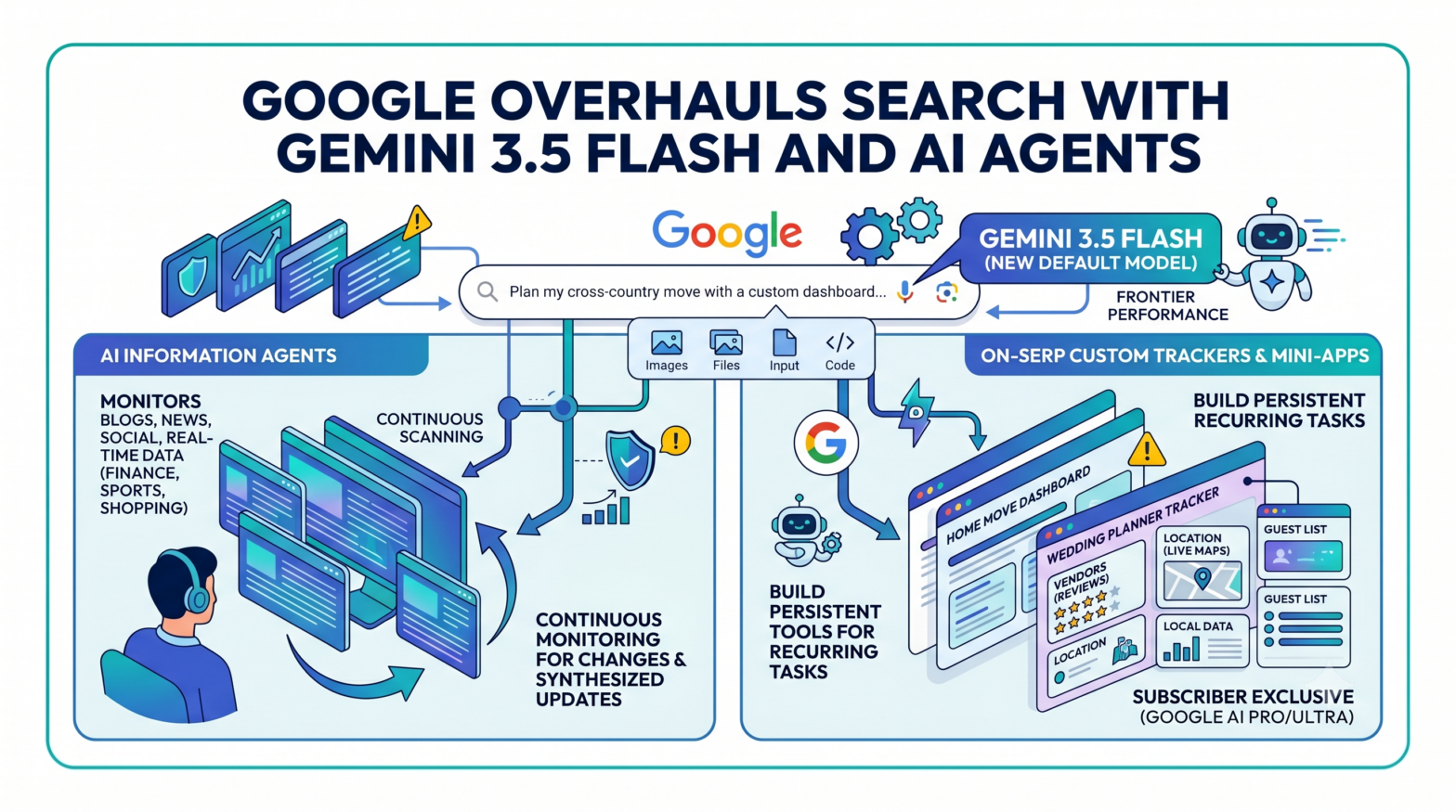
Google Search now operates on a new underlying model and introduces two agentic capabilities that allow subscribers to monitor the web continuously and build persistent, task-specific tools directly within search results. Google confirmed all three changes at its I/O 2026 developer conference on May 19, publishing details in a dedicated Search announcement on the Google Search blog the same day.
Gemini 3.5 Flash Becomes the Default Model in AI Mode
As of May 19, Google upgraded Search with Gemini 3.5 Flash as the new default model in AI Mode for all users globally. The company says the latest Flash model is designed to deliver sustained frontier performance for agentic workflows, reasoning, and coding tasks directly inside Search.
Just one year after its debut, AI Mode has surpassed one billion monthly users, with queries more than doubling every quarter since launch. As people have relied more heavily on conversational and AI-assisted searches, overall Search queries reached an all-time high last quarter.
A Redesigned Search Box, Built for Longer and Conversational Queries
Google is introducing a new intelligent Search box that expands the more a user types, billed as the "biggest upgrade to [the] Search box in over 25 years." The redesign is a direct response to how search behaviour has shifted toward longer, more contextual prompts.
The box dynamically expands to give users space to describe exactly what they need, and is designed to anticipate intent with AI-powered suggestions that go beyond autocomplete. Users can also search across modalities, using text, images, files, videos, or Chrome tabs as inputs.
The new intelligent Search box began rolling out on May 19 in all countries and languages where AI Mode is available.
Information Agents Monitor the Web on a Subscriber's Behalf
The second major announcement introduces a persistent monitoring capability into Search. Information agents allow users to stay updated on topics that matter most to them, scanning blogs, news sites, social posts, and real-time data on finance, shopping, and sports to monitor for changes and then deliver an intelligent, synthesized update with the ability to take action.
Background monitoring is what separates these agents from ordinary search queries; they keep tracking a topic after the initial request and surface updates when prices, weather, traffic, sports, markets, or housing conditions change. Users can review or adjust tracked tasks through AI Mode history in the Google app.
Information agents will launch first for Google AI Pro and Ultra subscribers this summer.
Custom Dashboards and Mini Apps for Recurring Tasks
Beyond single-session queries, for ongoing tasks that users find themselves searching repeatedly, like planning a wedding or managing a home move, Search can now go further, building custom dashboards or trackers that users can return to and continue making progress on.
Search will code custom trackers by tapping into real-time sources, including reviews, live maps, and local data. Users will be able to build these custom experiences, described as mini apps, right within Search in the coming months, starting first for Google AI Pro and Ultra subscribers in the US.
Google says these experiences can draw on live information from maps, reviews, weather data, and other real-time sources.
Availability and Subscription Requirements
The new AI-powered Search box and conversational AI Overview improvements are rolling out globally in supported AI Mode regions and languages. Generative UI capabilities in Search will roll out globally this summer, free of charge. Information agents and Antigravity-powered mini apps will launch first for Google AI Pro and AI Ultra subscribers this summer.
For marketers and SEOs, the combination of persistent information agents, on-SERP custom dashboards, and an AI-powered search interface that anticipates user intent represents a material shift in how users may engage with search results. Queries are expected to become longer and more task-oriented, which could reduce conventional click-through behaviour for informational keywords while increasing the visibility of content that can satisfy multi-step or ongoing user needs. These are practical implications based on industry norms and announced feature behaviour; Google has not made specific claims about impacts to organic search performance.
Google's May 19 Search blog post confirmed that Personal Intelligence in AI Mode is also expanding to users in nearly 200 countries and territories across 98 languages, available at no cost, as part of the same I/O 2026 Search update.