
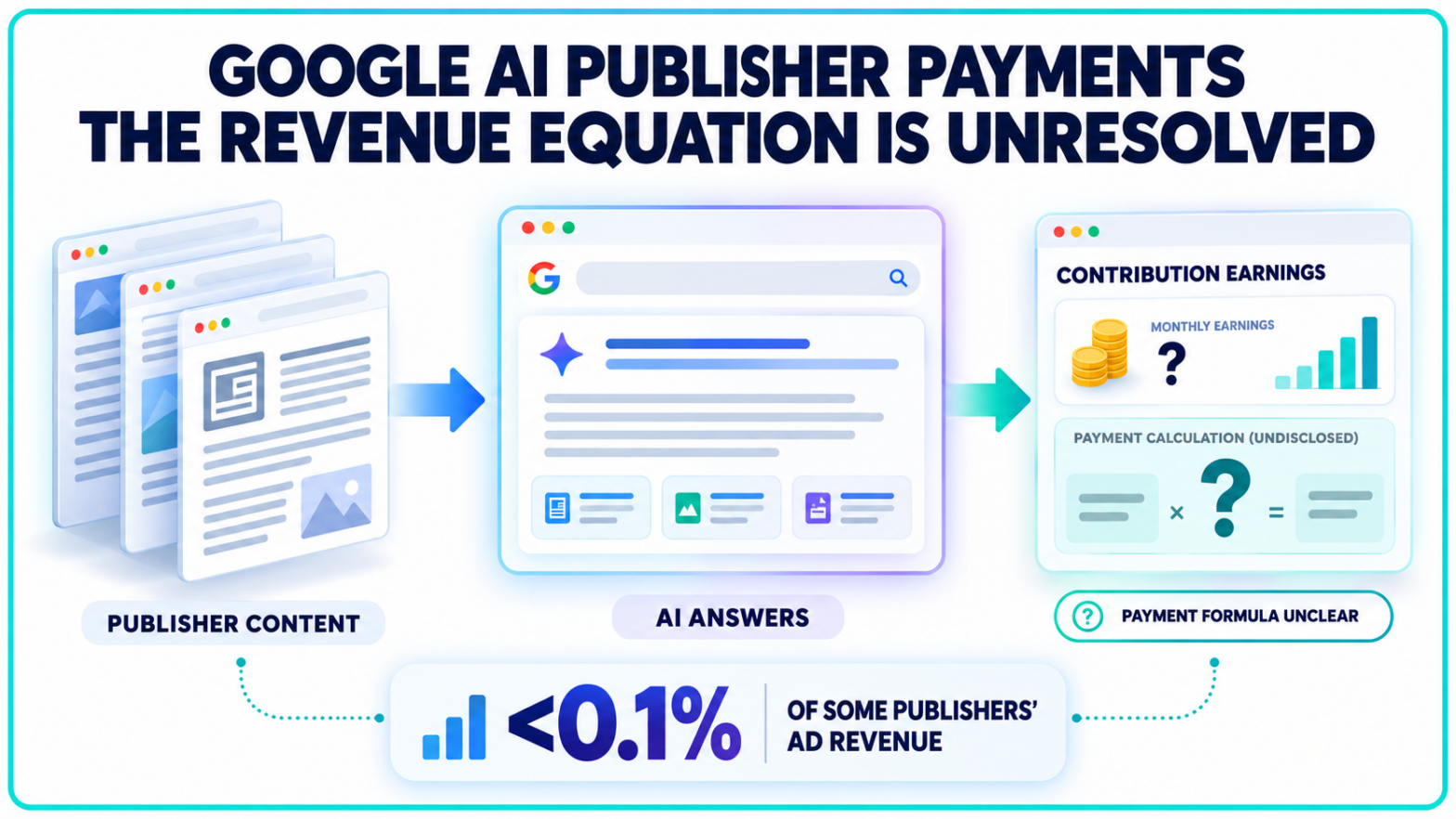
Google is paying some publishers for content used in AI answers. For several small and midsize sites, reported payments amount to less than 0.1% of their advertising revenue, leaving a gap between being compensated and establishing a substantial new income stream.
The early figures describe individual experiences inside a limited pilot. They do not establish an average payout or a standard revenue share.
The programme reportedly includes about 100 digital publishers and covers contributions to AI Overviews, AI Mode and Gemini. Google has publicly confirmed that it is testing partnerships with websites whose material helps ground generative AI responses, but its public explanation does not provide a payment formula.
The 0.1 Percent Figure Is a Comparison Rather Than a Rate
The reported percentage compares pilot payments with participating publishers’ own advertising revenue. It does not describe a share of Google’s ad revenue distributed to websites, or a contractual rate applied to every AI answer.
That distinction changes the story. The figure measures how small the new income is relative to an existing business, rather than explaining how Google prices a contribution.
Reported earnings also vary sharply. Several smaller sites have received less than $1,000 across multiple months. One publisher that joined more recently reportedly earned roughly $50,000 to $60,000, while an early participant is reportedly earning more than $1 million a year.
Those examples use different time periods and unnamed businesses. They cannot support a meaningful average, a typical monthly payment or a conclusion that every participant earns below 0.1% of ad revenue.
Nor do the figures measure lost income. A payment expressed as a fraction of advertising revenue does not reveal whether the same publisher experienced a search traffic decline, how large that decline was or what caused it.
Google Is Testing Payment for Grounding Content
Google’s June 18 public policy statement places the experiment within a broader effort to develop new partnerships with content owners.
The company says it is piloting a way to work with “websites whose content meaningfully contributes to the freshness and factuality of generative AI responses” through grounding. Grounding connects an AI response with source information used to support its accuracy.
The same statement discusses a separate News AI pilot involving more than 200 publications. That programme pays for enhanced content rights and specialized delivery methods. Its participant count should not be treated as the size of the AI contribution pilot.
These are different arrangements within Google’s publishing relationships.
For publishers following Google AI search, the distinction is commercially relevant. A partnership covering particular content rights is not interchangeable with a payment attached to a contribution to an answer. Neither establishes a universal entitlement for every website appearing in Search.
Google’s public statement confirms the direction of the grounding experiment. It does not identify the reported payment amounts as company-published results.
A Monthly Earnings Number Does Not Explain Content Value
Participating publishers reportedly see an AI contribution earnings panel inside Search Console, with a monthly payment figure and some history. The calculation behind that figure remains unclear to publishers describing the programme.
The reported model rewards material judged to have meaningfully contributed to an AI response. The available information does not establish a fixed payment per citation, impression or click.
That leaves an important analytical gap. A publisher can observe revenue without being able to reconcile it against the pages used, the frequency of use or the contribution assigned to each source.
Monthly changes are difficult to interpret under those conditions. More earnings could reflect more qualifying uses, a different mix of content or another element of the calculation; the reported panel does not establish which explanation applies.
A visible link in AI Overviews is therefore not, on the evidence available, a reliable unit for predicting a payment. Visibility, visits and contribution earnings answer different questions about the same content.
Search Console Visibility Reports Are a Separate Measurement
Google now provides dedicated generative AI performance reports for Search and Discover. Its announcement, published June 3, states that the insights reached websites worldwide by August 31.
The reports show impressions and the pages appearing in generative AI features, with country and date information. Device information is available for Search results. Google says the data also remains included in the overall performance report.
Those reports establish where and how often URLs appear. They are not presented as a ledger of paid contributions under the licensing experiment.
An impression is a visibility measure. A referral is a visit. An earnings entry records compensation. Treating these as equivalent would obscure the economics publishers are trying to understand.
For SEO and analytics teams, the practical implication is to assess contribution payments alongside referral traffic and revenue using matching periods. Search visibility can be evaluated separately, but it cannot substitute for an explanation of the payout calculation or establish that payments offset a change in advertising income.
The ongoing publisher traffic debate and the emerging compensation model therefore require separate evidence.
Content Controls Do Not Establish Payment Terms
Google has also expanded the choices available to website owners. Its Search controls announcement, updated August 31, describes a Search Console toggle for deciding whether a site appears in and helps ground generative AI Search responses.
Google says those controls are now available worldwide. Opting out removes impressions and traffic from its generative AI features; the choice is not used as a ranking signal for search results outside those features.
That provides a content-use decision. It does not explain how a participating publisher’s contribution is valued, or guarantee a payment to a site that remains included.
The early payout reports concern a selected group of publishers. Google’s public grounding partnership statement supplies no standard rate, minimum payment or timetable for opening the contribution programme to every website.