

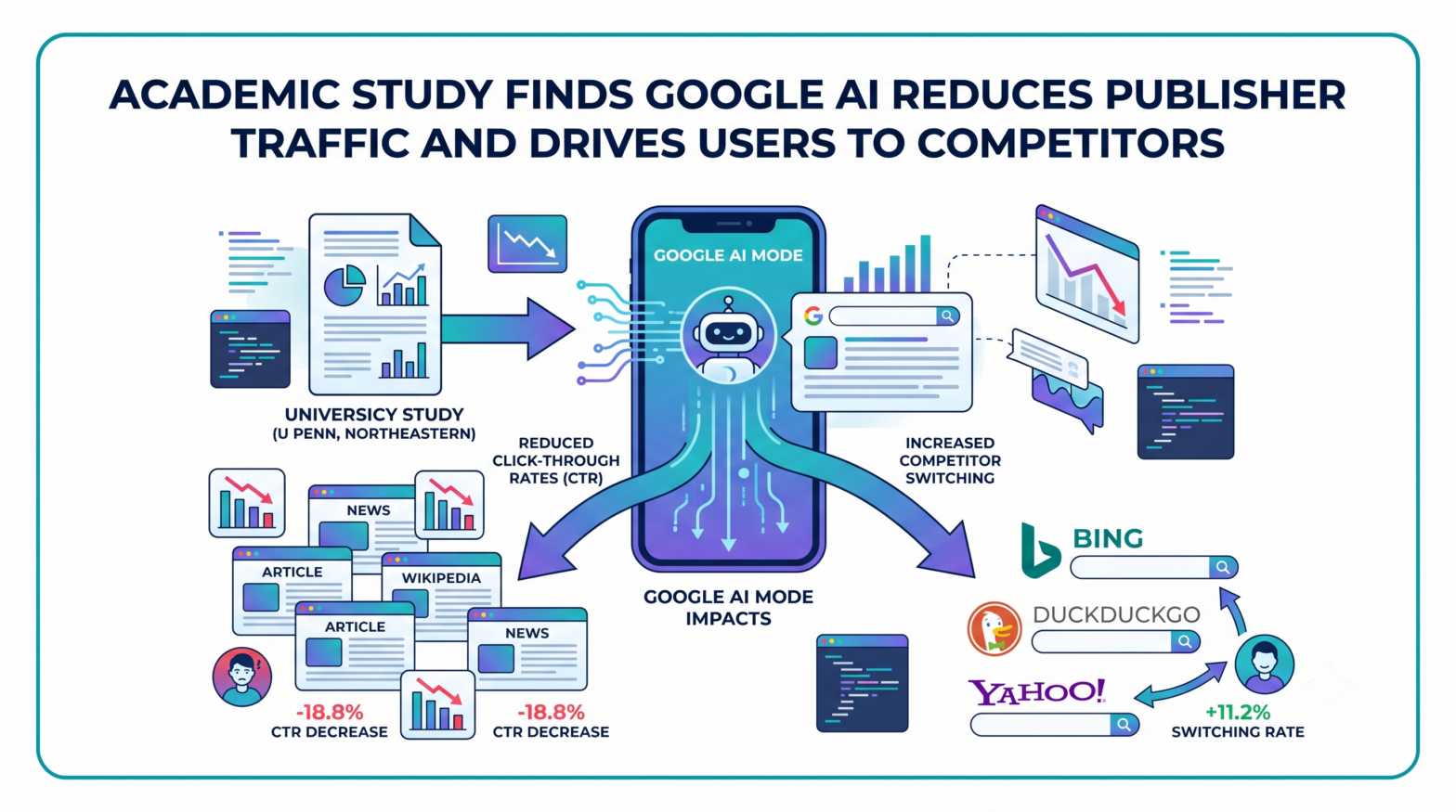
Google's AI Mode measurably reduces organic click-through rates to third-party websites and increases the likelihood that users switch to competing search engines. Researchers from the University of Pennsylvania and Northeastern University confirmed those findings in a preregistered field experiment published to arXiv on August 18, 2026, under the title AI in Search Reduces Publisher Referrals Without Improving User Experience: Experimental Evidence.
Study Design and Methodology
The researchers conducted a preregistered field experiment with 1,100 participants on Google Search to estimate the causal effects of AI Overviews and AI Mode on user behaviour, publisher traffic, and user perceptions. Participants were recruited between March 17 and March 19, 2026, and were limited to U.S.-based adults who used Google Chrome as their primary browser and Google Search as their primary search engine.
Unlike prior research on the topic, which relied on observational comparisons of search traffic before and after AI Overviews rolled out, this paper used a custom-built browser extension to randomly assign real users to see or not see the AI-generated summaries Google places atop many search results pages. The extension also recorded browsing history and snapshots of search results pages, enabling the researchers to track searches, clicks, AI Overview appearances, and whether users navigated to external sites.
Participants were randomly assigned to one of three conditions: standard Google Search with AI Overviews and AI Mode suppressed; Google's default experience with AI features enabled as normal; or a forced AI Mode experience where all searches were redirected into AI Mode.
The paper notes a technical complication during the experiment. During the study period, Google changed the HTML structure of AI Overviews, which broke the extension's logic for identifying and hiding them. As a result, the paper reports that AI Overviews were successfully hidden in only 51.1% of cases in the No AI condition.
Click-Through Rate Findings
AI Mode reduced external click-through rates by 18.8 percentage points, while removing AI features increased click-through rates by 8.8 percentage points. The paper concludes that removing AI Overviews and AI Mode increases click-through rates to publishers, while an AI Mode-only experience reduces click-through rates and erodes user trust in information found on Google.
AI Mode specifically reduced clicks to news sites, Reddit, and Wikipedia. Users spent more time per search session in AI Mode but conducted fewer overall search sessions.
Competitor Engine Switching
Assignment to AI Mode significantly increased the fraction of users searching on a competing engine, Bing, DuckDuckGo, or Yahoo, by 11.2 percentage points, a finding the paper reports as statistically significant at p<0.001. The researchers found no evidence that exposure to the No AI Search condition impacted substitution to competitor engines or users' long-term intention to switch. That asymmetry indicates the competitor migration effect is attributable specifically to AI Mode, not to the absence of AI features.
User Perception and Satisfaction
AI Mode reduced users' reported trust, satisfaction, perceived usefulness, sense of agency, and perceived personalization and relevance. The paper notes that these declines were broadly consistent across different user segments, with one exception: heavy users of Google Search experienced a more pronounced reduction in search sessions than lighter users did.
Notably, the study found no detectable change in user perceptions when AI features were removed. Stripping out AI Overviews neither improved nor worsened how users perceived their search experience, a finding that directly undermines the premise that AI Overviews are adding meaningful user value.
For news-related queries specifically, the researchers found no statistically significant difference in user perceptions between AI Mode and standard Google Search.
Google's Stated Position
At Alphabet's Q1 2026 earnings call, CEO Sundar Pichai stated that "people love our AI experiences like AI Mode and AI Overviews, and they're coming back to search more." Pichai has also claimed that AI Mode sends more traffic to a wider range of web sources. The August 18 paper's experimental findings directly contradict both claims on measurable behavioural grounds.
At Google I/O 2026, Pichai announced that AI Overviews has over 2.5 billion monthly active users and that AI Mode has surpassed 1 billion monthly active users, calling it "our biggest upgrade to Search ever." Google has not published peer-reviewed or independently verifiable data on click-through rates or publisher referral volumes under AI Mode.
Broader Research Context
The arXiv paper's findings align with a growing body of independent research. An Ahrefs study published in February 2026 found that AI Overviews correlate with a 58% reduction in click-through rates for top-ranking pages, nearly double the 34.5% decline the same firm documented in April 2025. The Pew Research Center found that only 8% of users click on traditional search results when an AI Overview is present, compared to 15% when no overview appears.
The Reuters Institute's 2026 journalism trends report, using Chartbeat data from more than 2,500 news sites, found Google organic search traffic down 33% globally and 38% in the U.S. between November 2024 and November 2025.
Implications for Search and Content Strategy
For digital marketers and SEO practitioners, the study's experimental design carries particular weight. Because it randomly assigned users to conditions rather than relying on before-and-after traffic comparisons, its findings establish a causal relationship between AI Mode exposure and reduced external clicks, not merely a correlation. Practitioners tracking organic click-through rate in Google Search Console should treat AI Mode as a structural suppression factor when analyzing performance declines, and should document session-level behaviour rather than relying solely on impression-based metrics. The documented competitor switching effect also suggests that audiences in AI Mode-heavy query categories may be partially migrating to alternative platforms.
The paper's authors conclude that integrating generative AI into web search reshapes online attention, with economic consequences for the online publishers that sustain both search platforms and the overall information ecosystem.