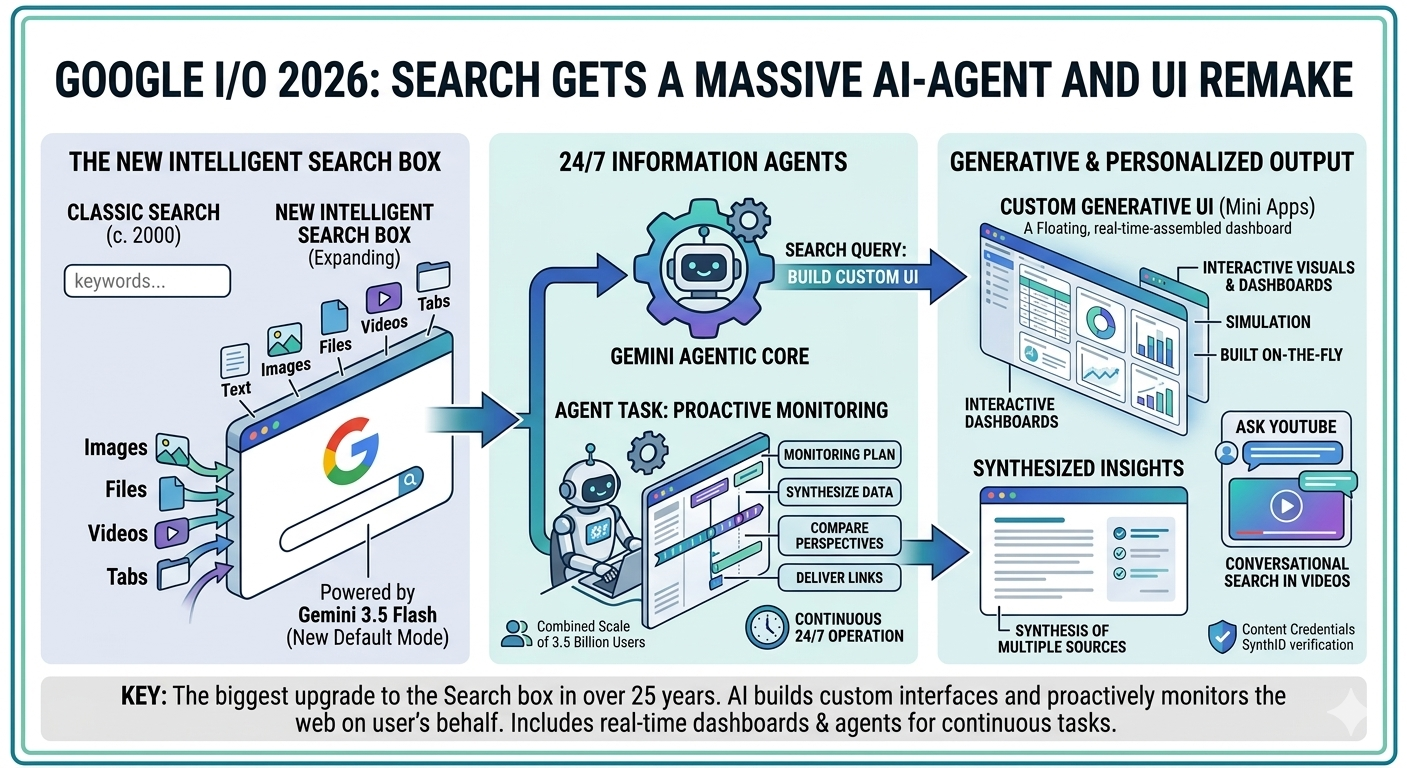
Google users will encounter a fundamentally different Search interface starting this week. At its I/O 2026 developer conference on May 19, Google upgraded Search with Gemini 3.5 Flash as the new default model in AI Mode and announced what it describes as the biggest upgrade to its Search box in over 25 years.
The redesigned interface, which Google calls the "intelligent Search box," puts its most powerful AI tools directly in the search entry point. It expands dynamically to accommodate longer queries, includes AI-powered suggestions that go beyond autocomplete, and accepts input across text, images, files, videos, and Chrome tabs.
The new intelligent Search box began rolling out on May 20 in all countries and languages where AI Mode is available.
A Wider Model Rollout Behind the Interface Change
The model powering the new Search experience is Gemini 3.5 Flash, announced at the same keynote. Gemini 3.5 Flash combines frontier intelligence with the ability to perform agentic tasks, surpassing Gemini 3.1 Pro in coding, agentic, and multimodal benchmarks, at four times the output token speed of other frontier models. As of May 19, Gemini 3.5 Flash is the default model in the Gemini app and in AI Mode in Search globally.
The model is available generally via Antigravity, the Gemini API, and Gemini Enterprise, as well as through the Gemini app and AI Mode in Search. Google confirmed that Gemini 3.5 Pro is already in internal use and is expected to roll out next month.
Information Agents to Monitor the Web on Users' Behalf
Alongside the interface changes, Google announced a new agentic capability it calls information agents. Unlike traditional search tools that respond only when prompted, Google's information agents are designed to operate continuously in the background, 24/7, helping users stay informed about their interests without needing to repeatedly search for the same information.
Instead of delivering a list of links, the agents can synthesize information from multiple sources, explain why something matters, compare perspectives, and provide actionable insights. Google's head of Search, Liz Reid, described one use case in a press briefing ahead of I/O: an agent that could track market movements in a specific sector with defined parameters, map out a monitoring plan, and deliver a synthesized update with links when relevant conditions are met.
Information agents will launch first for Google AI Pro and Ultra subscribers this summer. The feature represents an evolution of Google Alerts, the notification service Google launched in 2003.
Generative UI Coming to Search This Summer at No Cost
Google also confirmed that Search will gain the ability to build custom interfaces in response to individual queries. Google is bringing the capabilities of Antigravity and the agentic coding features of Gemini 3.5 Flash into Search, allowing it to build the ideal response on the fly. This includes custom generative UI — visual tools and simulations — assembled in real time from components such as interactive visuals, tables, graphs, and simulations.
These generative UI capabilities will be available for everyone in Search this summer, free of charge. Google Search will also be able to build custom dashboards and trackers for continuous tasks, described as "mini apps for your own specific tasks," available in the coming months for AI Pro and Ultra subscribers in the US.
AI Mode and AI Overviews Reach Combined Scale of 3.5 Billion Users
Google CEO Sundar Pichai disclosed updated usage figures during the May 19 keynote. AI Overviews now has over 2.5 billion monthly active users, and AI Mode, which Pichai described as Google's biggest upgrade to Search ever, has surpassed 1 billion monthly active users in just one year since launch.
AI Mode has seen queries more than double every quarter since launch, and last quarter, Search queries reached an all-time high.
Ask YouTube Adds Conversational Search to Video
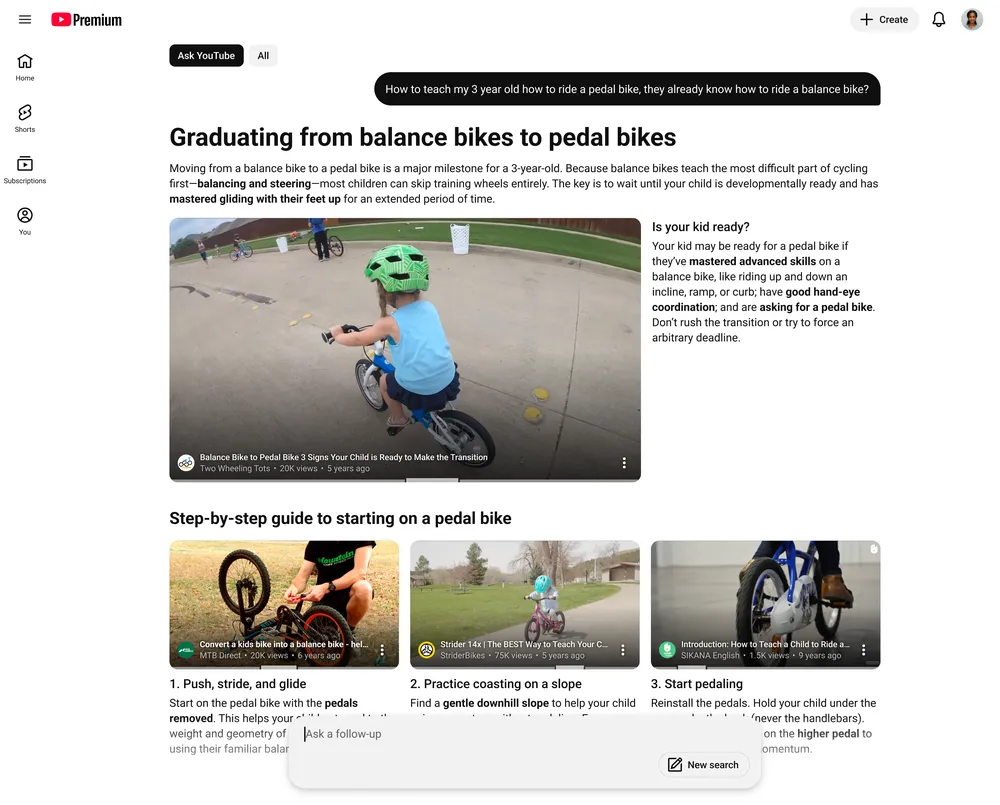
Google also announced Ask YouTube, which allows users to ask questions and jump to relevant moments in videos. Ask YouTube can handle complex search queries and follow-ups, listing the most relevant videos across the YouTube catalogue with an interactive, structured response. It is currently available for Premium subscribers in the US. Broader rollout in the US is planned for this summer.
SynthID and Content Credentials Verification Expanding to Search and Chrome
Google announced at I/O 2026 that C2PA Content Credentials verification and SynthID are rolling out to Google Search and Chrome. SynthID, Google's digital watermarking tool for AI-generated content, has now been used to stamp over 100 billion images, videos, and audio files.
Under the C2PA Content Credentials standard, details like image origin and edit history are directly embedded into the file. SynthID identifies AI-generated content, while C2PA Content Credentials record the full origin and edit history. Together, they provide verifiable information about whether content is real or AI-generated. Google noted that OpenAI, Kakao, and ElevenLabs are integrating SynthID watermarks into AI-generated material.
What These Changes Mean for Marketers and SEOs
The announcements have practical implications for digital marketers and search professionals. The expansion of generative UI means Search results may increasingly take the form of custom-built layouts and interactive tools rather than ranked pages, reducing the role of traditional blue-link clicks in driving traffic. Content that is clearly structured, topically authoritative, and directly useful to a specific task is better positioned to be drawn into AI-generated summaries and agent-led experiences. For video, the Ask YouTube feature makes spoken content, chapter organization, and topical accuracy more important signals, since AI will select and surface specific video moments rather than simply indexing titles and descriptions. Teams publishing AI-assisted media will also need to consider how their content aligns with emerging provenance standards as SynthID and Content Credentials verification become part of the Search and Chrome experience.
Google CEO Sundar Pichai said the I/O 2026 announcements marked the beginning of what he called the "agentic Gemini era," where AI systems move beyond responding to prompts and are able to independently plan, reason, and perform tasks.