

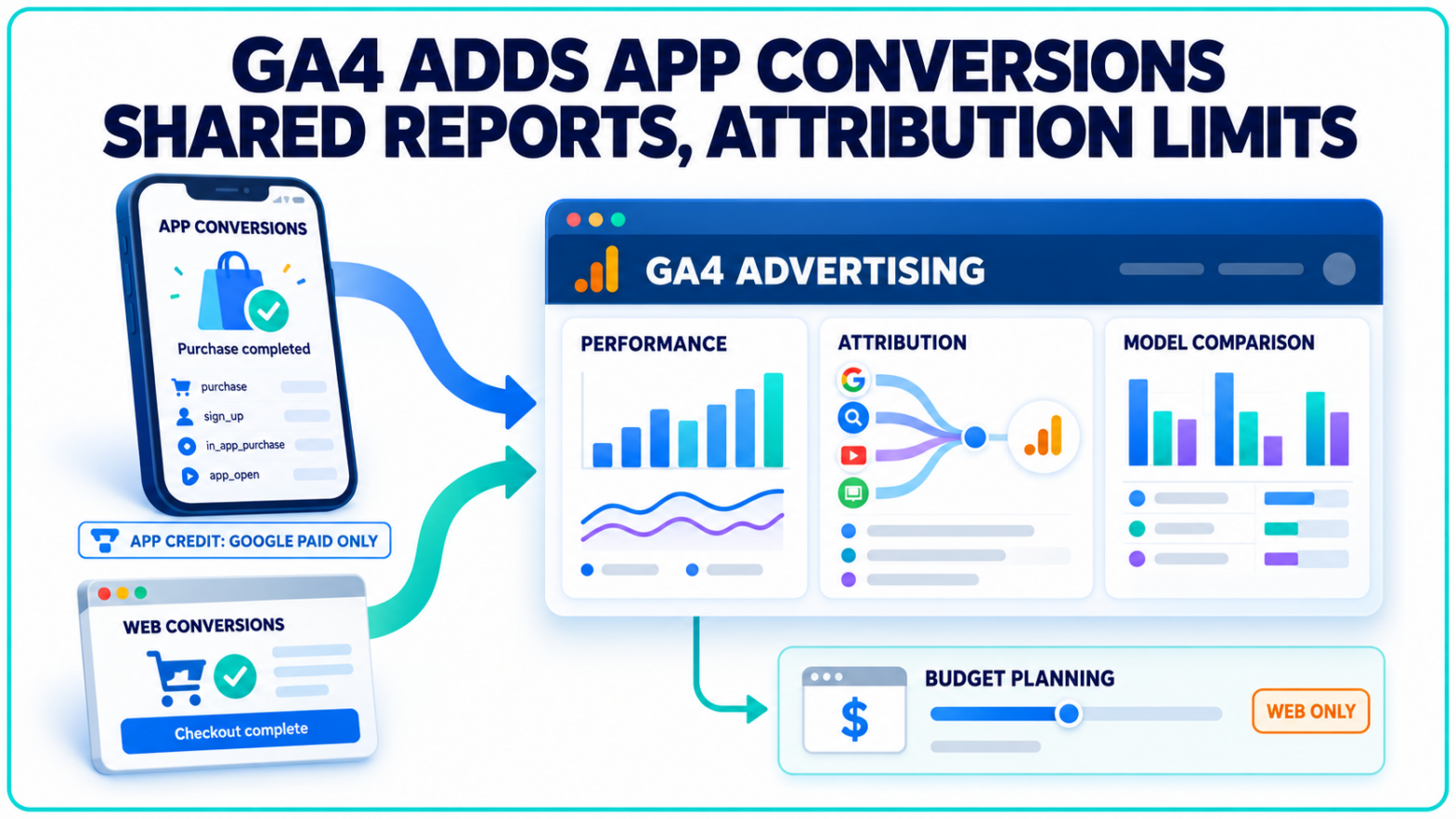
App conversions are entering more of GA4’s advertising reports. They are not gaining the same channel coverage as web conversions.
Google’s September 29 update extends conversion performance reporting, attribution analysis and attribution model comparisons to app conversions, giving eligible advertisers more ways to examine app outcomes within the Analytics advertising workspace. The rollout also adds independent attribution settings for app conversions.
The change brings app measurement further into a reporting system previously expanded for web conversions. But Google’s documentation retains two limits: app conversion credit goes to Google paid channels, and cross-channel budgeting still supports web conversions only.
App Conversions Enter Three Advertising Reports
Google’s Analytics release notes identify performance, attribution analysis and attribution models as the conversion reports that now support app conversions.
Each serves a different reporting question. Performance reports examine outcomes associated with channels and campaigns. Attribution analysis examines contributing interactions, while model comparisons show how different credit rules change the reported distribution.
For advertisers running both website and app activity, the expansion puts more of those outcomes within the same reporting area. It does not turn every app event into an advertising conversion or establish that every Analytics report now supports app conversions.
Google also says the feature may not be available to every property and that it is working to expand eligibility. The September 29 date is the announcement date, rather than a guarantee that every account received the tools that day.
The change continues the development of Google Analytics as a place to evaluate advertising conversions alongside other marketing activity.
A Linked Ads Account Defines the Reporting Scope
The Conversion performance report displays selected conversions shared with a Google Ads account. Its prerequisites include a property collecting data, a marked key event, a linked Ads account and an Ads conversion created from that Analytics key event.
That makes the update relevant to advertisers using Analytics app events as the basis for Google Ads conversion measurement. Collecting app activity alone does not fulfil the report’s setup requirements.
Google distinguishes these advertising conversions from key events in its measurement definitions. Key events identify actions important to a business across its website or app. Conversions support advertising measurement and campaign optimization, with an aligned definition across Analytics and Google Ads.
The distinction is more than terminology. A business might record several useful app actions while choosing only some as advertising conversion goals. Bringing app conversions into additional reports expands the analysis of those selected outcomes; it does not require every behavioural event to become a bidding target.
Conversions and key events continue to occupy separate reporting sections in the Advertising workspace.
Shared Reports Still Have Different Channel Rules
The most consequential qualification appears in Google’s attribution settings documentation. Its note states:
“Paid and organic channels only applies to web conversions; app conversions always use Google paid channels.”
Web conversions can therefore receive credit across a broader eligible channel set under the paid-and-organic setting. App conversions remain subject to the Google-paid restriction.
The September announcement says attribution settings can now be adjusted independently for app conversions. It does not announce that organic, direct or non-Google paid channels have become eligible for app conversion credit under that setting.
Sharing a reporting interface does not make the underlying attribution rules identical.
That matters when a dashboard places web purchases beside app purchases. A channel absent from the app conversion credit distribution cannot automatically be treated as a channel that contributed nothing to the customer’s journey. Its eligibility for credit is part of the interpretation.
Independent conversion attribution settings give advertisers more control over measurement. The scope of that control still depends on the conversion type and the settings Google supports.
Report Timing Can Explain Apparent Discrepancies
Google’s cross-channel conversion reporting guide describes a choice between Analytics property settings and Google Ads account settings, alongside conversion selection and reporting by conversion or interaction time.
Conversion time places an outcome on the date it occurred. Interaction time places it against the earlier ad interaction that led to it. A purchase made this week after an ad interaction last week can fall into different reporting periods under those two views.
Model selection also works differently. In the Analytics view of the performance report, the selected attribution model applies across the chosen date range. In the Google Ads view, the report reflects the active setting used for each conversion, which may have changed during that period.
An apparent mismatch can therefore come from the reporting configuration before it points to missing data.
For paid media and analytics teams, comparisons need a consistent conversion selection, date range, time basis and eligible channel scope. App and web outcomes can be reviewed together, but those settings must remain visible when evaluating acquisition costs or channel contribution. Attributed conversions measure assigned credit; they do not independently establish incremental sales.
The wider cross-channel reporting workflow still depends on clean inputs and comparable definitions.
App Reporting Arrives Before App Budget Planning
Google explicitly excludes app conversions from cross-channel budgeting in the September 29 release. Support in conversion reports should not be interpreted as support in the budget planning tools.
Google’s cross-channel measurement roadmap describes projection plans for forecasting performance and scenario plans for exploring outcomes at different budget levels. Those planning tools answer a different question from reports that describe past conversions.
The reporting expansion does not establish a launch date for app support in those plans.
Key event reporting also remains relevant. Google’s reporting guide directs users to key events where conversion-based reports do not support the required data or where an event has not been converted into an advertising conversion. It identifies the Attribution paths report as a key-event report.
Google’s general reporting guide still contains references to unsupported app conversion data, alongside the newer release note announcing support in three conversion report types. The named September update establishes those additions; it does not resolve every report-level limitation.
Availability remains property-dependent. Google directs advertisers with questions about eligibility to their support team, and its current release notes continue to specify web-only conversion support for cross-channel budgeting.