
Attribution has a naming problem.
One platform can appear under three different source labels, a staging domain can leak into production data, and AI referrals are no longer fringe traffic. Google Analytics is now trying to bring that sprawl under tighter control.
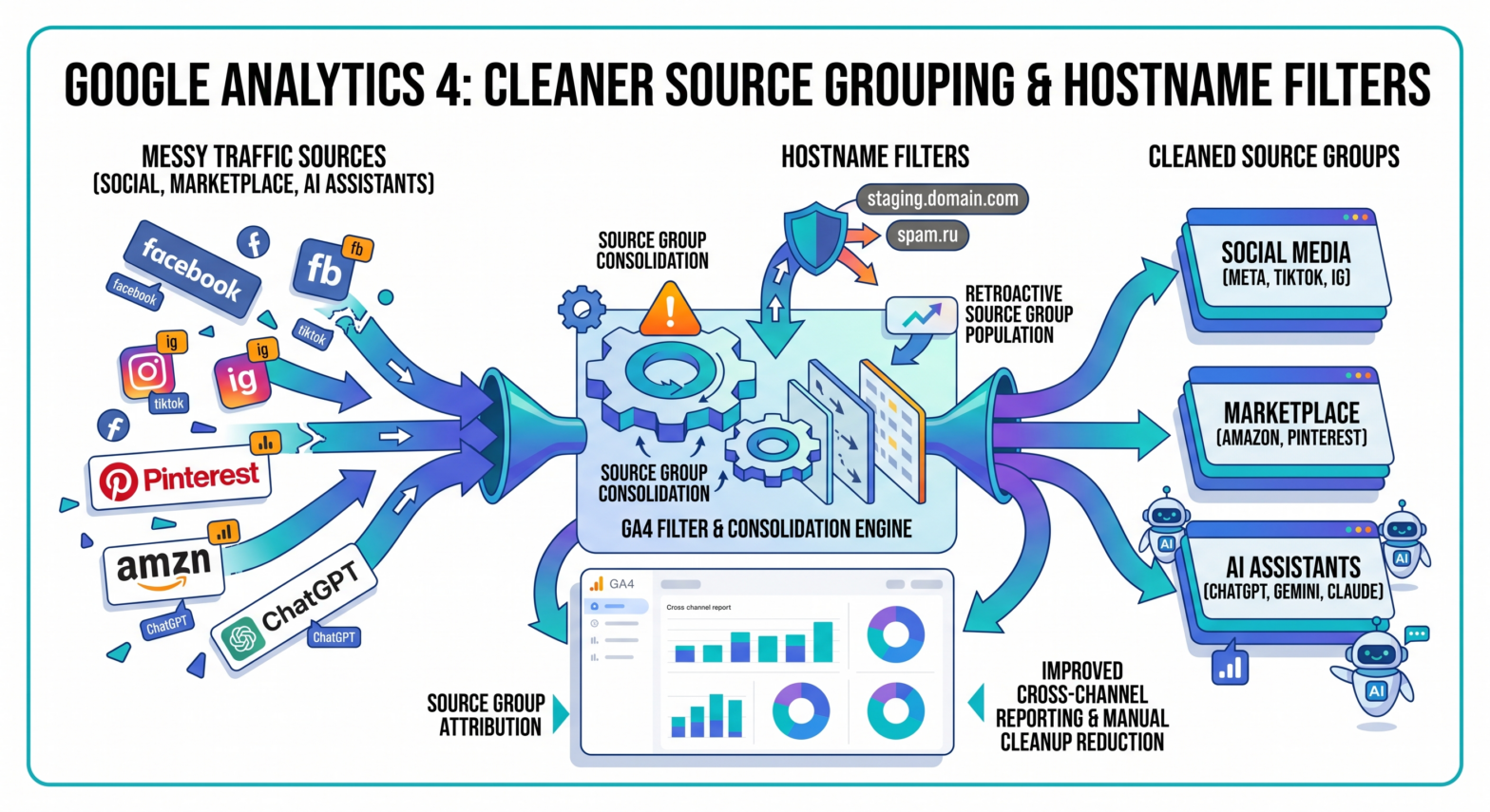
Google confirmed a new Source Group reporting dimension for GA4 on June 11, along with updates to Source Platform values and a new hostname filter inside Admin. The change is aimed at cleaning up source reporting across paid, organic, social, marketplace, and AI-driven traffic sources, according to Google’s Analytics release notes.
Facebook, TikTok, Amazon, And AI Referrals Get Less Fragmented
Source Group is built for a familiar reporting headache: inconsistent source names.
A single platform can show up in GA4 under several variations depending on tagging, referrer behaviour, campaign setup, or naming discipline. Facebook traffic, for example, may appear under source values such as “facebook,” “fb,” or other campaign-specific variants. That fragmentation makes platform-level performance harder to compare cleanly.
The new dimension consolidates common online platforms into standardized source values. Google names Facebook, Instagram, and TikTok as examples, while also pointing to third-party platforms such as Pinterest and Amazon.
The goal is not to replace every traffic-source field in GA4. It gives marketers another reporting layer that groups messy source values into a cleaner classification for performance analysis.
Google is also updating Source Platform, an existing field, so its classifications line up more closely with Source Group. That pairing matters because marketers often need to know both where traffic came from and which broader platform ecosystem it belongs to.
A cleaner Instagram source group paired with Meta Ads as a source platform is easier to interpret than a table scattered across inconsistent lowercase, abbreviated, or manually tagged variants.
AI Assistant Traffic Is Being Pulled Into The Same Reporting System
The timing is important.
Google Analytics already added an AI Assistant channel in May for traffic from platforms such as ChatGPT, Gemini, and Claude. TechWyse previously covered that rollout in Google Analytics Adds AI Assistant Channel to GA4, where the change marked a shift from custom reporting workarounds toward default classification for AI referrals.
Source Group extends that direction.
Google says the new grouping includes built-in support for emerging traffic sources such as ChatGPT from OpenAI and Perplexity. That gives marketers a more structured way to view AI-driven referrals beside traditional channels, rather than treating them as scattered referral anomalies.
That does not mean AI assistant traffic is suddenly large for every site. Many businesses will still see limited volume, uneven attribution, or referral gaps depending on how assistant platforms send users to websites.
But the reporting category now exists in the default measurement language.
For brands monitoring AI visibility, that matters. GA4 cannot measure every form of AI interaction. It will not capture AI crawler activity that never loads a client-side analytics tag, a limitation TechWyse examined in OpenAI’s Automated Crawlers Tripled Since GPT-5. It can, however, classify sessions when users click through from recognized assistant sources.
That makes Source Group part of a larger analytics adjustment: separating measurable AI referral traffic from invisible AI discovery activity.
Hostname Filters Move Domain Hygiene Into Admin
The second part of the release is less flashy, but it may solve a more immediate data-quality problem.
Google is adding hostname filters as a new data filter type in the Admin section. The filter allows GA4 users to exclude events based on hostname before they are processed, according to Google’s data filters documentation.
That is different from filtering a report after the fact.
A report filter changes what is displayed. A data filter affects incoming event data. Google’s documentation states that data filters are evaluated from the point they are created and do not affect historical data. Once an exclude filter is applied, the excluded data is not processed in Google Analytics or BigQuery.
That permanence is useful and risky.
For businesses with clean domain governance, hostname filters can keep unwanted domains out of GA4 reporting. That includes staging environments, preview URLs, spammy hostnames, internal test domains, or third-party domains incorrectly sending events into the property.
For businesses with complex measurement setups, the filter needs careful handling. A badly configured hostname exclusion could permanently remove legitimate events from production reporting.
The practical rule is straightforward: test the logic before treating the filter as a cleanup shortcut.
Cross-Channel Attribution Needs Cleaner Inputs
GA4 has been moving steadily toward more centralized cross-channel reporting.
Earlier this year, Google added new conversion reporting surfaces, Data API access for cross-channel conversion data, Google Business Profile links, and broader AI-driven assistance across the marketing stack. TechWyse covered the local reporting piece in GA4 Adds Google Business Profile Links, where Business Profile interactions began moving closer to website and app reporting.
Source Group fits inside the same pattern.
Google wants marketers to use GA4 for budget analysis across Google inventory, third-party ad platforms, local surfaces, AI assistants, and other acquisition sources. That only works if the source labels are usable.
Messy inputs distort channel comparisons. A platform split across several source values may look weaker than it is. A wrongly included hostname can inflate sessions, conversions, engagement, or revenue. AI assistant referrals can disappear into generic referral traffic if the reporting structure does not identify them consistently.
The update does not solve attribution by itself. It reduces one layer of noise.
For advertisers, cleaner source grouping can make budget conversations less dependent on manual cleanup inside Looker Studio, spreadsheets, or custom channel definitions. Teams still need consistent UTM practices, documented campaign naming, and source-platform review. Source Group gives them a cleaner baseline to work from.
The Reporting Win Is Retroactive, But The Filtering Win Is Not
One detail stands out in Google’s release notes: Source Group is populated retroactively.
That gives marketers the ability to analyze historical source data using the new grouping dimension, rather than waiting for data to accumulate after launch. For teams trying to compare Facebook, Instagram, TikTok, Amazon, Pinterest, or AI assistant traffic over prior periods, retroactive grouping could make trend analysis easier almost immediately.
Hostname filters work differently.
Because they are data filters, they apply from the point of creation forward. Google’s filter documentation makes clear that data filters do not change historical data. That creates two separate workflows for marketers and analysts.
Source Group can help clean up analysis of past traffic.
Hostname filters help prevent future contamination.
The distinction matters for reporting conversations. A marketer reviewing May or early June data may be able to use Source Group retroactively, but they cannot retroactively remove staging-domain events with a hostname filter. Historical cleanup still requires report-level filtering, exploration filters, BigQuery adjustments, annotations, or a clear caveat in reporting.
What Marketers Should Watch In GA4 Reports
For marketing teams, the practical impact is mostly operational. Source Group can reduce manual source normalization when reviewing acquisition, attribution, and channel-level performance. Hostname filters can improve data quality when a GA4 property receives events from domains that should not contribute to reporting. Teams should review source values, compare the new dimension against existing UTM conventions, and audit hostnames before enabling permanent exclusions. AI referral reporting should also be reviewed separately from broader referral traffic, since assistant-driven visits may now appear more consistently but will still represent only click-through sessions.
The update arrives as Google continues to wire AI more deeply into both advertising and measurement. At Google Marketing Live 2026, Google introduced tools that connect Google Ads, Google Analytics, Google Marketing Platform, and Merchant Center through Gemini-powered workflows, a shift TechWyse covered in Google Marketing Live 2026: AI Ads, Ask Advisor & UCP.
Measurement is following the same direction.
GA4 is no longer just reporting on neat buckets like organic search, paid search, social, and referral. It is being pushed to classify traffic from fragmented platforms, local surfaces, AI assistants, and automated campaign systems.
The new Source Group dimension and hostname filters do not change the fundamentals of analytics governance. They make the consequences of poor governance easier to see.
And, in some cases, easier to keep out of the dataset entirely.