
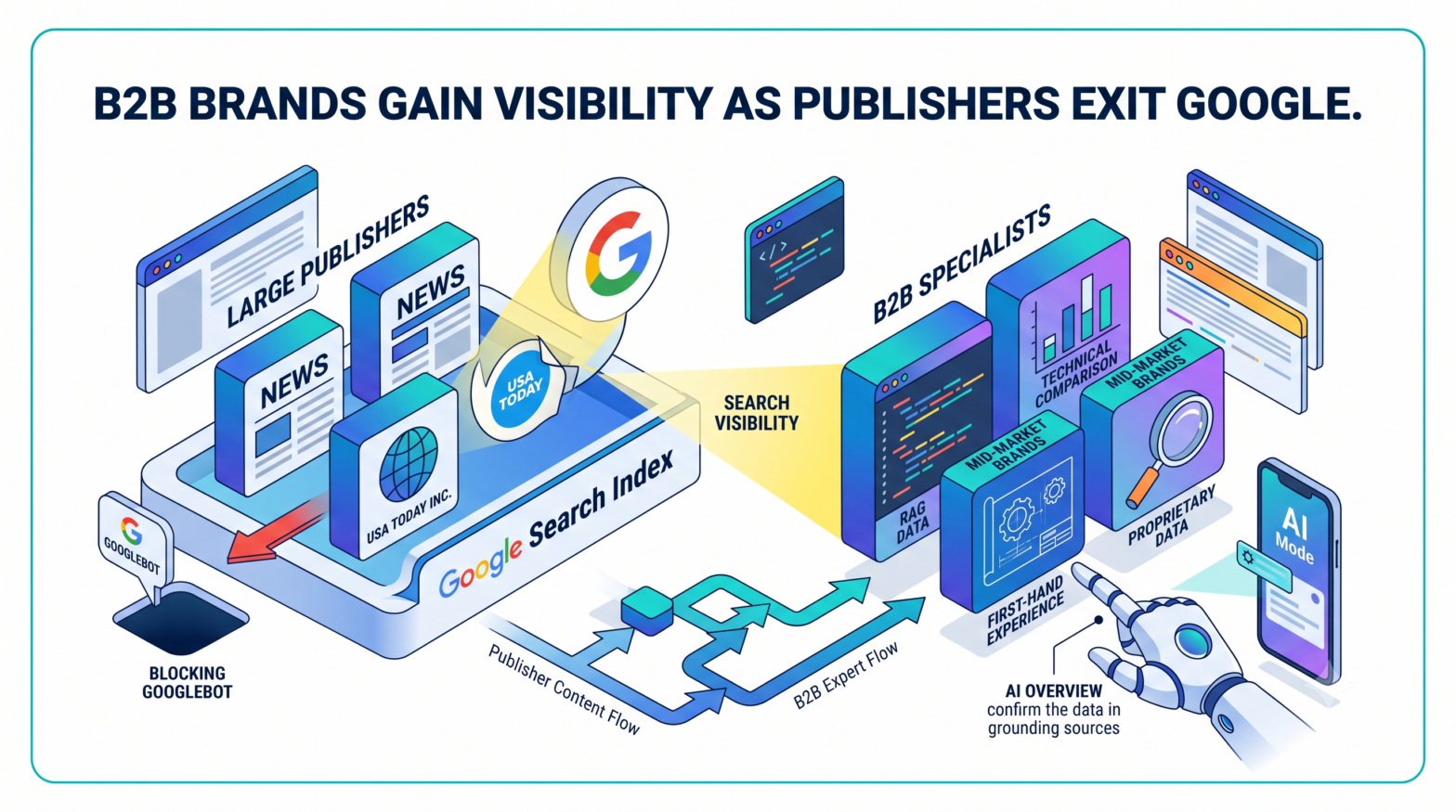
Google Search has spent decades rewarding the web’s largest publishers with visibility few corporate websites could match.
That hierarchy may be starting to loosen.
Major media companies are now considering whether Google still sends enough traffic to justify giving the platform broad access to their content. USA Today Inc., for example, is reportedly prepared to remove its publications from Google Search within the next six to 12 months if the commercial relationship does not improve.
For publishers, delisting remains a high-risk move. For B2B and mid-market companies still investing in searchable, original content, it could create a rare opening.
Publisher Frustration Has Reached the Search Index
The conflict between publishers and Google is no longer limited to complaints about declining referral traffic.
Some media organizations are reportedly exploring the possibility of blocking Googlebot entirely. Doing so would remove their articles from conventional search results, AI Overviews and other Google experiences that depend on the Search index.
That would have been nearly unthinkable several years ago. Search referrals were central to publisher audience growth, while visibility in Google gave news organizations a reliable path to advertising revenue and subscriptions.
The economics have changed.
AI Overviews and AI Mode can synthesize information directly on the search results page, reducing the need for users to visit the websites that supplied the underlying material. Publishers still bear the cost of reporting, editing and maintaining that content, but the opportunity to monetize the resulting audience is less certain.
Research published in 2026 has added evidence to those concerns. One large study found that AI Overviews appeared for 13.7% of tested trending searches and for 64.7% of question-based queries. More than half of the pages cited in those summaries relied on display advertising, leaving publishers exposed when a searcher consumes the answer without opening the source page.
A separate study examining Wikipedia estimated that exposure to AI Overviews reduced daily traffic to affected English-language articles by approximately 15%.
The publisher response is no longer theoretical. Delisting is becoming a negotiating position.
Google’s AI Opt-Out Does Not Resolve the Wider Dispute
Google has introduced more granular controls for publishers in response to regulatory pressure in the United Kingdom.
The UK Competition and Markets Authority ordered Google to provide publishers with effective controls over whether their content can be used in generative AI features. The requirement covers uses such as grounding AI Overviews and AI Mode, along with certain forms of model training and fine-tuning. Publishers must also receive clearer attribution and more detailed engagement data.
That gives publishers an alternative to leaving Google Search altogether.
A website can remain eligible for conventional organic listings while declining participation in generative AI search features. Google’s updated documentation says pages must be indexed, snippet-eligible and included in Search’s generative AI features to appear in AI Overviews or AI Mode.
The distinction matters, but it does not settle the commercial argument.
Publishers are questioning whether traditional search visibility, AI citations and Google’s licensing arrangements collectively deliver fair value for the content being supplied. A technical opt-out protects intellectual property only if a publisher is willing to surrender the associated AI visibility.
Blocking Googlebot goes much further. It removes the publisher from the underlying index and gives competitors a chance to occupy queries the publication previously dominated.
Search Results Cannot Leave High-Intent Questions Unanswered
Google still needs sources.
AI Overviews use retrieval-augmented generation, drawing on current pages from the Search index to ground generated responses. Google also uses query fan-out, where its systems run several related searches to gather enough information for a broader answer.
When a major publication blocks access, the relevant query does not disappear. Google must identify other eligible pages capable of answering it.
That is where the visibility vacuum begins.
Large publishers frequently rank for broad informational searches because they have strong domain authority, extensive archives and established backlink profiles. Their articles may compete with B2B companies even when the publisher has no direct expertise in delivering the product, service or operational solution being discussed.
Consider searches involving enterprise software implementation, commercial insurance, industrial automation, logistics, cybersecurity, professional services or regulatory compliance. A national publication may publish a general explainer and immediately outrank a specialist with decades of practical experience.
Removing the publisher does not guarantee the specialist will move up. Google rankings are not reassigned automatically, and indexing never guarantees placement.
It does remove one prominent candidate.
For companies with credible expertise, technically accessible pages and detailed original material, fewer publisher domains in the index could increase the available surface area across organic search, AI Overviews and AI Mode.
B2B Expertise Has More Retrieval Value Than Generic Commentary
The strongest opportunity is not to imitate newsroom content.
Google’s current generative search guidance explicitly favours non-commodity material that provides original knowledge, first-hand experience and a distinct point of view. It warns against recycling information that already exists or publishing content that could be produced easily by a generative AI system.
That standard aligns closely with the information many B2B companies already possess but rarely publish.
Implementation data. Procurement criteria. Failure patterns. Technical comparisons. Customer questions. Internal benchmarks. Regulatory interpretations. Engineering decisions. Field observations.
These details are difficult for general-interest publishers to reproduce without direct access to specialists.
They are also useful to AI systems trying to answer increasingly specific commercial questions.
A mid-market software company may not outrank a national publication for “what is workflow automation.” It has a stronger factual basis for answering questions about integrating automation into a 200-person professional services firm, migrating away from a legacy platform or calculating the operational cost of a failed deployment.
The same principle applies across industries. Search visibility is increasingly tied to whether a source contributes information unavailable elsewhere, not simply whether it repeats a well-established definition with polished formatting.
TechWyse has previously covered how brand authority in AI search depends on recognizable expertise and credible signals beyond isolated keywords. Publisher withdrawal could give those signals more room to influence source selection.
The Opportunity Extends Beyond Traditional Rankings
A publisher exit would affect more than the familiar list of blue links.
Google says its generative search experiences rely on the core Search index and ranking systems. A page that cannot be crawled and indexed cannot become a grounding source for an AI-generated answer.
Academic research also suggests that AI Overviews do not simply reproduce the first page of conventional results. In one 2026 study, nearly 30% of cited domains did not appear among the accompanying first-page listings.
AI citation visibility is therefore related to organic performance, but not identical to it.
A B2B company that cannot displace a major publication in position one may still be selected as a supporting source when its page contains a specific statistic, product comparison, expert explanation or first-hand operational detail.
That makes AI search visibility a broader publishing question. Companies need content that can rank as a complete page while also containing individual passages useful enough to support a generated answer.
Search Console’s expanding generative AI reporting may help companies identify where that is already happening. Google now provides separate performance information for visibility in AI Overviews, AI Mode and related generative experiences, rather than folding every impression into undifferentiated web search reporting.
The Vacuum Will Reward Evidence, Not Content Volume
For marketers, the practical implication is narrow but significant.
Companies should identify commercially relevant subjects where large media sites currently outrank genuine industry specialists, then assess whether they can publish something materially more useful. That may involve proprietary data, named expert input, detailed process explanations, case evidence or limitations that generic articles omit.
Publishing more pages for every possible query variation is unlikely to help. Google specifically cautions against producing high volumes of near-duplicate pages to capture fan-out searches and says such tactics can violate its scaled content abuse policies.
A stronger B2B content marketing approach would concentrate expertise into fewer, defensible resources.
The opportunity is also likely to develop unevenly. Not every publisher will leave Google. Some may use AI opt-out controls while retaining conventional rankings. Others may negotiate licensing agreements or restrict only selected sections of their sites.
USA Today Inc.’s reported willingness to delist is still a stated future position, not evidence of a broad publisher exodus.
But the underlying assumption has changed. Large publishers no longer universally treat Google indexing as non-negotiable.
Should even a small number follow through, the resulting vacancies will not remain empty. Google will retrieve other sources, and B2B brands that have already built crawlable, evidence-led content will be available when it does.