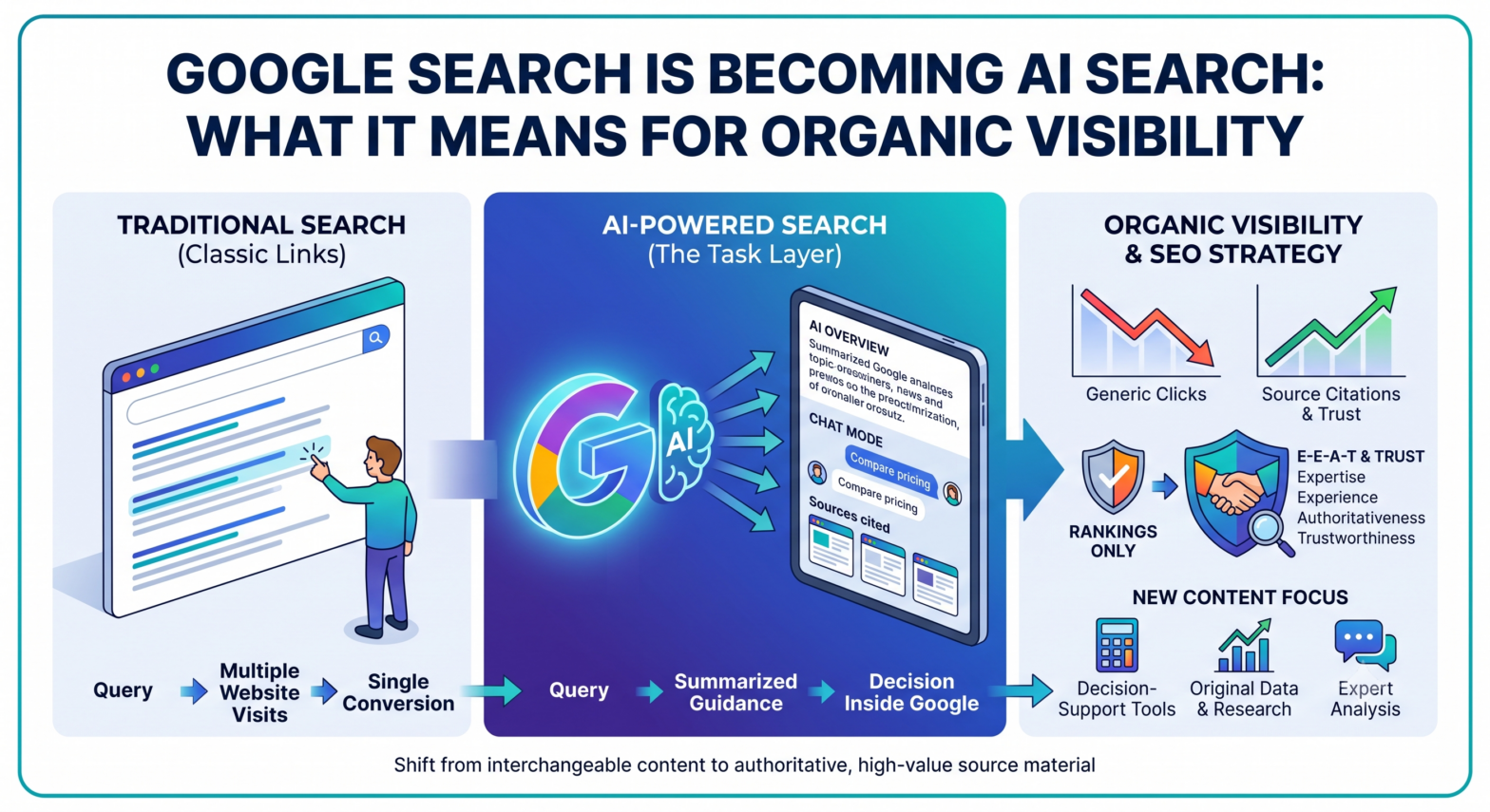
The end of traditional search is rapidly approaching. Soon, users will say goodbye to Google Search as they used to know it. With expanded AI Overviews, broader Google AI Mode capabilities, and AI agents shown at Google I/O 2026, Search is moving deeper into the research and decision-making process.
Users can ask follow-up questions, compare options, and get summarized guidance without opening several tabs. For marketers, the question is direct: how can brands stay visible when AI search reduces the need to click?
Websites still shape what Google can understand and surface. Organic visibility now depends on trust, source selection, and usefulness, not rankings alone.
Google Search Is Becoming an AI-Powered Task Layer
A traditional search journey often started with a query, moved into a list of links, and continued across multiple websites. AI-powered search compresses more of that journey into the results page.
A user researching software might compare pricing models, implementation concerns, and feature differences without visiting ten separate pages. Search can summarize information, handle follow-up questions, and move the user closer to a decision within Google.
The shift changes the role of website content:
- Links are giving way to synthesized answers.
- One-off searches are becoming ongoing assistance.
- Websites are serving as source material, not just destinations.
- Rankings now sit alongside AI visibility and trust signals.
Search visibility is becoming less about winning a single position and more about being useful enough for systems and users to rely on.
What Happens to Organic Visibility When Google Answers the Query First?
A page can influence the answer without receiving the visit. Google still needs web content, but users may get the most convenient version of that content inside Search. Ranking highly can still matter, especially for competitive and high-intent queries, but it no longer guarantees the same click behaviour.
Why are fewer searches leading to traditional clicks?
AI Overviews and generative answers can satisfy basic informational intent directly in the search results. Definitions, simple comparisons, introductory guides, and surface-level FAQs are especially exposed because users may get enough context without visiting the original pages.
That pattern feeds into zero-click search. The search engine uses information from across the web, while the user stays inside the results experience.
Not all traffic disappears. Complex buying decisions, local searches, detailed research, and high-stakes topics still give users reasons to click. The weakest position is held by generic content created mainly to capture keyword volume.
How does AI Mode change the search journey?
Google AI Mode turns search into a conversation. Users can refine a query, ask for comparisons, narrow by use case, and explore tradeoffs without starting over.
Someone researching CRM software might begin with a broad comparison, then ask about integrations, pricing, migration timelines, or industry-specific features. That early-stage journey can happen inside Google Search before the user visits a vendor, review site, or service provider.
For SEO strategy, this means fewer isolated keyword moments and more layered search sessions where context carries forward.
Why does source selection matter more than ranking alone?
AI-generated responses depend on sources that are credible, current, and easy to interpret. A page with clear expertise, accurate information, useful structure, and fresh detail has a better chance of shaping an answer than thin content built around a single keyword.
The user may never see the source page, but the brand can still influence what the answer says. Source inclusion is now part of organic visibility.
Which content is most vulnerable, and which content can still earn attention?
AI search creates a sharper divide between content that answers a basic question and content that helps users evaluate, compare, or make a decision.
|
More vulnerable content |
Stronger content assets |
|
Basic definitions |
Original research |
|
Thin FAQ pages |
Proprietary data |
|
Surface-level how-to posts |
Detailed case studies |
|
Simple comparison articles |
First-hand expert analysis |
|
Commodity explainers |
Local knowledge and service-fit guidance |
|
Keyword-volume content with little added insight |
Pricing context and decision support |
Informational content still has a role, but it needs more than a keyword target. Strong examples, context, original interpretation, and decision-level detail make it harder to flatten into a generic summary.
How Should Marketers Adapt Their Content Strategy for AI Search?
More content will not fix a visibility problem if the content is interchangeable. Pages need to be specific, credible, well structured, and difficult to replace with a generic summary.
A stronger AI search content strategy should focus on:
- Decision-focused topics, such as comparisons, pricing context, implementation considerations, migration questions, and service-fit guidance.
- Visible expertise, including clear authorship, practical examples, transparent sourcing, and first-hand observations.
- Human-friendly structure, with clear headings, direct answers, concise summaries, organized sections, and schema where appropriate.
- Click-worthy assets, such as calculators, templates, original data, downloadable resources, interactive content, and deeper expert guidance.
Keyword research still matters, but durable content answers questions people ask when they are evaluating options, not just gathering definitions.
The Future of Google Search Is About Trust, Not Just Traffic
Marketers cannot measure AI search success only by ranking position and organic sessions. The search journey is becoming less linear, and some influence now happens before the click.
Pages need to be accurate enough to cite, clear enough to interpret, specific enough to trust, and useful enough to earn attention beyond a short summary.
Brands that keep publishing interchangeable content will become easier to summarize and easier to ignore. Brands that invest in authority, practical insight, and distinct value will give both AI search and real users a reason to choose them.