
Some page speed fixes fail because the page was never slow in the way teams thought it was.
That is the lesson behind a new web.dev case study amplified by Google Search Advocate John Mueller, who pointed to Nuvemshop’s year-long work on Largest Contentful Paint and Core Web Vitals. His message was blunt enough for SEOs to notice: “Core Web Vitals are alive,” and working on them can improve conversion rates.
The Browser Was Measuring The Wrong Thing
Nuvemshop, also known as Tiendanube in Spanish-speaking Latin America, operates an ecommerce platform used by more than 180,000 online stores. Its performance problem looked familiar at first: heavy images, slow server response, and the usual suspects behind poor load speed.
That diagnosis did not hold.
The platform’s storefronts are highly customizable, letting merchants arrange carousels, banners, product grids, and custom modules in different orders. According to the web.dev case study, this flexibility created a measurement problem. The element shoppers appeared to see first was not always the element the browser treated as the page’s Largest Contentful Paint candidate.
That distinction matters. LCP does not measure when everything loads. It reports when the largest image, video, or text block visible in the viewport renders relative to the user’s navigation. Google’s web.dev guidance describes LCP as a measure of perceived load speed because it marks when the page’s main content has likely loaded.
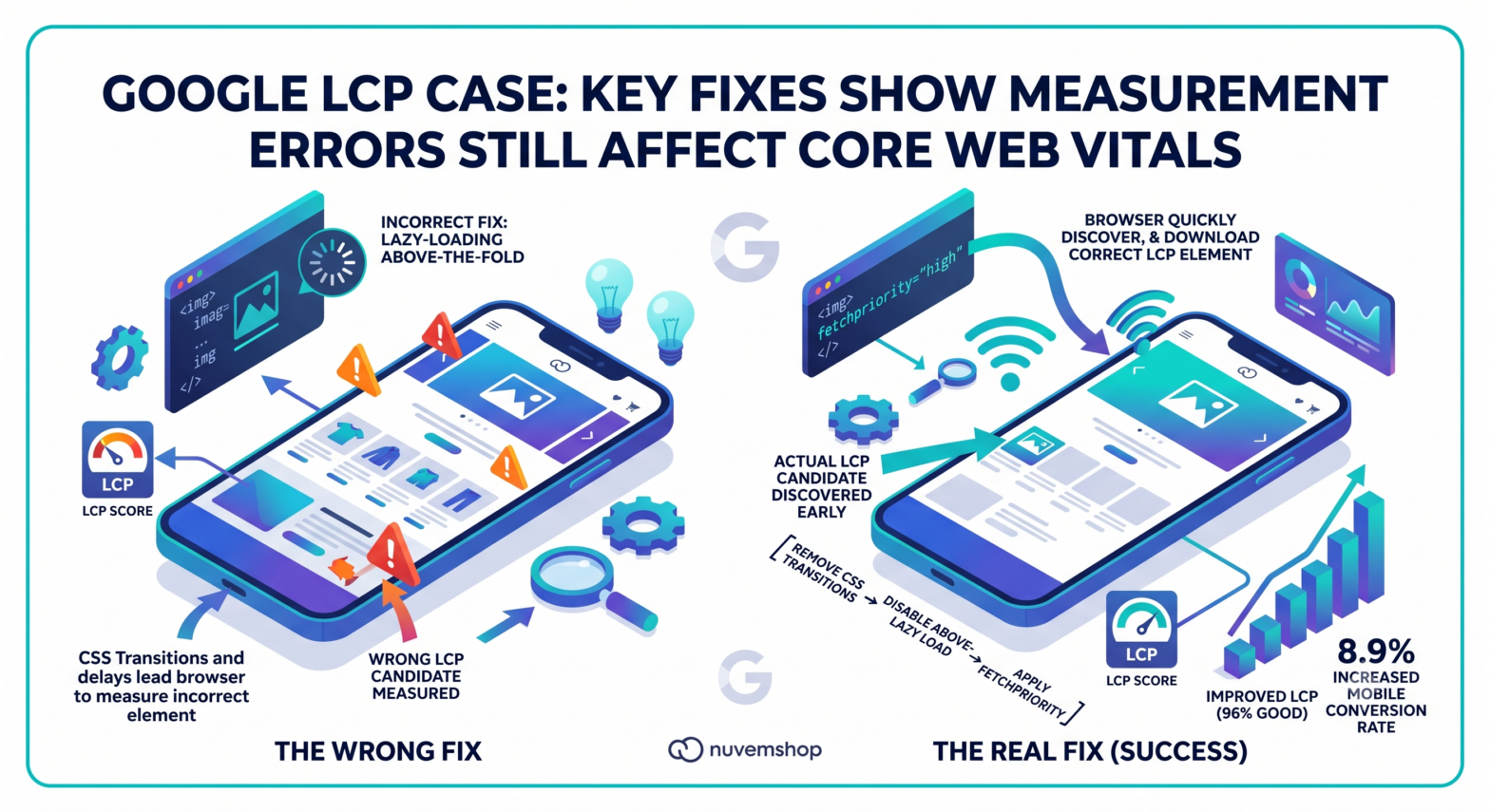
On Nuvemshop’s storefronts, carousels were present on 85% of sites reviewed in the case study. CSS transitions delayed when those carousel and banner elements became visible to the browser’s LCP detection algorithm. Shoppers could perceive the carousel as loading first, while the browser sometimes marked another banner lower in the viewport as the LCP element.
That made previous optimization work less effective. The team was improving elements that were not always being counted.
For anyone working in technical SEO, that is the uncomfortable part. A page can have a real performance issue, but the first fix may still be aimed at the wrong target.
LCP Optimization Was Less About Compression Than Discovery
The usual LCP playbook often starts with image compression. Smaller file sizes help, but Nuvemshop’s case shows why image weight is only one part of the problem.
Google’s LCP optimization guide says the metric is affected by the entire loading process, including server response, resource load delay, resource load duration, and element render delay. It also warns that a quick fix to a single part of a page rarely produces meaningful LCP improvement on its own.
Nuvemshop’s fixes were practical, but not generic.
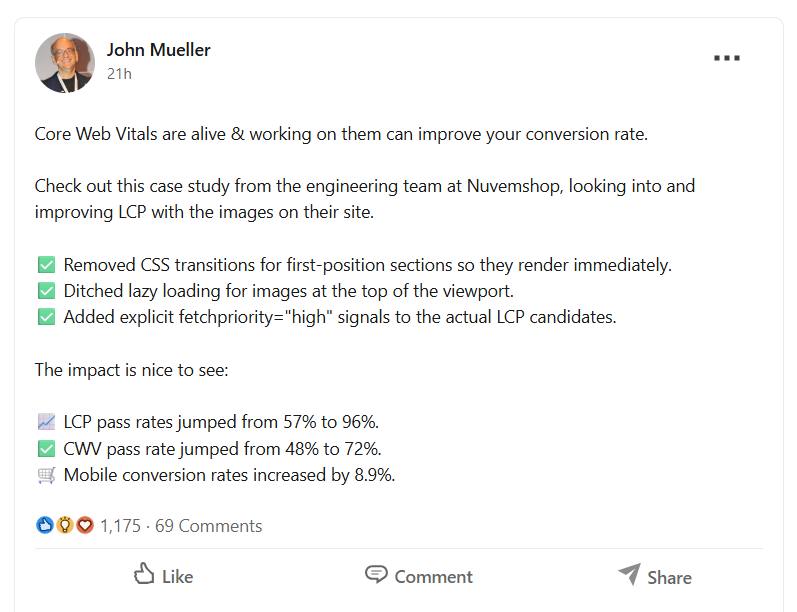
The team removed CSS transitions from first-position page sections so they could render immediately. It removed lazy loading from images at the top of the viewport. It also added fetchpriority="high" to likely LCP images, with validation rules to prevent priority signals from being applied too broadly.
That last detail is important. Priority hints can help the browser discover and download the right image earlier, but overusing them creates a new problem. Nuvemshop’s case study specifically notes that if every image is marked high priority, nothing is truly high priority.
This is where Core Web Vitals work becomes less about chasing a score and more about reading the rendering path. The question is not only whether the hero image is too large. It is whether the browser can identify, request, and render the real main element early enough.
That is a different kind of audit.
The Results Give Core Web Vitals A Business Context
Nuvemshop reported that the share of stores with good LCP scores improved from 57% to 96% over one year. Its overall Core Web Vitals pass rate rose from 48% to 72%.
The company also reviewed the same cohort of Brazilian stores active in January 2025 and January 2026. For mobile visitors from Google organic search, Nuvemshop reported an 8.9% increase in conversion rate and an 8.4% increase in cart engagement.
Those figures should be read carefully. The case study is not a controlled experiment isolating page speed from every other commercial variable. Ecommerce conversion rates can be influenced by pricing, product mix, promotions, traffic quality, trust signals, checkout design, and seasonality.
Still, the direction is notable because it ties performance work to user behaviour rather than rankings alone.
Google’s Search Central documentation says Core Web Vitals measure real-world user experience across loading performance, interactivity, and visual stability. Google recommends that site owners achieve good Core Web Vitals for Search success and general user experience. The three current metrics are Largest Contentful Paint, Interaction to Next Paint, and Cumulative Layout Shift.
For LCP specifically, the target remains 2.5 seconds or less for at least 75% of page visits.
That is the baseline. The harder work is finding why a page misses it.
Rankings Are Part Of The Story, Not The Whole Story
Core Web Vitals sit inside Google’s broader page experience framework. Google’s documentation says its core ranking systems look to reward content with a good page experience, but also says site owners should not focus on only one or two page experience factors.
That leaves less room for simplistic SEO framing.
A better LCP score does not automatically push a weak page above a stronger, more relevant one. Google’s page experience documentation says good Core Web Vitals reports or third-party tool scores do not guarantee top rankings, and that page experience is one part of a broader evaluation.
For marketers, the practical takeaway is narrower but more useful: LCP optimization should be treated as a conversion and usability issue as much as a search performance issue. On ecommerce pages, landing pages, service pages, and lead-generation pages, delayed main content can create friction before the user reads an offer, views a product, or reaches the next step.
That applies especially to mobile.
Nuvemshop’s reported gains came from mobile visitors arriving through Google organic search. That is the same environment where connection quality, device limitations, JavaScript execution, and image loading conflicts often make LCP harder to pass.
Template-Driven Sites Need Page-Type Testing
The Nuvemshop case matters because it reflects a common problem on modern websites: teams test one clean page and assume the template is fixed everywhere.
That assumption breaks quickly.
Nuvemshop found that a significant share of LCP measurements came from category and product pages, not only homepages. The fixes had to work across themes, page types, and merchant-controlled section arrangements.
This is where many Core Web Vitals projects lose accuracy. A homepage audit may identify one hero image as the LCP element. A product page may identify a product photo. A category page may identify a banner, grid image, heading block, or carousel. A different viewport can change the candidate again.
Google’s LCP documentation also notes that field and lab measurements can differ because LCP includes factors such as previous page unload time, connection setup, redirects, and Time to First Byte delays.
A clean Lighthouse run is useful. It is not the full picture.
For SEO teams and developers, the stronger workflow is to segment LCP analysis by page type, device class, template, traffic source, and real user data. The first question should be: what element is actually being measured for real users?
Only then does the fix make sense.
Nuvemshop’s case does not introduce a new ranking factor or a new Google requirement. It puts a current example behind existing Google guidance: identify the real LCP candidate, make it immediately visible, avoid lazy-loading above-the-fold images, and give the browser clear priority signals where they are genuinely needed.
The score improved after the target became clear.