
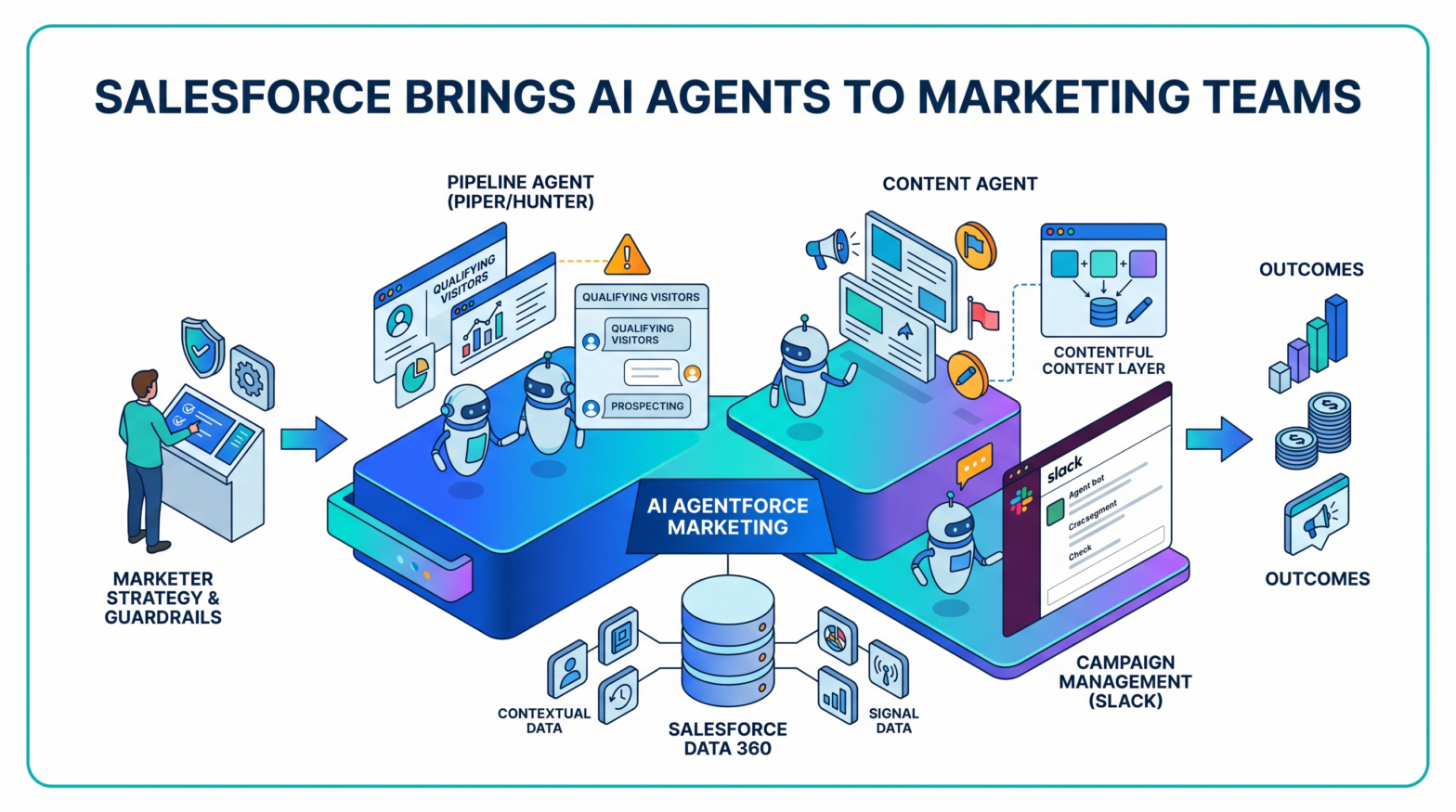
Marketing teams are not just getting another AI writing assistant. Salesforce is pushing agents into the operational middle of marketing, where leads are qualified, campaigns are built, content is localized, and performance signals decide what happens next.
The company announced a new set of Agentforce Marketing capabilities on June 3 at Connections, positioning AI agents as collaborators that can take on campaign execution work while marketers define strategy, budgets, guardrails, and outcomes.
Salesforce Is Moving AI From Suggestions to Execution
Salesforce’s new Agentforce Marketing rollout is built around a sharper idea than faster content production. The company wants marketing teams to manage AI agents that can complete multi-step work across pipeline generation, content creation, campaign orchestration, and customer engagement.
That makes the announcement different from the first wave of generative AI tools, where the main promise was drafting copy or summarizing data. Agentforce Marketing is designed to use customer and business context from Salesforce Data 360, Marketing Cloud, sales workflows, service history, commerce activity, and content systems.
The point is context.
Without shared customer data, an AI agent can only react to narrow signals. With shared context, Salesforce says agents can avoid disconnected customer experiences, the kind where a brand promotes a product someone already bought or asks a returning customer to repeat information the company already has.
Salesforce framed the announcement as a shift in how marketers work. Eric Zenz, SVP of Product Management for Agentforce Marketing, said the company’s goal is to “Empower marketers with AI agents that help them do work that wasn’t possible before.”
That sentence does a lot of work. Salesforce is not selling AI as a side panel. It is putting agents closer to the machinery of campaign operations.
For marketers watching the rise of agentic AI, the pattern is familiar: software is moving from recommendation to action. The human still sets the direction. The system is expected to handle more of the routing, assembly, testing, and adjustment.
Lead Qualification Is Becoming an Agent Job
Pipeline generation is one of the first places Salesforce is putting agents to work.
The announcement highlights Piper, Qualified’s AI SDR Agent, which Salesforce says can identify and qualify website visitors in real time. Instead of forcing prospects through a form and delayed follow-up sequence, Piper can answer questions conversationally, assess buyer intent, and route qualified prospects into sales interactions.
Salesforce also introduced Hunter, a Prospecting Agent designed to identify prospects using buyer intent, start outreach, and run email nurture sequences. Hunter is generally available now, according to the company.
That matters because B2B marketing teams have spent years trying to reduce friction between web visits and sales conversations. Forms, lead scoring, routing rules, and manual qualification all create lag. Agents are being positioned as a faster layer between anonymous interest and active pipeline.
Salesforce cited Emplifi as an example of the productivity case, saying the company reduced lead qualifying reps by about 20% while increasing opportunity creation by more than 22%.
Those figures should be read carefully. They are customer-reported results, not a universal benchmark. Still, they show where Salesforce expects the market to look first: lower handoff cost, faster qualification, and more immediate sales engagement.
For performance teams, this pushes AI marketing automation beyond email triggers and nurture branches. Agents are being attached to the moment when buying intent appears, not just the follow-up sequence after a form submission.
Contentful Gives the System a Content Layer
Salesforce’s agentic marketing pitch depends on content being available in a more flexible form. That is where Contentful comes in.
On June 1, Salesforce said it had signed a definitive agreement to acquire Contentful, the composable content platform used by more than 4,800 brands. The deal is expected to close in the third quarter of Salesforce’s fiscal year 2027, subject to customary closing conditions and regulatory approvals.
Salesforce says Contentful will add a native content layer to Headless 360. That would allow structured content to be assembled and delivered across channels by Agentforce, rather than rebuilt manually for every email, website, mobile message, or localized campaign.
The operational logic is clear. If an agent can generate or recommend campaign actions but cannot reliably access approved product copy, brand rules, localized assets, and channel-ready content blocks, the workflow breaks.
Agentforce Content Agent is meant to address that gap. Salesforce says marketers will be able to describe a campaign and have the agent generate omnichannel content across email, mobile messages, SMS, RCS conversations, and promotional experiences. Localization is designed to happen in the same workflow.
The Content Agent is in pilot now.
For teams already navigating AI marketing automation, the content layer may be the more important part of the announcement. Generating more assets is easy. Keeping them usable, governed, localized, and connected to customer context is where enterprise marketing usually slows down.
Campaigns Can Now Be Managed From Slack
Salesforce is also extending campaign management beyond the marketing application itself.
The company says Agentforce Marketing will expose campaign management capabilities as MCP tools, allowing campaign workflows to be managed through interfaces such as Slack. Campaign management in Slack using MCP is expected to be generally available in June 2026.
That gives Salesforce’s broader Headless 360 strategy a marketing-specific use case. Instead of requiring users to move into a dedicated marketing interface for every action, Salesforce wants campaign work to happen inside the tools where teams already communicate.
In practical terms, marketers could ask for audience segments, create campaigns, update journeys, or check performance through conversational workflows. The system still depends on permissions, business rules, data quality, and user guardrails. But the interface changes.
That is a significant shift for marketing operations.
For years, campaign execution has lived inside platform dashboards. Every major martech system has its own navigation, objects, rules, and reporting logic. By exposing campaign capabilities as tools that agents can call, Salesforce is preparing for a workflow where the dashboard is no longer the default starting point.
The same direction is showing up across the market. Google, Microsoft, OpenAI, and Salesforce are all pushing AI deeper into the work layer of advertising, analytics, content, and customer engagement. Recent platform moves around AI-powered PPC point to the same broader trend: marketers are spending less time operating individual controls and more time defining objectives, constraints, and acceptable trade-offs.
The Practical Shift Is Less Tool Work, More Guardrail Work
For marketers and SEOs, Salesforce’s announcement points to a practical change in day-to-day execution. Campaign teams will need cleaner customer data, stronger content governance, clearer approval rules, and tighter measurement definitions before agents can be trusted with larger parts of the workflow. The work does not disappear. It moves upstream into strategy, data hygiene, audience logic, brand controls, compliance rules, and performance evaluation.
That has consequences for smaller teams, too.
Enterprise platforms usually launch these capabilities first because they have the customer data, platform depth, and implementation budgets required to support them. But the working model tends to move downmarket. Once marketers become comfortable assigning campaign tasks to agents inside Salesforce, expectations change across the rest of the stack.
Manual handoffs start to feel slower. Static campaign calendars look less responsive. Content bottlenecks become more visible.
Salesforce is not claiming every feature is fully available today. Piper and Hunter are generally available. Campaign management in Slack using MCP is generally available in June 2026. Agentforce Content Agent and Agentforce Marketing Goals Agent are both in pilot.
That staged availability matters. The full agent-managed marketing system is still developing, and customers evaluating these tools will need to distinguish between live features, pilots, and roadmap language.
The clearest near-term change is not that AI replaces marketers. It is that marketing platforms are being rebuilt around agents that can act across data, content, and workflow systems. Salesforce is now putting that model directly inside marketing operations, where campaign speed has always depended on how quickly teams can turn signals into coordinated action.