
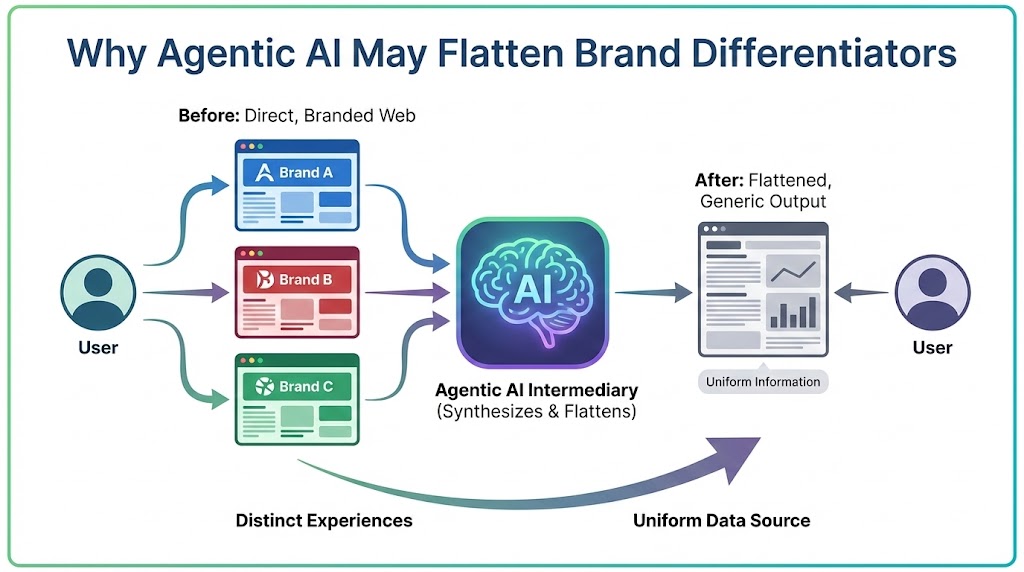
Agentic AI is reshaping how information is discovered, presented, and acted upon online. According to James LePage, Director of Engineering for AI at Automattic and co-lead of the WordPress AI Team, this shift introduces a more complex future for websites, particularly when it comes to branding, voice, and differentiation.
Rather than users navigating sites directly, AI agents increasingly act as intermediaries. These agents gather information, synthesize it, and present outcomes to users based on goals or constraints the user has set. As that mediation increases, the traditional website experience becomes less visible, and in some cases, less relevant.
From Assisted Search to Autonomous Agents
LePage describes agentic AI as evolving along a spectrum of autonomy. Today’s systems resemble advanced search tools that gather information and summarize it for users. In the near term, agents will be trusted to complete bounded tasks such as bookings or purchases. Further out, agents may operate with standing instructions, acting more independently while humans oversee results rather than every step.
In this model, humans move from approving individual actions to defining outcomes and guidelines. The details are handled by agents operating at scale, across multiple sites and services.
When Websites Become Data Sources
One of LePage’s most consequential observations is that agentic AI changes who controls representation. When an agent accesses a website, it extracts what it needs and leaves. The site’s design, tone, and narrative structure no longer frame the experience. Instead, the agent decides how information is summarized and presented to the user.
In practical terms, this means many sites risk becoming raw data inputs rather than destinations. The agent becomes the interface. The website becomes a source.
For brands that have invested heavily in storytelling, visual identity, and editorial voice, this represents a loss of control. Information that once lived inside a carefully designed experience may now appear alongside similar content from competitors, flattened into a single synthesized response.
Experience Becomes the Differentiator
LePage argues that this shift does not eliminate the need for websites. Instead, it raises the bar for what a direct visit should offer. If AI can handle the informational layer anywhere, then differentiation moves to the experiential layer.
Websites that continue to attract human visitors will need to offer more than static content. AI-enabled experiences such as interactive tools, personalized flows, dynamic visualizations, and configurators become the new value proposition. In this model, information is assumed to be accessible everywhere, but experience is not.
This dynamic favors commercial sites where interaction, customization, and transactions are central to value creation. For ecommerce and services, agentic AI can accelerate comparisons, pricing checks, and checkout while still leaving room for branded experiences when users choose to engage directly.
A Harder Path for Informational and Media Sites
The implications are more challenging for informational, media, and opinion-driven sites. These properties rely on voice, perspective, and trust as differentiators. When an agent summarizes content from multiple sources, those qualities are easily diluted.
LePage characterizes the future for these sites as more complex. In practice, that complexity stems from a lack of clear value exchange. If users receive answers without visiting the site, there is no opportunity for advertising, subscription conversion, or deeper engagement. The brand becomes present in output but absent from the relationship.
A Possible Countermove: Site-Level Agents
LePage proposes a potential path forward that involves sites deploying their own AI agents. Instead of exposing only static content, a site could present an agent that understands its data, constraints, and priorities. That agent could interact with visiting user agents, answering questions, shaping presentation, and even negotiating outcomes.
In this model, the web evolves from documents to interactions between representatives. The user’s agent represents intent. The site’s agent represents capabilities and perspective. Protocols for this kind of interaction are already emerging, including Model Context Protocol and agent-to-agent standards being developed across the industry.
If implemented well, this approach could allow publishers and brands to retain more control over how they are represented, even in an agent-mediated world.
Adaptation or Irrelevance
LePage’s underlying message is that agentic AI forces a decision. Sites that adapt to agent-driven interactions may remain active participants in the digital ecosystem. Those that do not may still exist, but primarily as data to be extracted and summarized by others.
For brands, publishers, and service providers, the challenge is not simply to optimize content for AI consumption, but to decide how much of their value lives in information versus interaction. In an agentic future, information alone is unlikely to be enough.