
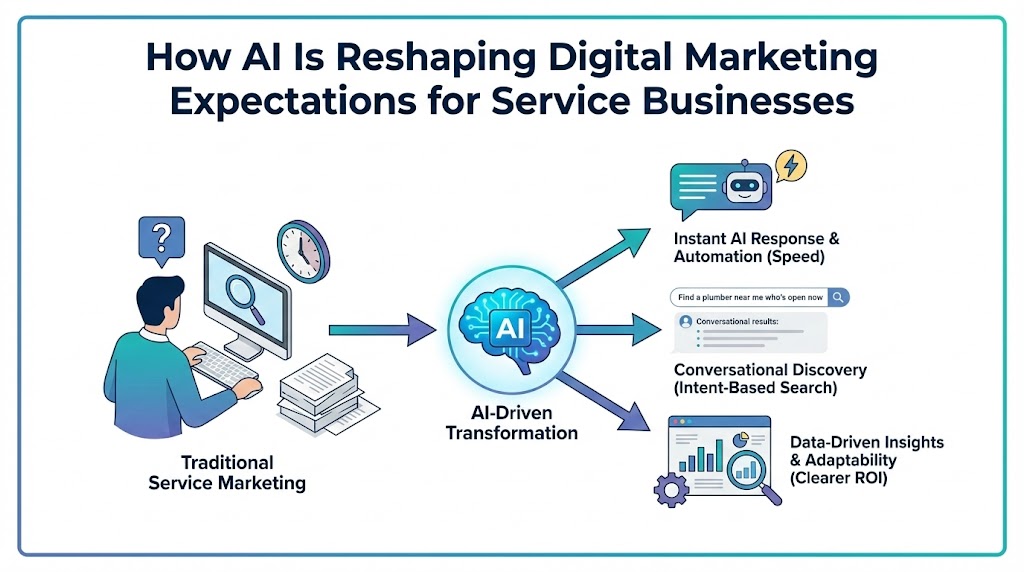
Artificial intelligence is increasingly influencing how consumers discover service providers, how quickly they expect responses, and which businesses ultimately earn their trust. For service-based industries, these shifts are changing the competitive landscape in ways that extend beyond traditional search engine optimization or advertising spend.
Recent industry discussions highlight that AI is no longer a future-facing concept in digital marketing. Instead, it is actively shaping customer expectations around speed, personalization, and availability.
Conversational search is redefining discovery
Search behavior is becoming more conversational as consumers rely on AI-powered tools to interpret intent rather than match keywords. Instead of short, location-based queries, users are asking detailed, situational questions that resemble natural language conversations.
AI-driven search systems draw answers from a business’s broader digital footprint, including website content, reviews, local profiles, and social activity. This means visibility is no longer determined solely by rankings, but by how clearly and consistently a business is represented across online channels.
For marketers, this places greater emphasis on reputation management, content clarity, and ensuring that AI systems can accurately interpret a brand’s strengths and services.
Speed has become a competitive advantage
Consumer tolerance for delayed responses continues to shrink. Industry data presented at recent trade events shows that a majority of customers choose a service provider within hours of making an inquiry, with a significant share of leads arriving outside standard business hours.
AI-powered tools are increasingly positioned as a way to close this gap. Automated responses, chatbots, and AI-assisted email replies allow businesses to acknowledge inquiries quickly, even when staff are unavailable. While these tools do not replace human follow-up, they help prevent leads from going unanswered during critical decision windows.
The expectation is not immediate resolution, but reassurance that the business is responsive and attentive.
Customer insights at scale
Beyond engagement, AI is being used to analyze customer interactions across email, chat, phone transcripts, and form submissions. These systems can identify recurring questions, common pain points, and sentiment trends that are difficult to surface through manual review.
For marketing teams, this analysis supports more informed content planning and campaign decisions. Frequently asked questions can inform website updates, while sentiment analysis can highlight gaps between marketing promises and customer experience.
Faster adaptation, clearer ROI
AI is also influencing how businesses evaluate and adjust their marketing investments. By analyzing performance data across channels, AI tools can surface patterns related to capacity, seasonality, and conversion efficiency.
Some platforms are beginning to automate budget adjustments based on operational capacity, reducing overspend during low availability periods and increasing visibility when teams are able to take on more work. This approach reframes AI as a decision-support system rather than a standalone marketing tactic.
Incremental adoption, not wholesale change
A recurring theme in industry guidance is that AI adoption does not require a complete overhaul of existing marketing operations. Many organizations are experimenting with targeted use cases—such as faster lead response or data analysis—before expanding into more advanced applications.
As AI-driven search and automation continue to mature, the businesses that benefit most are likely to be those that integrate these tools selectively, aligning them with customer expectations rather than treating AI as a replacement for established marketing fundamentals.
The broader takeaway is pragmatic: AI is becoming part of the infrastructure that shapes digital visibility and responsiveness. For service businesses, adapting to that reality is increasingly less about innovation and more about staying competitive.