Creative shortages no longer have to keep a Performance Max campaign away from video inventory. Google Ads can now crawl advertiser-approved sources for existing videos, while its landing-page image controls give the system another route to visual assets.
The expanded sourcing reduces manual upload work. It also gives advertisers a new set of settings, permissions and brand-safety decisions to monitor.
Sourced Videos Extend Google Ads Automation Beyond Uploads
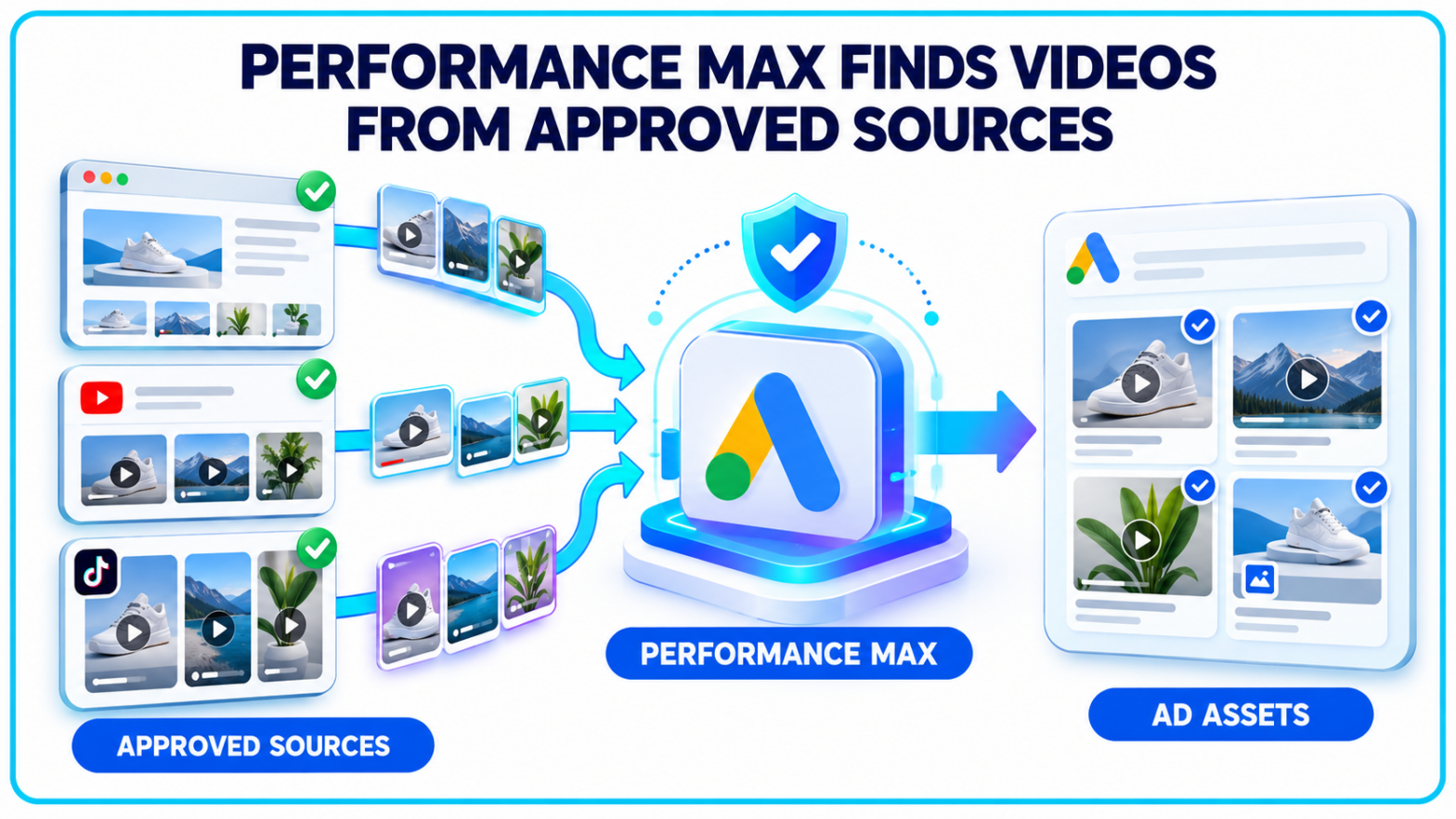
Google’s sourced videos documentation describes a campaign-level setting that uses AI and automated crawling to identify videos from approved online sources.
Advertisers decide which source URLs Google may access. Eligible sources can include social media platforms, the campaign’s landing page and a linked YouTube channel.

Google then evaluates available videos for relevance, potential performance and technical suitability, including whether their aspect ratios can support different video placements. The selected content is refreshed periodically, allowing Performance Max to draw from an advertiser’s broader video portfolio without each file being chosen and uploaded manually.
Up to 10 crawled videos can be added automatically to an asset group. They can run alongside videos uploaded by the advertiser and assets created through Google’s video-generation tools.
The distinction matters as Google Ads automation moves deeper into campaign construction. Sourced videos do not begin as newly generated creative. Google is finding and adapting content the business has already published, based on sources the advertiser approves.
Default Settings Could Change Existing Campaigns
Sourced videos are enabled by default for new Performance Max campaigns. Google also says the setting may have been activated automatically on some existing campaigns following a recent platform update.
Availability will not be uniform at first. The feature is rolling out in stages and may not yet appear in every account. Eligible Performance Max campaigns must also have a daily budget greater than US$5.
Advertisers can manage the feature from the campaign’s asset-group settings. Under “Asset optimization,” the “Sourced videos” option can be enabled or disabled, while “Manage sources” shows the URLs Google has permission to crawl.
Those controls make the feature optional, but its default status gives marketers a reason to inspect existing configurations instead of assuming that only manually uploaded videos are eligible to run.
Crawled videos appear in the campaign’s asset list, where their performance can be reviewed alongside other assets. If a video is removed from its original hosting platform, Google says it will also be removed automatically from Google Ads.
Landing Page Images Are an Older Part of the Creative System
Landing page images may appear beside sourced videos in the current asset-optimization interface, but the capability itself is not entirely new. Google announced the image control in April 2025, initially presenting it as a way to increase the variety of images available to Performance Max.
When enabled, the feature extracts relevant images from a campaign’s landing pages. Google chooses among them according to the query or serving context, then applies automated and manual quality checks before an image can run.
The option sits at the individual campaign level. Advertisers can enable or disable it under the image settings within “Asset optimization,” review selected assets and remove images they do not want to serve.
There is another default to watch. Google’s landing page image documentation says that when dynamic images are enabled, new Performance Max campaigns are created with landing page images turned on. An advertiser may still opt out for each campaign.
For teams already testing combinations within Performance Max campaigns, the sourcing control broadens the pool of creative that may enter those combinations. The website itself can become part of the ad asset library.
Source Approval Becomes a Brand-Governance Decision
An image or video being publicly available does not automatically make it suitable for advertising.
Landing pages may contain outdated product photography, temporary promotions, editorial images, customer-submitted content or material licensed only for use on the website. Social channels can hold behind-the-scenes clips and older branding that were never intended for paid distribution.
Google requires advertisers opting into landing page images to confirm that they own the necessary legal rights or have permission to use the images for advertising and other commercial purposes. Video sourcing follows a related control model by requiring advertisers to approve the source URLs Google may crawl.
In practice, marketers should review both the setting and the content available at every approved source. That review should cover usage rights, current offers, brand standards and whether each asset still represents the landing page users will reach. The asset report can then show which crawled materials Google has selected and how they are performing.
Approval operates at the source level rather than requiring the advertiser to select every individual video in advance. A newly published video placed at an approved source could therefore enter Google’s consideration during a later refresh.
AI Ad Labels Remain a Separate Compliance Layer
Sourcing an existing asset and generating a new one are not the same process, but Google’s wider AI disclosure rules may still become relevant when automation modifies creative.
Google says advertisers can designate assets as AI-created or edited. Those designations appear globally within the “How this ad was made” information in My Ad Centre. Campaigns targeting the European Union, India or New York can also show visible disclosures directly on ads containing designated assets.
Assets created or altered through Google’s fully automated features may be labelled by Google on the advertiser’s behalf. For sourced videos, Google requires every serving asset to be uploaded to YouTube. Crawled videos are placed on a dedicated Google-owned YouTube channel branded with the advertiser’s logo and business name, with viewers directed to the campaign landing page.