Setting up a Google Ads campaign has traditionally meant choosing from Google's list of objectives before building the campaign. Now, Google is testing a different starting point: advertisers describe what they want to achieve, and artificial intelligence suggests how to get there.
The experimental interface places a written business goal ahead of the familiar campaign configuration process. It represents another step in Google's move toward AI-assisted advertising, although the company has not announced a wider release.
Google Ads Campaign Creation Could Start With a Written Brief
New campaign creation flow on Google Ads #ppc #google_ads 🤨 https://t.co/0NAKrpO5VM
— Dima #PPC Skills (@skills_web) October 9, 2026
The biggest change isn't the use of artificial intelligence. It's where Google is introducing it.
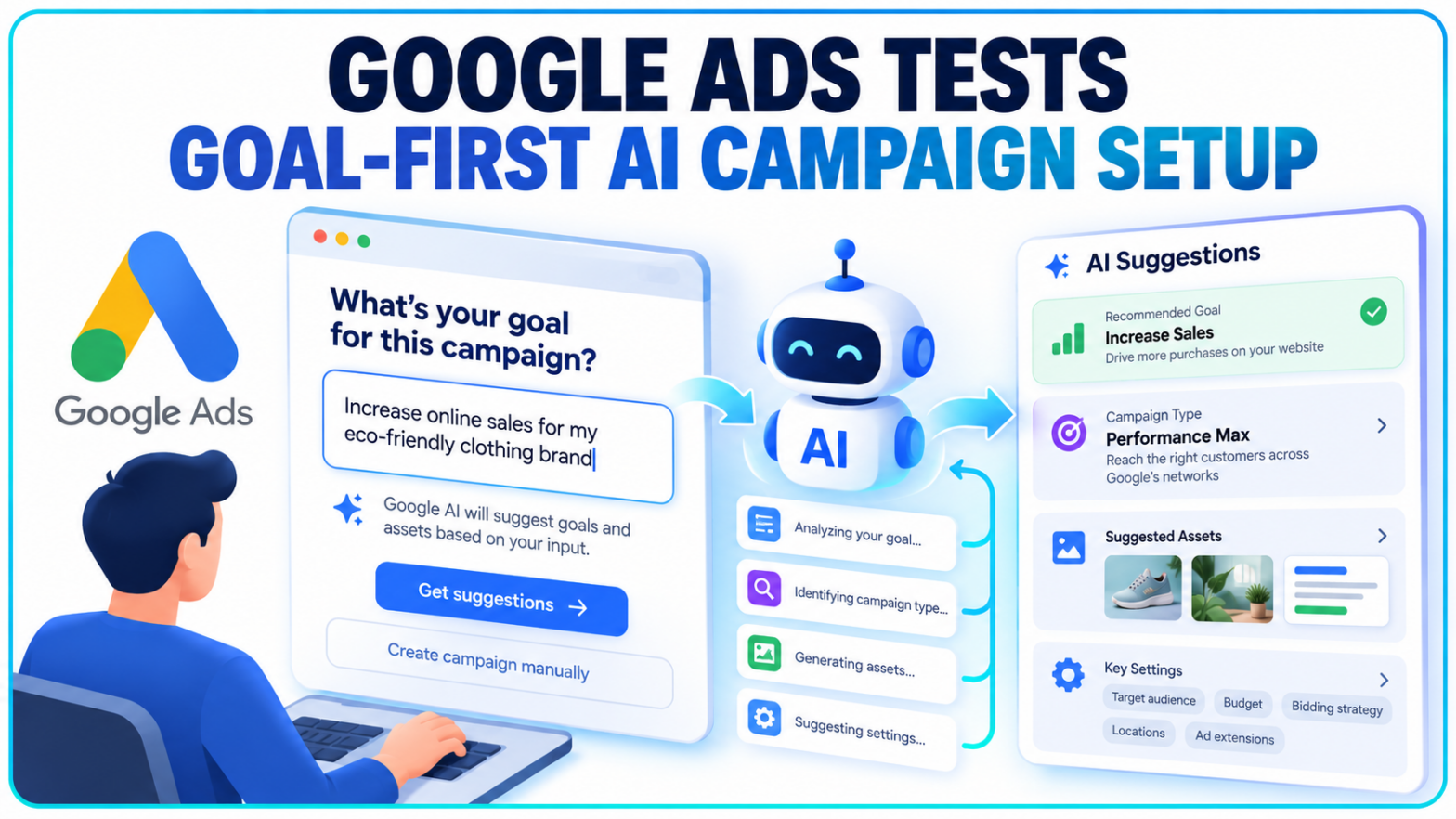
Screenshots shared on October 12, 2026, show an experimental campaign creation screen that opens with a question:
"What's your goal for this campaign?"
Instead of requiring advertisers to immediately select an objective, the interface presents a large text field where they can describe their intended outcome.
A message beneath the question explains:
"Google AI will suggest goals and assets based on your input."
The approach changes the order in which advertisers communicate their intentions to Google Ads.
Under the conventional setup process, advertisers select objectives such as sales, leads or website traffic, then proceed through compatible campaign types and configuration options.
The experimental version starts with the advertiser's own description.
A local business, for example, might describe its intention to increase appointment bookings. An online retailer could explain that it wants to attract customers interested in a particular product category.
Those examples illustrate how written business goals could inform campaign recommendations. Google has not demonstrated the exact recommendations the experimental system would produce for either scenario.
Importantly, the screen retains a Create campaign manually option. Advertisers who prefer the conventional setup process can bypass the AI-assisted entry point.
Google Ads Liaison Ginny Marvin confirmed the test in a public response on X.
"Yes, this is an experiment. We welcome advertisers’ feedback around how and where this type of workflow would be helpful."
Her confirmation establishes that the interface is being tested, rather than introduced as a generally available replacement for campaign creation.
Natural Language Advertising Is Already Part of Google Ads
Google has been using conversational AI inside campaign creation for several years.
Its existing conversational experience in Google Ads already helps eligible advertisers build Search campaigns using natural language.
That workflow begins with a landing page URL. Google's AI examines the page, generates a business description and suggests related campaign assets.
Depending on the available functionality, those suggestions can include keywords, ad groups, headlines, descriptions, images and sitelinks.
Advertisers can then review the generated material, revise it and continue interacting with the system before publishing.
The difference in the latest experiment is the position of the AI prompt.
The established conversational experience operates within the Search campaign creation workflow, particularly around keyword and asset generation. The new test places a written objective at the beginning of campaign setup.
It potentially allows advertisers to explain their intentions before committing to Google's predefined campaign categories.
That distinction matters because a business objective doesn't always translate neatly into a single advertising setting.
An advertiser seeking more profitable customers, for instance, may need to account for conversion values, margins, customer acquisition goals and existing campaign performance.
Google's experiment indicates that AI could participate earlier in interpreting those requirements. It does not yet establish how deeply the system understands such business constraints.
The test also arrives as Google expands other forms of Google Ads automation through AI Max, where machine learning already influences search matching and creative optimization.
Those capabilities operate at different stages of advertising. The latest interface concentrates on how a campaign begins.
AI Campaign Setup Still Leaves Major Configuration Questions
The experimental screen makes one capability clear: Google AI can suggest campaign goals and assets from written input.
Several other aspects remain unanswered.
Google has not disclosed which campaign types support the interface, whether the test is limited to certain accounts or regions, or when broader access might become available.
The company has also not explained how the suggested goals would translate into the settings advertisers normally configure.
Campaign objectives are only one part of paid advertising.
Advertisers must also establish budgets, bidding strategies, conversion actions, geographic targeting, audience settings and landing page requirements.
A natural language prompt might describe some of those priorities, but the available evidence does not show whether the experimental workflow can configure them.
Nor has Google established whether its recommendations would appear as editable suggestions, a partially completed campaign or another form of guided setup.
There is an important difference between generating a proposed campaign structure and being authorized to publish one.
Google's existing conversational experience explicitly requires advertisers to review and approve AI-generated suggestions. The level of approval built into this newer experiment has not been detailed.
The manual creation option indicates that the traditional workflow remains accessible within the test.
It does not establish whether other campaign controls will remain unchanged if Google expands the feature.
Ask Advisor and AI Max Are Moving Toward the Same Starting Point
The campaign creation experiment fits within a broader change in how Google is designing its advertising tools.
At Google Marketing Live 2026, the company introduced Ask Advisor, an AI agent designed to connect marketing tasks and information across Google's advertising products.
According to Google's official Ask Advisor announcement, advertisers can describe a business objective and receive assistance translating it into campaign actions.
Google demonstrated the concept using a retailer seeking new customers for hair care products. The AI agent could retrieve relevant Merchant Center product information and help create a campaign in Google Ads.
That functionality operates across Google's marketing ecosystem.
The newly observed interface is narrower in what has been demonstrated. It introduces a written business-goal prompt directly into the campaign creation screen.
Google has not confirmed whether the experiment uses Ask Advisor or shares its underlying workflow.
Another related development is AI Brief.
In September, Google expanded its AI Brief beta, allowing advertisers to communicate additional business context, audience priorities and messaging requirements using everyday language.
AI Brief works within AI Max rather than replacing the initial campaign objective selection process.
Separately, Google has introduced AI-generated copy previews, allowing advertisers to inspect example headlines and descriptions before enabling certain automated creative features.
Each tool addresses a different part of campaign management.
AI Brief helps advertisers guide campaign automation. Creative previews provide a way to evaluate generated messaging. Ask Advisor connects marketing requests with platform actions.
The new campaign creation test examines whether advertisers should begin by explaining their business goals rather than immediately working through Google's existing interface.
Advertisers Still Need to Evaluate the AI's Campaign Recommendations
For paid media teams, the practical implications centre on how Google interprets a written brief.
A campaign objective selected by AI still needs to correspond to the advertiser's intended conversion action. Lead generation campaigns, for example, may track form submissions, telephone calls or qualified leads, depending on the business and its measurement setup.
Those differences affect how campaign performance is evaluated.
The same applies to budgets, bidding and geographic targeting. Even when AI produces a suitable initial recommendation, advertisers remain responsible for ensuring that the eventual configuration matches their approved campaign requirements.
Google's existing conversational experience documentation also warns that AI-generated suggestions can be inaccurate or irrelevant and places responsibility for reviewing adopted suggestions on the advertiser.
The new experiment has not been shown to change that responsibility.
For now, marketers have no confirmed rollout to prepare for and no evidence that existing campaigns will be altered by the test.
The experiment instead introduces another possible entry point into Google Ads, one where a written description could influence the initial campaign structure.
Google has not published an availability schedule, confirmed supported campaign types or specified the extent of advertiser control over the recommendations generated through this interface.
The company is currently collecting feedback on where advertisers would find the workflow useful. Manual campaign creation remains available in the experimental screen.