
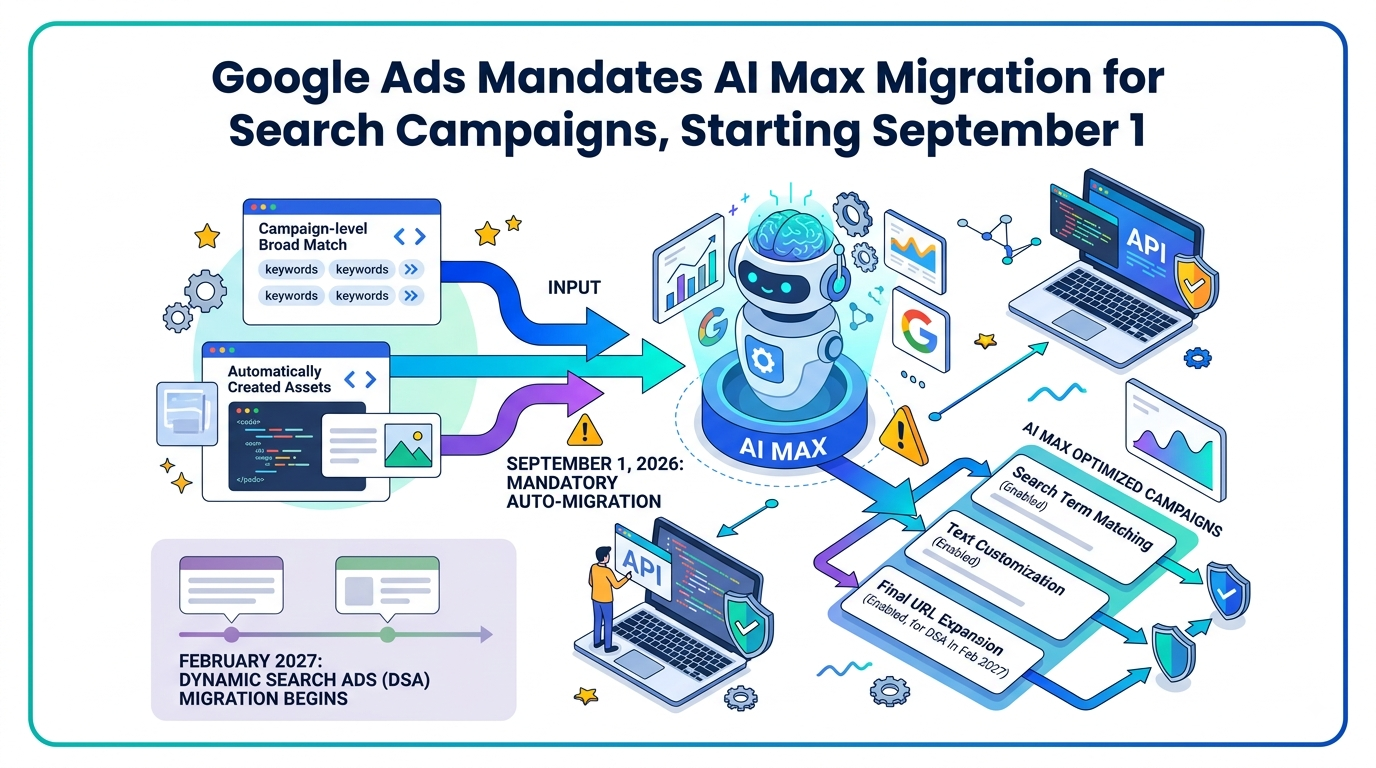
Google Ads accounts running Campaign-level Broad Match or Automatically Created Assets will be automatically upgraded to AI Max beginning September 1, with no manual opt-in required. Google published the technical details of the migration on the Google Ads Developer Blog on August 12, 2026, two weeks after the company notified affected advertisers directly by email on August 5.
Two-Phase Migration With Separate Deadlines
The transition is structured in two phases with distinct timelines. Google published the technical mechanics of its September migration on August 12, 2026, confirming that creation of legacy Campaign-level Broad Match and Automatically Created Assets configurations was switched off nine days earlier.
Beginning August 3, Google stopped allowing the creation of new Campaign-level Broad Match and legacy Automatically Created Assets across the Google Ads UI, Ads Editor, and API. Automatic migration of those campaign types to AI Max then begins September 1 and runs through September 30.
The migration was originally announced on April 15, 2026, by Brandon Ervin, Director of Product Management at Google Ads, when AI Max officially left beta, and Google scheduled Dynamic Search Ads, Automatically Created Assets, and Campaign-level Broad Match for a combined September 2026 upgrade. That bundled timeline was later split. On June 11, 2026, Google moved the Dynamic Search Ads auto-migration to February 2027, a five-month extension published on the Google Ads Developer Blog and attributed to advertiser feedback about fourth-quarter planning risk.
The timeline for campaigns using Automatically Created Assets and Campaign-level Broad Match did not change. According to Google's updated June 11 post on the Ads and Commerce Blog, "campaigns using Automatically Created Assets (ACA) and campaign-level broad match setting will continue to be auto-upgraded starting in September 2026."
How Campaigns Are Migrated
After migration, campaigns with Automatically Created Assets receive Search Term Matching and Text Customization enabled by default. Campaigns with the Campaign-level Broad Match setting receive Search Term Matching only, without automatic Text Customization or Final URL Expansion.
Existing brand settings are preserved. The August 12 Developer Blog post confirms that brand inclusions and exclusions carry over automatically into the new AI Max configuration, and that campaigns are migrated in place using equivalent AI Max settings to minimize performance disruption.
There is no opt-out option other than disabling the affected features before September 1. Advertisers who manually disable Campaign-level Broad Match or Automatically Created Assets before that date will not be subject to the automatic upgrade.
API Versioning and Developer Impact
The migration introduces a split support model for the Google Ads API. Any new versions of the Google Ads API released after September 1, 2026, will completely remove the legacy entities used to create or manage Campaign-level Broad Match settings and Automatically Created Assets.
Previously released API versions that are currently active will temporarily continue to support both legacy setups. The sunset timeline is tied to the standard version lifecycle rather than to the migration. Older Google Ads API versions supporting legacy Broad Match and ACA entities are expected to reach their scheduled sunset around September 2027, permanently removing support.
The August 12 Developer Blog post advises developers to audit any scripts, external tools, or client libraries currently attempting to create or edit Campaign-level Broad Match settings or legacy ACA configurations, and to update campaign construction workflows to use standard Search campaigns with AI Max settings.
Dynamic Search Ads: February 2027 Timeline
In-account notices encouraging voluntary Dynamic Search Ads upgrades to AI Max begin appearing in September 2026. Google sends official reminder notifications to all impacted accounts on January 15, 2027. Automatic migration of Dynamic Search Ads begins February 1 through February 28, 2027, at which point the ability to create new DSA ad groups is permanently removed.
All three AI Max features, Search Term Matching, Text Customization, and Final URL Expansion, will be enabled by default during the DSA migration, with legacy URL controls preserved. A parallel-running period is built in: the system generates new Responsive Search Ads and submits them to policy review, and only when those RSAs pass review and become active are the legacy Dynamic Search Ads paused and placed in a view-only state.
Advertisers with active DSA campaigns can voluntarily upgrade before February by selecting "Upgrade Your Dynamic Search Ads to AI Max" under Campaign Settings, as outlined in the August 12 Developer Blog post.
What This Means for Advertisers and Developers
For advertisers currently running Campaign-level Broad Match or Automatically Created Assets, the September 1 start date leaves limited time for pre-migration review. Standard industry practice before any automated campaign restructuring includes auditing active brand exclusion lists, verifying that account-level conversion tracking is correctly configured, and establishing pre-migration performance baselines to allow accurate post-migration comparison. For developers, the priority is identifying which API version each integration targets and whether campaign construction logic relies on any of the legacy entities being deprecated in post-September API releases.
Google confirmed in the August 12 Developer Blog post that the ability to create new Dynamic Search Ad groups will be permanently removed when the February 2027 auto-migration begins, marking the end of DSA as a standalone campaign structure within Google Ads.