Website traffic used to mean people visiting pages, clicking buttons and making purchases. Now, an increasing share of those interactions involves AI agents acting on someone's behalf.
Traditional analytics tools weren't built to make that distinction.
Microsoft is addressing the gap with new capabilities in Clarity, including AI agent tracking, automated website testing and conversational analytics that can explain visitor behaviour using recorded session data.
Announced on November 4, 2026, the expansion introduces a different approach to measuring website performance: understanding not just who arrives, but what AI systems and human visitors actually accomplish.
AI Agents Are Becoming a Measurable Part of Website Traffic
The growth of AI-powered browsing has created an unusual problem for website owners. An automated agent might search for a product, complete a form or initiate checkout, yet conventional traffic reports provide little indication that an AI system participated.
Microsoft's latest Clarity announcement introduces an Agent Activity dashboard designed to make those interactions more visible.
The company has supporting data.
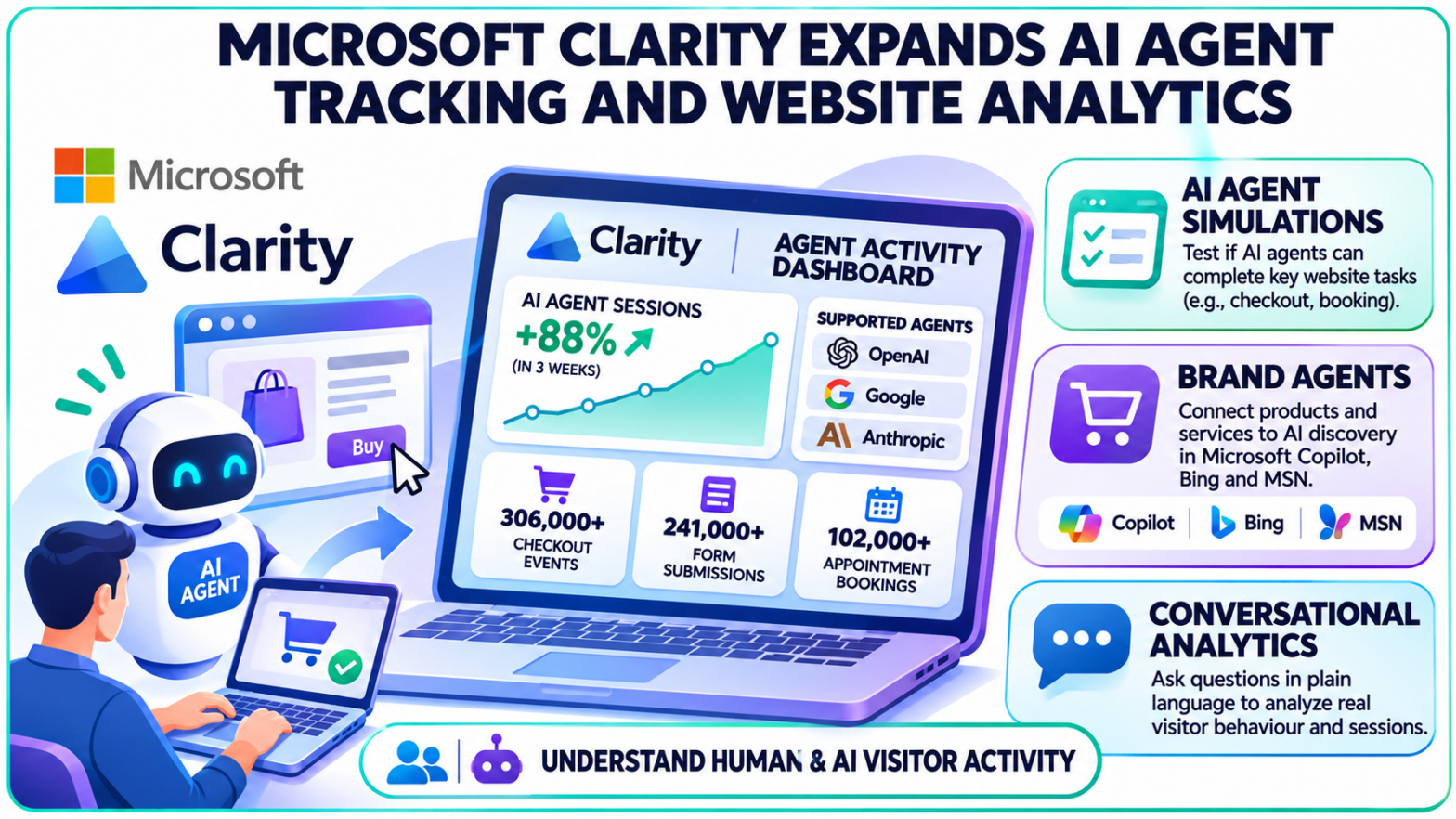
In a study covering more than 5.2 million agentic sessions across 230,511 Clarity projects, Microsoft found that weekly AI agent sessions increased by 88% over three weeks, approaching two million.
The analysis covered August 13 through September 9, 2026, and identified sessions associated with agent operators from OpenAI, Google and Anthropic.
More revealing than the traffic increase was what happened during those visits.
Microsoft recorded checkout events in more than 306,000 agentic sessions, form submissions in over 241,000 and appointment-booking events in more than 102,000.
These weren't simply automated requests for website content. The sessions contained interactions associated with commercial activity.
There is an important limitation, however.
Microsoft acknowledges that agentic sessions can include human handoffs. Its reporting cannot always separate the actions performed by the agent from those completed by a person during the same session.
Recorded checkout activity therefore doesn't prove that an AI agent independently finished a purchase.
The findings expand an existing conversation around AI search visibility, where businesses are increasingly distinguishing automated content access from genuine engagement and measurable customer activity.
Microsoft Clarity Can Now Examine Agent Behaviour Beyond Pageviews
The new Agent Activity dashboard moves beyond identifying whether automated systems visited a website.
It reports which supported AI agents are active, how their traffic changes over time and what actions occur during their sessions.
Tracked events can include website searches, logins, downloads, form submissions, appointment bookings and checkout activity.
For businesses, the distinction is useful.
A retailer might see that agentic sessions frequently reach product pages but rarely progress to checkout. A travel provider could identify activity around availability searches without assuming that every session resulted in a completed reservation.
Those patterns offer more context than a count of visits alone.
Clarity is also introducing simulation assessments that test whether AI agents can complete selected website tasks.
The assessments measure task completion, the time required and the number of interactions involved. They also identify points where the process encounters difficulty.
Microsoft is initially focusing these simulations on commerce and travel scenarios, with broader use cases planned.
That approach adds a testing component to AI agent analytics.
Instead of waiting for actual customer journeys to expose problems, supported businesses can assess whether agents can navigate important tasks under simulated conditions.
The capability is particularly relevant as agentic AI changes how customers interact with websites. An AI assistant acting for a user may navigate a site differently from someone browsing manually.
Microsoft says the Agent Activity dashboard is generally available for Clarity projects with detected agentic traffic. Current agent identification covers supported operators from Google, OpenAI and Anthropic rather than every automated browser or assistant.
Brand Agents Connect AI Discovery With Purchases and Bookings
Microsoft is extending Clarity beyond observation.
Its Brand Agents product, which previously focused on helping shoppers navigate products on business websites, is expanding into Microsoft-operated AI discovery experiences and local service interactions.
For eligible Shopify and WooCommerce merchants, Brand Agents can make catalogue information available through Microsoft Copilot, Bing, MSN and other supported experiences.
Products can appear when consumers ask AI tools for recommendations, with purchases completed through the merchant's website.
Microsoft says businesses already using Brand Agents don't need to upload their catalogues again to participate. During setup, eligible merchants can also choose between offering the assistant on their own websites and extending product discovery into Microsoft's AI experiences.
The local business expansion follows a different model.
An AI assistant embedded on a service provider's website can help visitors identify suitable services, answer questions and proceed toward appointments.
For example, someone looking for plumbing repairs could describe their problem conversationally instead of searching through a conventional service menu.
Brand Agents can connect with supported scheduling and customer management systems, including Square, Jobber, HubSpot, Calendly, Housecall Pro and Salesforce.
Eligible WordPress businesses can access the local service capability through Clarity's Brand Agents setup.
These features extend Microsoft's role in the customer journey from measuring engagement to facilitating specific interactions.
They don't replace conventional analytics or guarantee that a business will appear in an AI-generated recommendation.
Eligibility, platform support and the availability of relevant catalogue or booking integrations still determine which businesses can use the expanded functionality.
Ask Clarity Brings Conversational Analytics to Session Recordings
Traditional website analytics can tell a marketer that conversion rates declined. Discovering the reason often takes considerably more work.
Teams may need to compare audience segments, examine heatmaps, review recordings and test different explanations.
Microsoft's new Ask Clarity capability is designed to handle more of that investigation through natural-language questions.
A marketer could ask why visitors from one region convert less frequently than visitors elsewhere.
Rather than relying only on a broad performance metric, Ask Clarity examines available behavioural evidence, including session recordings, heatmaps, funnels and recorded events.
It then produces findings with links to relevant session recordings, allowing users to inspect the underlying activity.
Consider an international retailer experiencing weaker sales in a particular market.
Pricing might initially appear responsible. Behavioural evidence could instead show visitors encountering untranslated pages or delivery options that don't serve their location.
The value of conversational analytics in this situation is not simply receiving an AI-generated explanation. It is having supporting evidence available for review.
Microsoft already offers AI-powered features through Copilot in Clarity, including summaries of recordings and heatmaps. Ask Clarity expands that approach toward investigating questions across several behavioural signals.
Access remains limited.
Ask Clarity is currently in a closed beta for retailers, with a waitlist for interested users.
Microsoft reported that 14 of 16 surveyed early-access participants discovered something new about their business or website. The sample is too small to establish how consistently other businesses would experience similar results.
The company also plans to extend Ask Clarity to additional data sources, including AI Visibility and advertising information. Those integrations have not yet been released as part of the current experience.
AI Analytics Still Cannot Explain Every Customer Journey
Microsoft's expansion addresses three distinct parts of online customer activity: agents performing tasks, AI systems recommending products or services, and people browsing websites themselves.
Each generates different measurement signals.
An AI crawler requesting product information isn't equivalent to an agent attempting a purchase. Neither activity necessarily proves that a human customer discovered the business through an AI-generated recommendation.
Even when a person reaches a website, identifying the original source can remain difficult.
TechWyse previously reported on an AI traffic attribution problem in which missing referral signals caused some ChatGPT visits to appear as Direct traffic.
The visitors were still reaching websites. Their reported acquisition channel had changed.
Clarity's new tools provide additional behavioural evidence, but they don't eliminate those attribution limits.
For marketers, the practical implication is a broader way to evaluate website performance. AI agent activity can be examined alongside human sessions, conversion events, traffic sources and customer journey recordings. Simulation results can identify potential task failures, while conventional analytics remain necessary for understanding campaign performance and completed business outcomes.
Agent participation and successful conversions also need to remain separate measures. A session that includes checkout activity doesn't necessarily represent an independently completed AI transaction.
Microsoft continues to develop its AI measurement tools across these different stages.
The company's November 4 release makes Agent Activity available to projects with supported agent traffic, extends Brand Agents to eligible commerce and local business applications, and introduces Ask Clarity through a restricted retailer beta.
For now, the most significant change is the additional visibility into activity that existing pageview and referral reports were never designed to explain.