Microsoft Advertising is no longer treating transparency as a reporting feature. It is turning visibility and control into a product strategy.
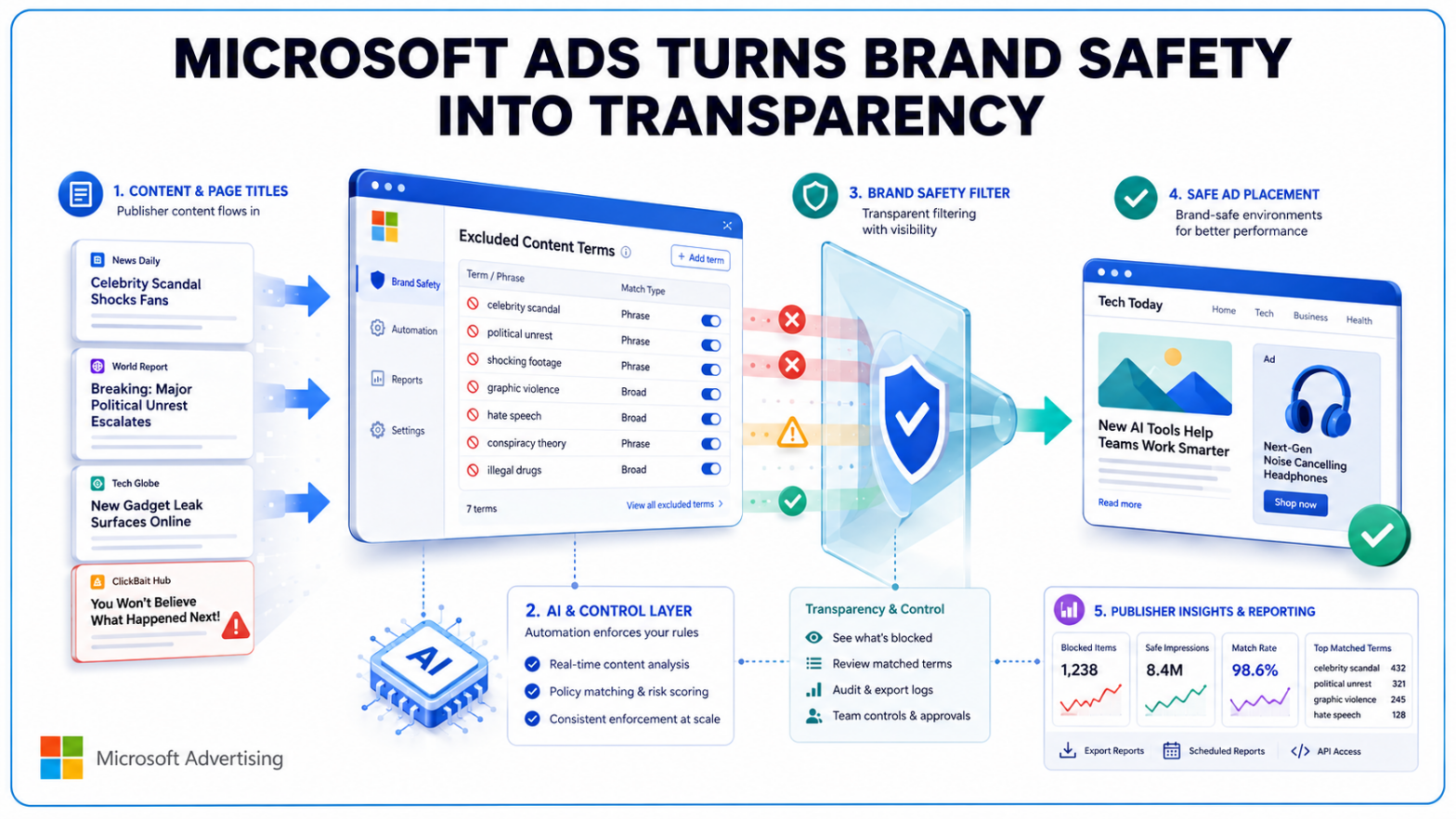
The platform is gradually rolling out excluded content terms, a new content suitability control that lets advertisers prevent ads from appearing beside page titles containing specified words or phrases. The release is narrow on its own. Viewed alongside Microsoft’s recent AI visibility reports, Performance Max experiments, publisher-level metrics, and creative previews, it points to a larger competitive argument.
Automation does not have to operate behind a curtain.
Advertisers Can Now Block Page Titles, Not Just Websites
Excluded content terms are designed to stop ads from appearing beside page titles that contain language an advertiser considers unsuitable.
A technology company, for example, could exclude a phrase associated with defective products. Microsoft would then avoid placing the company’s ads next to page titles containing that phrase.
The control is more precise than blocking an entire website. A publisher may be broadly acceptable while hosting an individual article about a sensitive event, controversial subject, competitor, or reputational risk.
Microsoft says advertisers can enter as many as 1,000 excluded content terms. The settings can be added at the account or campaign level, although Microsoft’s documentation says terms entered during campaign setup are applied across campaigns in the account.
Access is still being rolled out. Microsoft’s help documentation states that the feature is not yet available to every advertiser.
The control appears under Tools > Content suitability > Excluded content terms. Advertisers can add terms individually, paste them one per line, or use an AI prompt during Performance Max campaign creation to generate suggested exclusions.
That last option reflects Microsoft’s current product philosophy: use AI to reduce setup work, but leave the final restrictions visible and editable.
Brand Safety Is Moving Beyond Broad Categories
Advertising platforms have traditionally handled contextual risk through two blunt instruments.
The first is a website exclusion list, which blocks an advertiser from appearing on specified domains. The second is category-level filtering, which avoids broad classes of sensitive content such as violence, gambling, crime, political material, or natural disasters.
Excluded content terms sit between those controls.
Microsoft Advertising already uses Integral Ad Science technology to screen audience placements for several high-risk categories. Microsoft says medium- and high-risk content involving subjects such as adult material, illegal drugs, hate speech, offensive language, and violence is automatically blocked under that system. Advertisers can also apply additional sensitive-content exclusions.
Term-based controls address cases that category filters may not capture.
A page can be technically safe for advertising while still creating an unwanted association. An airline may not want its ads beside a headline about a specific aviation incident. A financial institution may want to avoid articles mentioning a named fraud investigation. A retailer may need to exclude language tied to recalls, counterfeit products, or labour disputes.
Blocking every news website that could publish those stories would eliminate a large amount of legitimate inventory. Blocking specific title language offers a narrower response.
It is not a guarantee. Microsoft explicitly warns that content suitability controls may not block every instance of excluded material. The feature should be treated as another layer of brand safety, not a replacement for placement reporting, publisher exclusions, or regular campaign review.
Microsoft Is Making Automation Easier to Inspect
The timing is more important than the feature itself.
Microsoft has spent much of 2026 releasing tools that expose more information about automated campaign delivery.
In May, the company expanded Performance Max reporting with publisher-level clicks, spend, and conversion data. Microsoft positioned the release as going beyond placement reports that show impressions without enough performance context. Landing page reporting and search term reporting were added to give advertisers a clearer view of where traffic was sent and which customer queries were associated with results.
That reporting push was followed by native Performance Max experiments. Uplift experiments allow advertisers to compare Performance Max against existing campaigns, while upgrade experiments are designed to measure the effect of moving eligible campaigns into the automated format.
The addition gave marketers a way to test whether automation produces incremental performance instead of relying on a before-and-after comparison. TechWyse previously examined how Microsoft Advertising added Performance Max experiment types as the platform worked to close one of the campaign format’s clearest measurement gaps.
Microsoft has also expanded controls around customer acquisition, negative keywords, brand exclusions, search themes, and AI-generated text. Its Performance Max setup now includes text guidelines that let advertisers identify words and phrases that should not appear in automatically generated assets.
Excluded content terms extend that logic from what an ad says to the environment in which it appears.
Creative Previews Remove Another Layer of Guesswork
Audience ads have often been difficult to approve in advance because their final appearance changes by publisher, placement, device, and available asset.
Microsoft addressed part of that problem in February with an expanded ad preview hub.
Advertisers can preview how Audience ads may appear on specific supported publishers and devices, select individual creative assets, and switch between an isolated ad view and the surrounding page. The initial publisher support includes MSN and Outlook, with additional sites expected later.
Preview links can also be shared with clients, partners, or internal reviewers who do not have access to the advertising account.
That may sound like a workflow improvement rather than a major advertising update. For regulated brands and agencies with formal approval processes, it solves a practical problem.
A campaign manager can show where the creative may appear, how it renders, and which contextual restrictions have been applied before the campaign begins spending. The process still cannot reproduce every live impression, but it provides more evidence than a collection of uploaded assets and a promise that the platform will assemble them correctly.
The feature also creates a clear contrast with the longstanding Performance Max black-box problem. Automated campaigns are easier to defend internally when marketers can preview the creative, inspect the publisher, review search terms, and test incremental impact.
The Transparency Argument Now Reaches AI Search
Microsoft is applying the same positioning outside paid media.
Its AI Performance dashboard in Bing Webmaster Tools gives publishers visibility into how their content appears in AI-generated answers. The dashboard reports cited URLs, grounding queries, citation activity, topics, intents, and comparative trends.
The reporting does not turn AI visibility into a conventional rank-tracking metric. It does, however, expose information that publishers previously had to estimate using third-party tools or manual prompt testing.
Microsoft has described the dashboard as a way to show where a brand appears across the AI web. TechWyse’s coverage of the expanded Bing AI visibility reporting found that the platform is moving beyond raw citation counts toward more diagnostic information about intent, themes, and changes over time.
Paid media and organic reporting are different product categories, but the underlying message is consistent.
Microsoft wants advertisers and publishers to see more of what its automation is doing.
Google has also expanded Performance Max diagnostics, channel reporting, AI controls, and automated campaign insights. Microsoft is not operating without competition. The distinction lies in how directly it is tying these releases together around advertiser confidence, testing, and inspectability.
What Changes for Advertisers in Practice
For paid media teams, excluded content terms add a more granular control between domain-level blocking and broad sensitive-content categories. Existing website exclusion lists should remain in place, while term lists can cover brand-specific risks such as competitor names, recalls, litigation, political controversies, or other unsuitable associations.
Terms will need careful maintenance. Broad words can remove acceptable inventory, while overly specific phrases may miss variations of the same topic. Advertisers should review placement and publisher reports after implementation rather than assuming the list has eliminated every contextual risk.
Microsoft’s rollout does not make Audience ads fully predictable. Automated placement, creative assembly, and contextual classification still depend on systems advertisers cannot directly control.
What has changed is the amount of evidence available around those systems.
The platform now lets advertisers preview more creative combinations, measure Performance Max through experiments, inspect publisher-level results, review AI-generated assets against text guidelines, and restrict the page-title language surrounding their ads.
Excluded content terms are one more control in that stack. Microsoft’s broader bet is that advertisers will place greater trust in automation when they can see where it went, test whether it worked, and draw clearer boundaries around what it is allowed to do.