
Diversifying paid media sounds sensible until a campaign crosses into a second automated platform.
Then the practical problems appear. New placements, unfamiliar creative combinations and another approval process can make advertisers retreat to the network they already know. Microsoft Advertising is trying to remove one of those barriers by bringing its Ad Preview Hub to Performance Max campaigns.
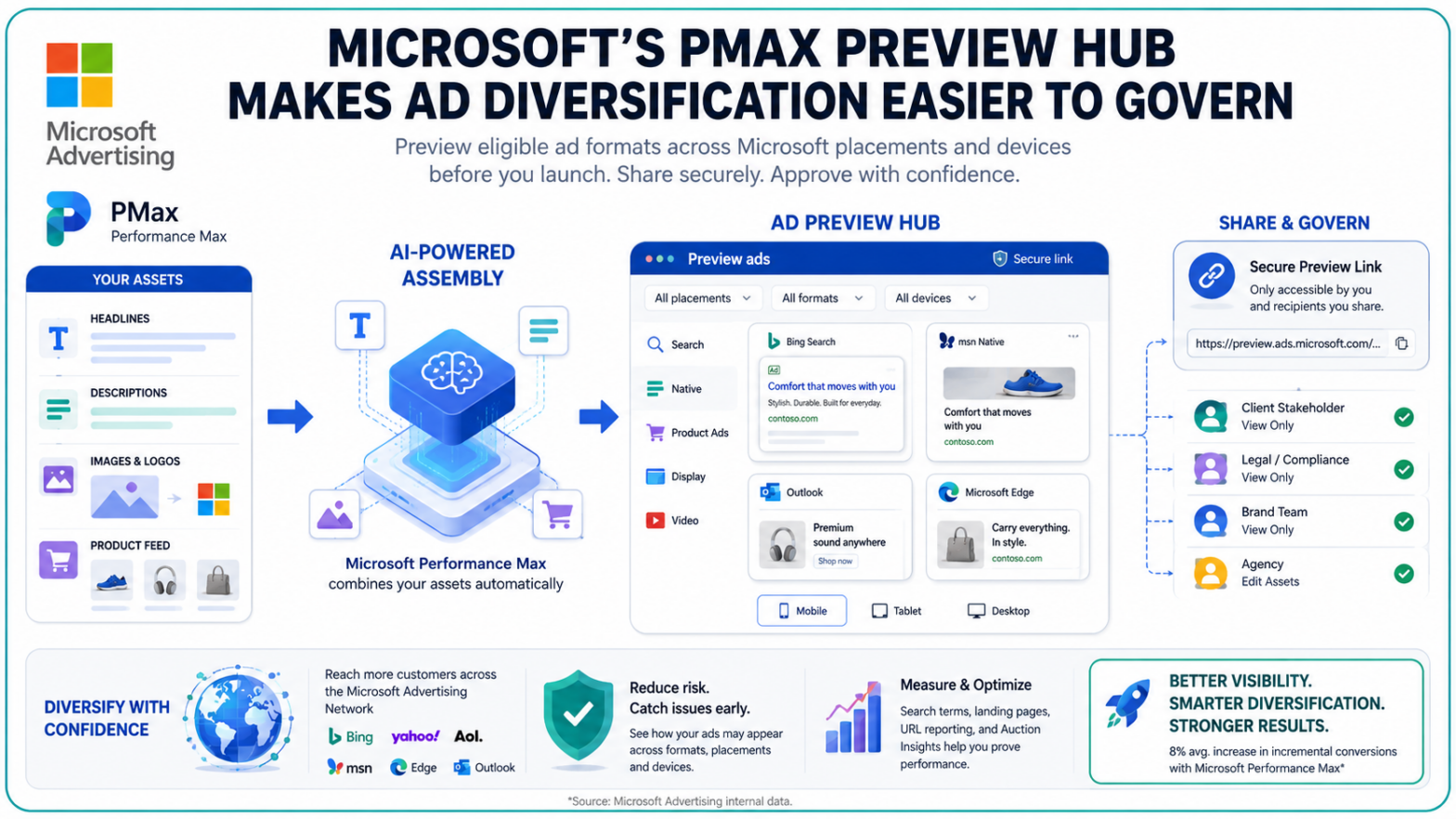
The feature lets advertisers inspect eligible ad formats across Microsoft placements and devices before a campaign launches. Teams can also generate a secure preview link for clients or internal stakeholders who do not have access to the advertising account.
It is a creative review tool. Viewed more broadly, it also supports a diversification strategy by making Microsoft’s automated inventory easier to assess before budgets move beyond Google.
Microsoft Is Reducing the Operational Cost of a Second Platform
Advertisers can open an asset group inside a Microsoft Performance Max campaign and select “Preview ads” to enter the Ad Preview Hub. From there, they can review how eligible creative combinations may appear across different formats, placements and devices.
The preview can then be shared through a secure link. Microsoft says access is limited to the person who creates the link and the recipients with whom it is shared.
That changes a familiar agency workflow.
Creative approvals for automated campaigns have often relied on static screenshots, mockups or explanations of how a platform may combine supplied assets. Those materials quickly become incomplete when an automated system can rearrange headlines, descriptions and images for several environments.
The Ad Preview Hub brings those combinations into a single review interface. A client can inspect the work without being added to the account. A legal or brand team can review formats in context. An agency can spot an awkward image crop or mismatched message before delivery begins.
Microsoft first introduced the enhanced preview environment for Audience Ads in February 2026, initially supporting previews on MSN and Outlook. At the time, the company said it planned to extend the hub to additional campaign types. Performance Max is now part of that expansion.
Diversification Fails When Governance Does Not Travel With the Budget
Paid media diversification is usually framed as an audience or auction decision. Advertisers may want less dependence on Google, access to Microsoft’s search and native inventory, or another source of incremental conversions.
Execution is often the harder part.
A second ad platform brings a second set of controls, reporting conventions and creative behaviours. Automated formats amplify that burden because advertisers are not approving one finished ad. They are supplying ingredients that the platform assembles dynamically.
Microsoft Performance Max can combine advertiser assets into search, native and product ads across the Microsoft Advertising Network. Microsoft has identified Bing, Yahoo, AOL, MSN, Edge and Outlook among the surfaces its PMax campaigns can reach.
That reach creates the argument for diversification. It also raises the approval risk.
A headline that works beside one image may read differently beside another. A wide creative may lose important information when adapted for a smaller placement. Brand teams may be comfortable with the source assets but not every automated combination the system could produce.
Previewing those outputs does not provide complete control over delivery. It does give advertisers a more concrete basis for deciding whether their Microsoft campaign is ready to receive budget.
That distinction matters as automated campaign types become a larger part of cross-platform paid media management. Campaign portability means little when review and governance processes cannot follow the campaign into the new network.
Microsoft Is Building Transparency Into Its PMax Pitch
The Ad Preview Hub is not an isolated concession.
Microsoft has been expanding the information available inside its Performance Max campaigns throughout 2026. Website URL reporting now includes clicks, spend and conversion metrics rather than stopping at impressions. Landing-page reporting provides URL-level performance data, while search-term reporting is intended to show the queries generating traffic.
Auction Insights for Performance Max has also been placed on Microsoft’s roadmap, with overlap rate and outranking share among the planned competitive metrics.
Together, these additions address different stages of campaign management.
The Ad Preview Hub operates before launch, when teams need to validate creative. Search-term, publisher and landing-page reports operate after delivery, when advertisers need to understand where traffic came from and what produced results. Microsoft has also introduced native PMax experimentation tools for advertisers testing campaign changes and incremental performance.
That progression gives Microsoft a potentially useful position in the automated advertising market. It is not offering advertisers manual control over every impression. It is making the automation easier to inspect at more points in the workflow.
Google has been moving in a similar direction. Its recent Performance Max channel diagnostics show which missing or disapproved assets may be preventing campaigns from serving on individual channels.
The two platforms are responding to the same pressure. Advertisers may accept automated delivery, but they still need enough visibility to explain creative decisions, diagnose problems and defend spending.
Creative Visibility Does Not Reveal the Entire Campaign
The new preview capability has clear boundaries.
An ad preview shows how supplied assets may be assembled. It does not predict which combinations Microsoft will favour, how frequently each placement will receive spend or whether the campaign will produce incremental conversions.
It is also not a placement exclusion tool. Seeing a possible ad format does not necessarily give the advertiser the option to remove that environment from PMax delivery.
That leaves the central trade-off of Performance Max intact. The platform controls much of the targeting, bidding and creative assembly in exchange for broader automated reach.
Microsoft has reported that advertisers using its Performance Max campaigns see an average 8% increase in incremental conversions. It has also reported stronger results when PMax is combined with Search campaigns, including an average 32% reduction in cost per acquisition and a threefold increase in return on ad spend compared with Search alone. Those are Microsoft’s aggregated platform findings, not guaranteed outcomes for an individual advertiser.
Preview access should therefore be treated as one layer of evidence. Advertisers still need conversion tracking, campaign experiments and post-launch placement reporting to determine whether Microsoft is adding reach or merely redistributing existing demand.
Microsoft’s recent Performance Max experimentation update is especially relevant here. Creative confidence may help a campaign launch, but controlled testing is what helps establish whether the additional platform belongs in the long-term media mix.
A Better Preview Can Make Smaller Microsoft Tests More Practical
For marketers, the immediate change is procedural. Creative and compliance reviews can happen through a platform-generated preview rather than a collection of screenshots. Agencies can send a link to clients, gather feedback and revise weak asset combinations before activation.
The diversification effect is more subtle.
Microsoft Ads does not need to replace Google Ads to become strategically useful. It needs to be testable without forcing teams to lower their standards for brand review, reporting or accountability. Tools that reduce those operational gaps make it easier to run a contained Microsoft PMax test alongside existing Search and Performance Max campaigns.
Advertisers should still evaluate the platform separately. Budgets, conversion goals and audience conditions differ across networks. Imported assets also require a fresh review because a creative set built for Google may render differently across Microsoft inventory.
The Ad Preview Hub cannot resolve every concern associated with automated campaigns. It does remove one avoidable source of uncertainty before launch.
Microsoft Performance Max now offers advertisers a clearer view of the ads they are being asked to trust. For brands considering a second automated advertising ecosystem, that visibility makes diversification easier to approve, even before performance data decides whether it is worth scaling.