
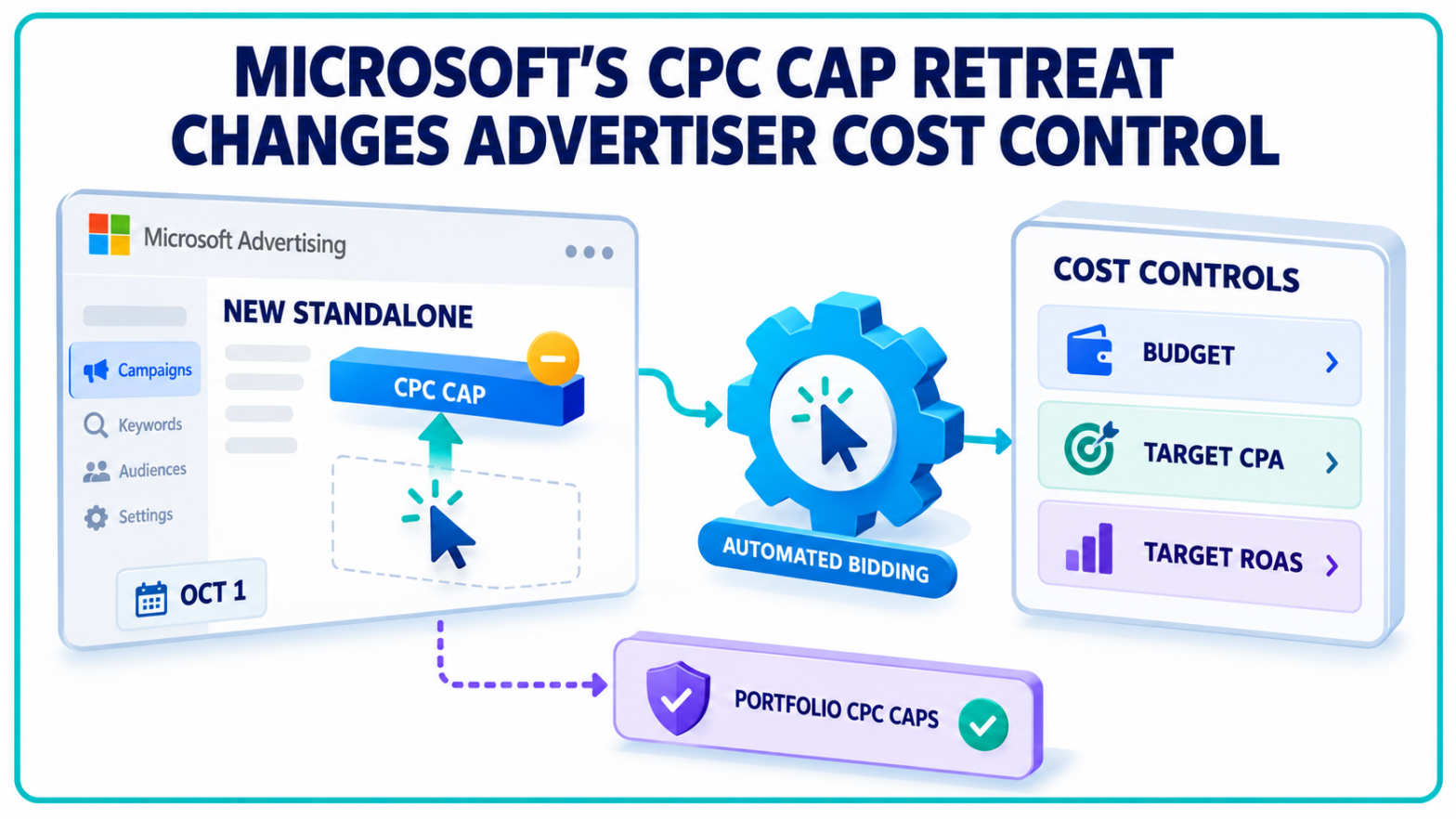
Microsoft is removing a price ceiling from campaigns that already let software set their bids. Starting October 1, 2026, selected new standalone campaigns will lose the option to limit the cost of an individual click.
The change narrows an advertiser’s control within automated bidding. It does not mark a platform-wide shutdown of manual bidding, nor does it immediately remove every existing Max CPC setting.
Microsoft’s advertiser notice, updated September 7, identifies its online interface and Advertising Editor as the first affected creation routes. The company recommends budgets, acquisition-cost targets, return-on-ad-spend targets and conversion value rules as the controls more directly connected to business outcomes.
For advertisers, the distinction is financial: a target for campaign efficiency does a different job from a ceiling on a single click.
Microsoft Advertising Draws a Line Between Old and New Campaigns
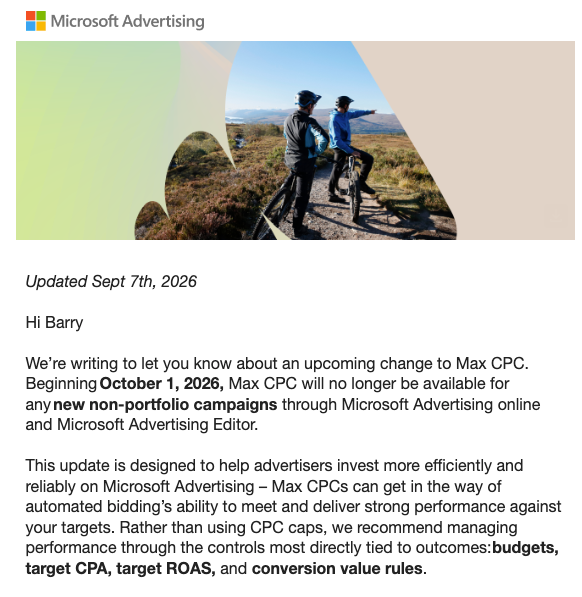
The affected standalone strategies include Maximize Clicks, Maximize Conversions and Maximize Conversion Value, with the updated communication also covering Target CPA and Target ROAS.
Campaigns already using Max CPC before October 1 can retain it. After that date, however, removing an existing cap is irreversible: advertisers will not be able to add it back. The transition also includes a January 12 deadline for API users, tool providers and Google Import, covering new campaigns and existing campaigns not already using the setting.
That makes a settings change more consequential than an ordinary bid adjustment. Keeping a functioning campaign and rebuilding it are no longer equivalent ways to preserve its cost controls.
The earlier Microsoft Advertising announcement established that existing campaigns would retain the feature. The additional restriction on restoring a removed cap matters to teams evaluating whether to test without it.
Microsoft’s original customer notice also preserves Max CPC for portfolio strategies. The policy leaves different configurations available within the same account.
A Target CPA Cannot Replace a Click Ceiling
Max CPC and target CPA constrain different parts of advertising economics.
Microsoft’s Maximize Clicks documentation describes a system that automatically sets bids to obtain as many clicks as possible within a budget. The optional CPC limit adds a maximum price for an individual click. Removing that setting leaves the strategy automated, with fewer restrictions on the prices it can pursue.
Target CPA instead gives the system an average acquisition-cost objective. Microsoft’s Target CPA definition explicitly allows individual conversions to cost more or less than the target while the system works toward the average.
A hypothetical $50 acquisition target therefore does not imply a $50 ceiling for every conversion, much less a particular ceiling for each click. A costly click can still contribute to an acceptable average if enough of the resulting traffic converts.
Target ROAS shifts the objective again, toward conversion value relative to advertising spend. Microsoft documents Maximize Conversion Value as automated bidding within a budget, with an optional ROAS target.
These are performance objectives. They are not interchangeable price limits.
Portfolio Bidding Retains a Different Set of Controls
The portfolio exception keeps a route to CPC limits within automated bidding.
Portfolio bidding manages campaigns under a shared strategy. Microsoft’s technical description says the system adjusts bids across campaigns working toward the same goal, balancing performance across the portfolio.
That is a substantive account structure, not simply another location for the same campaign setting. Campaigns contribute to a shared optimization objective, and supported combinations depend on campaign and strategy types. Microsoft advises using complementary budgets and a common goal.
Target Impression Share and enhanced CPC also remain outside the announced restriction, according to product liaison Navah Hopkins’s clarification. Their mechanics still need to be understood separately.
In particular, enhanced CPC starts with advertiser-set ad group or keyword bids and adjusts them at auction time. Microsoft says it aims to keep average CPC from exceeding the bid over time. That average-based behaviour should not be described as a hard ceiling on every individual click.
The available alternatives consequently differ in both optimization objective and the way advertiser inputs influence bidding.
Conversion Tracking Determines What the Targets Represent
An acquisition target only has meaning in relation to the event being counted.
Microsoft’s bidding guide requires conversion tracking for conversion-based strategies and supports offline conversions. Revenue-based bidding additionally needs revenue information. The system cannot evaluate a sales objective from click volume alone.
For a lead-generation business, an enquiry and a completed sale are different outcomes. A campaign reporting inexpensive enquiries can satisfy its configured objective even when few become customers. Retail accounts face a related distinction between transaction revenue and business profit.
That places conversion tracking at the centre of how advertisers interpret automated results. A lower reported CPA is meaningful only when the conversion definition remains comparable. Changes to recorded revenue can likewise alter reported ROAS without a matching change in underlying trading performance.
In practice, marketers assessing the transition compare spend, conversion volume, qualified outcomes and value together, while recording changes to bidding and measurement. An increase in average CPC alone does not establish that automation performed worse; a lower CPA alone does not establish that customer acquisition improved.
Campaign Budgets Still Govern Spending at a Different Level
The removal of a click cap leaves the campaign budget in place. It does not turn that budget into a substitute per-click maximum.
Microsoft’s budget documentation distinguishes daily targets from actual daily spending, which can fluctuate with traffic and delivery. For standard daily budgets, it also describes a calculated monthly limit. Advertisers evaluating cost exposure therefore need to distinguish the price of a click, average conversion efficiency and total campaign spending.
Microsoft’s stated rationale is that CPC limits can obstruct automated bidding from pursuing performance targets. Its notice directs advertisers toward outcome-based settings; it does not establish that removing a cap will improve every campaign.
The first implementation date is October 1 for the online interface and Advertising Editor. Existing qualifying caps remain supported, but a retained cap removed after the deadline cannot be restored.