
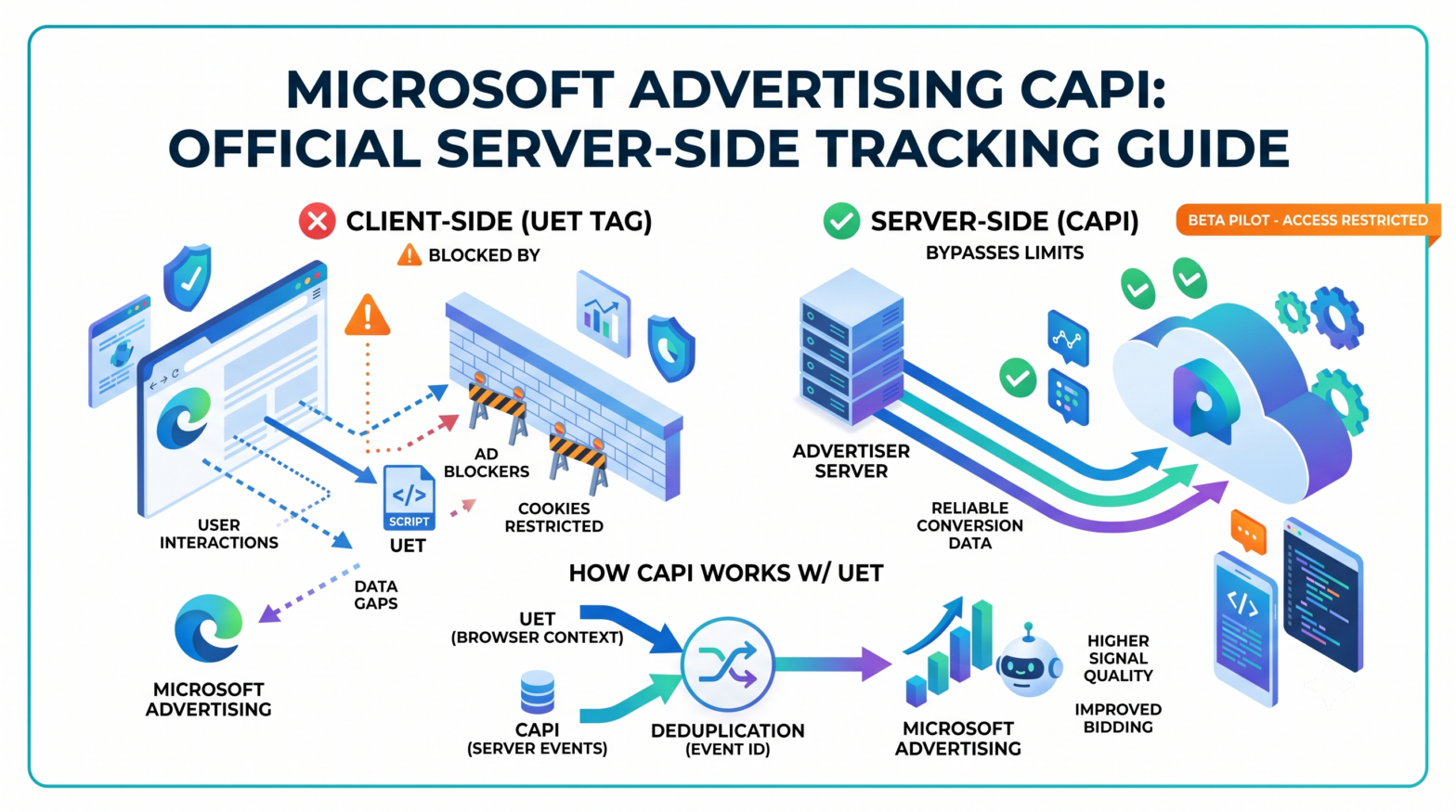
Microsoft Advertising advertisers now have an official technical reference for sending conversion data directly from their servers, bypassing the browser-based tracking methods that ad blockers and privacy controls increasingly disrupt. Microsoft published full documentation for its Conversions API (CAPI) on Microsoft Learn, formalizing a server-side measurement solution that remains in beta and is not yet available to all accounts.
What the Conversions API Does
CAPI is Microsoft Advertising's server-side solution for sending conversion and customer interaction data directly from an advertiser's systems to Microsoft Advertising. Advertisers can use CAPI to send website events, CRM events, offline sales transactions, and mobile events through one setup, supporting multiple measurement scenarios with a single connection.
The tool enables advertisers to send conversion and engagement events directly from their servers using Universal Event Tracking (UET). By moving conversion tracking server-side, CAPI helps ensure more reliable measurement when browser restrictions, privacy controls, or ad blockers limit client-side tracking.
The published documentation on Microsoft Learn outlines the full implementation process, including endpoint configuration, payload requirements, authorization token setup, and troubleshooting guidance.
How CAPI Works Alongside UET
Microsoft's documentation is explicit that CAPI is not a replacement for Universal Event Tracking. Microsoft recommends using CAPI with UET whenever possible. UET captures browser-based activity and page context, while CAPI provides a server-side path for sending additional events and details that occur after UET fires.
While most advertisers use the standard UET JavaScript tag for ease of implementation and advanced features, the Conversions API provides an alternative or complementary option for scenarios where JavaScript cannot be used.
When both systems are in use simultaneously, deduplication becomes a required consideration. When the same conversion can be sent by both UET and CAPI, Microsoft instructs advertisers to use a shared `eventId` so Microsoft Advertising can avoid double-counting.
Access Is Restricted to a Pilot Program
CAPI cannot be enabled directly from the UET tag settings by end users. Access to the Conversions API is currently in a pilot program and must be provisioned for the account by Microsoft. Advertisers must contact the Microsoft Advertising account manager or Microsoft Advertising support and request enrollment in the Conversions API pilot for their specific customer account.
While CAPI requires more engineering effort than UET JavaScript, it offers greater control, resilience to browser changes, and a future-ready approach to conversion tracking.
Three Implementation Paths
The documentation specifies three ways advertisers can send data to CAPI. The first is a direct API build, suited to organizations with engineering resources that need to send events from backend systems in real time or in batches. The second is through partner integrations. CAPI supports website, CRM, offline, mobile, and dynamic remarketing scenarios. Named partner integrations currently documented include Commanders Act, Freshpaint, Invoca, MetaRouter, Segment/Twilio, Stape.io, and Tealium, with Adobe Real-Time CDP and Switch Growth listed as coming soon. The third path uses a tag manager or server-side tag manager environment for web-focused advertisers seeking faster setup with less custom development.
Signal Requirements and Attribution
The documentation places particular emphasis on identifier quality. Advertisers are directed to capture and store Microsoft's click identifier, the `msclkid`, in a first-party cookie or server-side store with a recommended retention period of 90 days. To maximize measurement quality, advertisers should consistently send visitor IDs, the most recent Microsoft Click ID (msclkid), and, when available, hashed email and phone data.
ID Sync, a client-side pixel that connects an advertiser's anonymous visitor identifier to Microsoft identifiers, is required for dynamic remarketing use cases and strongly recommended for conversion measurement quality. The documentation specifies that the anonymous visitor ID used in ID Sync must match the identifier sent in CAPI events.
The API accepts events uploaded individually or in batches of up to 1,000. Real-time delivery is the recommended approach. Events older than seven days are rejected as invalid.
Practical Implications for Advertisers
Advertisers already running server-side measurement through Meta's Conversions API, Google's Enhanced Conversions, or similar solutions will recognize the same structural pattern here. Server-to-server event delivery improves data completeness and bidding signal quality by capturing conversions that ad blockers, ITP, and cookie consent restrictions would otherwise block. However, teams without in-house engineering capacity will face a more involved implementation than a standard browser tag. Those using an existing customer data platform or a supported partner connector may find the integration considerably more accessible. The pilot restriction also means advertisers cannot self-serve access and must contact Microsoft directly to be enrolled.
Microsoft's Conversions API is currently in beta and being rolled out to select advertisers. Access is not yet universally available, and the feature set is actively evolving.