

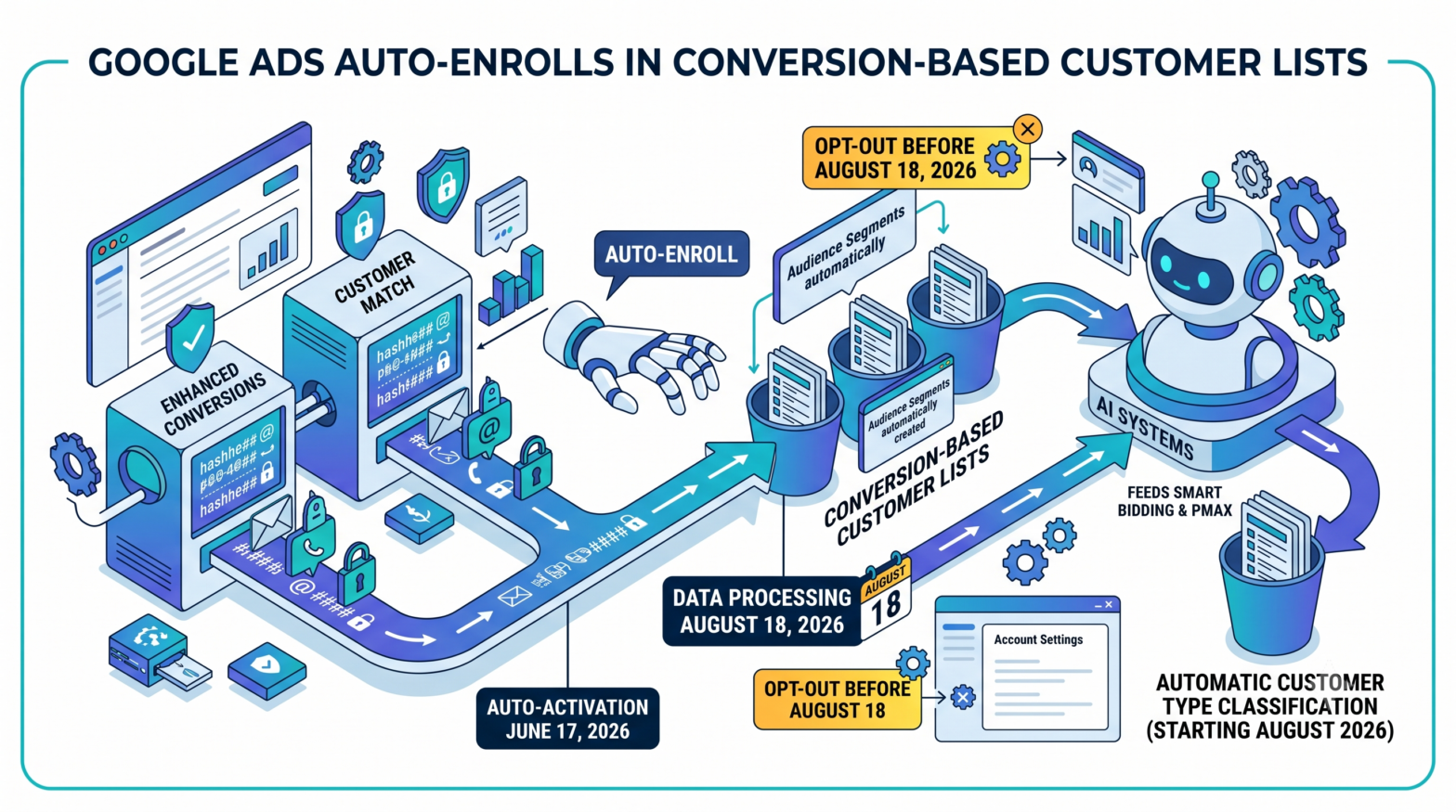
Google Ads accounts that already use both Enhanced Conversions and Customer Match are being automatically enrolled in a new audience-building feature without any required action from advertisers. Google notified affected advertisers by email that conversion-based customer lists will be turned on beginning June 17, 2026, with data processing set to begin on August 18, 2026.

Who Is Affected
The update applies to advertisers already using both Enhanced Conversions and Customer Match, but who have not yet activated conversion-based customer lists. Accounts that have already opted into the feature are not affected by the automatic rollout. Google's email communication to affected advertisers states the feature will be turned on to help maximize the value and performance of first-party data, and that no action is required to activate it.
How the Feature Works
Conversion-based customer lists are a feature that simplifies Customer Match setup, automatically creating audience segments for each conversion goal where Enhanced Conversions are active. Enhanced Conversions sends hashed first-party user-provided data from an advertiser's website to Google in a privacy-safe manner, and when conversion-based customer lists are configured, that same hashed data is also used to build a customer list.
The feature simplifies the path to measuring and activating first-party data, as conversion-based audience lists are automatically available in Audience Manager once enabled. Advertisers can then choose whether to attach those audiences to campaigns and ad groups as part of their targeting strategy.
The August 18 Data Processing Deadline
The automatic activation of conversion-based customer lists begins June 17, 2026, with data processing for those lists starting on August 18, 2026, making the feature fully operational at that point. The two-stage timeline gives advertisers a window to review their settings before any conversion data is actually processed into audience lists.
This rollout is the second in a pair of related changes Google has made to conversion-based customer lists in the same week. Earlier, Google separately announced that it is removing a layer of advertiser control over Customer Match audience classification by automatically assigning customer types to conversion-based lists starting in August 2026, meaning advertisers will no longer be able to leave eligible lists unclassified.
Opt-Out Option and Deadline
Advertisers who do not want the feature active have a defined window to act. Conversion-based customer lists can be turned off within account settings before August 18, 2026, for those who do not want this enabled. The opt-out is located in the Customer Match section under Account Settings in the Admin menu. Once August 18 passes and data processing begins, the opt-out window closes.
Privacy and Data Handling
Conversion-based customer lists use hashed user-provided data collected at conversion events to build audience segments tied to specific conversion goals. Once enabled, audience segments for each conversion goal appear in Audience Manager and can be attached to campaigns and ad groups. Although the lists rely on hashed first-party data, advertisers remain responsible for collecting data lawfully and obtaining appropriate consent.
Implications for Campaign Management
For advertisers who retain the feature, the automatically generated lists will feed into Google's AI-driven systems. Because these lists feed audience signals used by Smart Bidding and Performance Max, they can influence automated bidding and campaign outcomes. Using Customer Match improves Smart Bidding and allows the use of customer lifecycle optimization, such as new customer acquisition goals in Performance Max campaigns. Advertisers who keep the feature active should verify that their Enhanced Conversions implementation is correctly configured and that conversion tracking is accurate before August 18, since inaccurately tracked conversions would populate the automatically generated lists with incorrect audience data.
Beginning in August 2026, Google Ads will automatically assign conversion-based customer lists to one of several customer types, and the company is encouraging advertisers to review and update their audience classifications in Audience Manager before the change takes effect.