
Microsoft wants advertisers to tell its bidding system what a conversion is worth, then get out of the way.
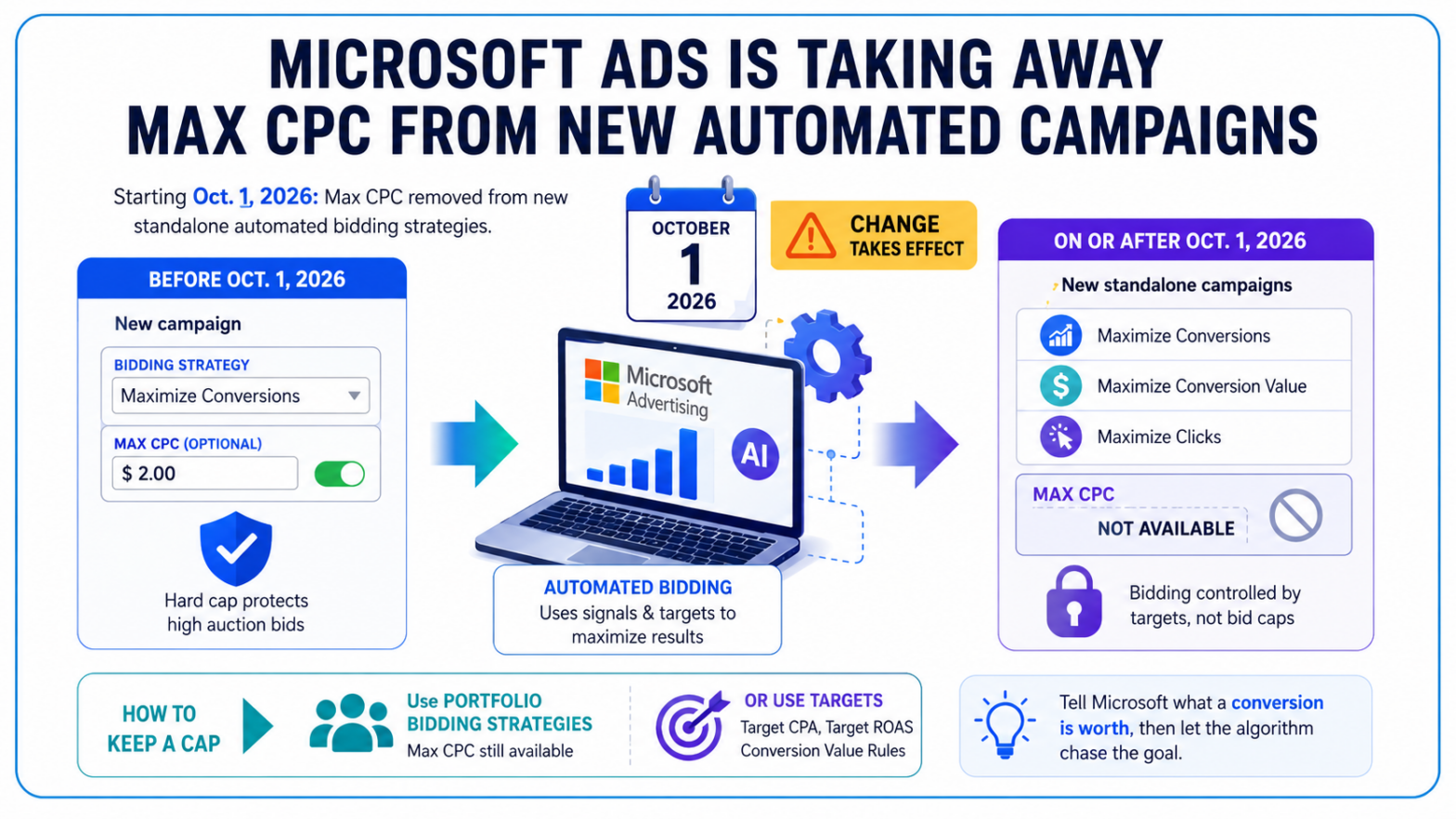
Starting October 1, 2026, that will become more literal. Microsoft Advertising is removing the option to set a maximum cost-per-click limit when advertisers create new campaigns using several standalone automated bidding strategies. Existing campaigns can keep their caps, but one familiar safeguard will disappear from much of the new-campaign workflow.
For advertisers that have used Max CPC as an emergency brake on expensive auctions, the change shifts a meaningful piece of control from the account manager to Microsoft's bidding algorithm.
Max CPC Disappears From Three Standalone Strategies
Microsoft Advertising Ads Liaison Navah Hopkins confirmed that the change takes effect October 1.
New campaigns using standalone Maximize Conversions, Maximize Conversion Value and Maximize Clicks bidding will no longer allow advertisers to add a Max CPC ceiling. Hopkins said existing campaigns that already have one will retain it, while portfolio bidding strategies will continue supporting the control. Target Impression Share and Enhanced CPC will also keep the option.
The distinction between existing and new campaigns matters.
Microsoft is not stripping bid limits from accounts overnight. Campaigns already running with Max CPC do not need an immediate migration. The restriction appears when advertisers build a new qualifying standalone campaign after the October deadline.
That makes this the latest step in a broader shift toward Microsoft Advertising's AI Max rollout (TechWyse), where machine learning is taking responsibility for more of the decisions that once sat directly with paid search managers.
Microsoft's rationale is straightforward. According to Hopkins, advertisers using conversion-based bidding with Target CPA or Target ROAS are having an easier time reaching their stated goals than advertisers relying on older controls.
Her explanation was unusually direct:
“Max CPCs override stated goals and can lead to spend pacing irregularities.”
In Microsoft's view, telling an algorithm to maximize conversions while simultaneously preventing it from bidding above a fixed amount can send conflicting instructions.
After October 1, fewer new campaigns will be able to resolve that conflict by simply imposing a ceiling.
A Click Can Now Cost More Than the Advertiser Would Have Allowed
Max CPC serves a simple function: regardless of what an automated bidding system believes an auction is worth, the advertiser can place an upper boundary on the bid.
Removing that boundary does not mean CPCs will automatically surge. It does mean a new standalone campaign can enter auctions at bid levels that would previously have been blocked by an advertiser's cap.
That is an important distinction.
An advertiser that historically refused to pay more than $8 for a click could set $8 as the limit. Under the affected strategies, that same new campaign will instead depend on budget settings, conversion signals and performance targets to influence how aggressively Microsoft bids.
Microsoft is effectively asking advertisers to manage economic risk through outcomes rather than auction-level price controls.
The platform has been moving in this direction for months. In March, Microsoft consolidated Target CPA and Target ROAS into optional targets within Maximize Conversions and Maximize Conversion Value for new campaigns, while leaving existing campaigns unchanged.
That earlier change simplified the bidding menu. Removing Max CPC goes further because it eliminates a control rather than reorganizing how a target is selected.
The change is unlikely to affect every account equally. Campaigns with large volumes of reliable conversion data can give an automated system substantially more information about which clicks are worth pursuing. Smaller campaigns, new accounts and advertisers with sparse conversion histories have less historical information feeding those decisions.
In those situations, a hard CPC ceiling has often functioned as protection while the campaign builds data.
That protection will now require a different campaign structure if advertisers want to preserve it.
Microsoft Wants Targets to Replace Bid Ceilings
Microsoft is not eliminating advertiser controls altogether.
Hopkins is steering advertisers toward Target CPA, Target ROAS and conversion value rules as the preferred ways to communicate business constraints to the bidding system.
The difference is where the control operates.
A Max CPC tells Microsoft what it cannot pay for a single click. Target CPA tells the system what acquisition economics the advertiser is trying to achieve across conversions. Target ROAS does the same thing around conversion value and return.
Those are not interchangeable guardrails.
A campaign can temporarily pay substantially more for an individual click while still attempting to hit a broader CPA or ROAS objective over time. The advertiser gives up certainty over the price of one auction in exchange for giving the bidding model more freedom to pursue the larger performance target.
Microsoft has already been expanding the infrastructure around this type of automated bidding; check out: Microsoft's cross-account portfolio bidding update on TechWyse. Its May update introduced cross-account portfolio bidding for Search and Shopping campaigns, allowing automated strategies to pool signals across multiple accounts. Microsoft also added average Target CPA, Target ROAS and Target Impression Share metrics to bid strategy reports.
The pattern is consistent: Microsoft is giving advertisers more ways to steer toward business outcomes while reducing emphasis on controlling individual bids.
Portfolio Bidding Becomes the Escape Hatch
Advertisers that still need a hard ceiling are not completely boxed in.
Portfolio bidding strategies will continue allowing Max CPC after October 1, according to Hopkins. That creates a clear route for teams whose governance rules, economics or internal policies require a maximum allowable bid.
Portfolio strategies are designed to manage bidding across groups of campaigns that share an objective. Microsoft expanded them earlier this year with cross-account functionality, allowing strategies to pool learning across campaigns in multiple accounts.
That option makes the October change less absolute than it initially appears.
Still, it changes the default architecture. An advertiser will no longer be able to create every qualifying standalone campaign, select an automated strategy and add a CPC ceiling as an extra layer of protection. Maintaining that protection may require using a portfolio strategy instead.
This also creates an interesting contrast with TechWyse's coverage of Microsoft's AI Max launch.
Microsoft has spent much of 2026 emphasizing that its AI-powered advertising products will come with controls and reporting. AI Max, for example, includes brand exclusions, term exclusions and URL rules designed to constrain how automation expands targeting and landing-page selection.
With bidding, however, Microsoft is removing one of the oldest and clearest constraints from new standalone campaigns.
Conversion Tracking Now Carries More Weight
For paid search teams, the practical consequence is not simply that bids could become higher.
The quality of the signals controlling those bids becomes more consequential.
A Target CPA is only useful if the conversion action being optimized reflects an outcome the business actually values. A campaign optimizing toward poorly configured lead events, duplicate conversions or low-value actions can still become efficient at producing the wrong result.
The same applies to Target ROAS. Conversion values need to communicate meaningful economic differences if Microsoft is expected to use them as a substitute for tighter bid restrictions.
That makes the removal of Max CPC partly a measurement story.
Microsoft has explicitly linked its bidding investments to improvements in measurement, and the company is encouraging advertisers to use conversion value rules where appropriate rather than relying on a bid ceiling.
Advertisers preparing new campaigns after October 1 will therefore need to decide whether outcome-based controls provide enough protection for the account or whether a portfolio strategy is necessary to retain a hard limit.
Existing campaigns with Max CPC can remain where they are. Hopkins has also encouraged advertisers to test removing the caps through optimization experiments before the deadline to see how campaign performance changes.
Microsoft has not removed every manual lever from paid search.
But for new standalone automated campaigns, one of the simplest ones is about to become unavailable.