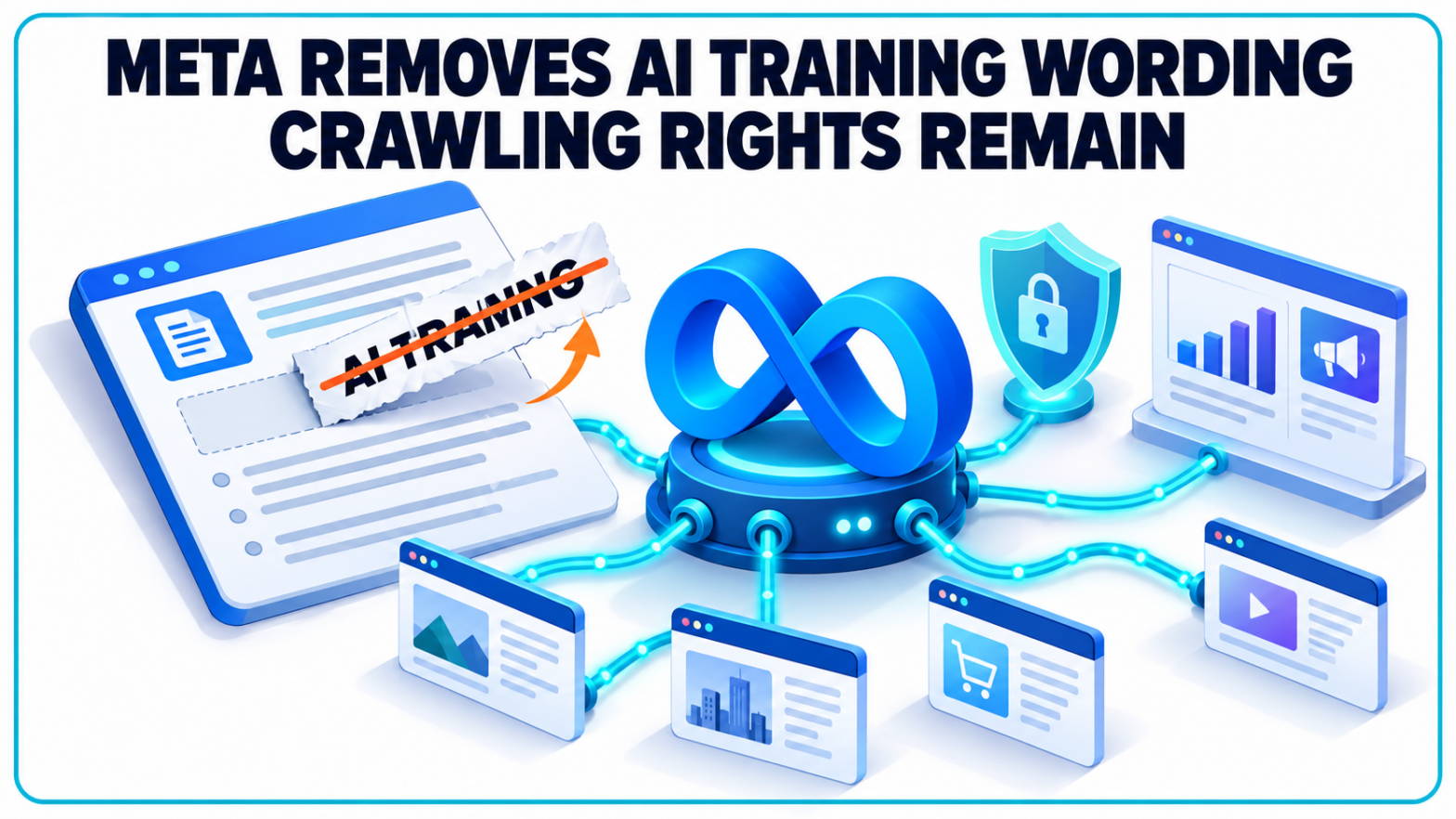
One disputed word is gone. The website-access permission Meta is asking businesses to grant remains firmly in place.
Meta has revised the commercial terms scheduled to take effect on October 30, 2026, removing an explicit reference to training its products with content collected from business-associated websites. The amended clause still authorizes extensive automated crawling for advertising, business products, security and platform integrity.
Meta Narrowed the Purpose, Not the Crawling Permission
An earlier preview of the updated Meta Commercial Terms authorized the company and entities acting on its behalf to use scrapers, bots, crawlers and other automated software to access websites associated with a business’s products or services.
That permission covered indexing, caching, analyzing, collecting and retrieving content. It also allowed Meta to create test credentials and periodically pull updates from the affected domains, pages and URLs.
A separate sentence said Meta could use the collected material to provide, develop, improve, research and train its products, services and features. That sentence triggered concern among publishers and other businesses whose websites contain copyrighted material.
Meta’s revision removes the word “train” and no longer says the company may use “any content” for that list of purposes. Crawling is now tied more specifically to providing, developing, improving, researching and maintaining advertising and business products. The clause also covers maintaining the integrity and security of Meta products.
That is a meaningful reduction in the purposes expressly named in the agreement. It is not a withdrawal of the underlying website-access permission.
The revised wording does not say that crawled content will never be used in AI-supported business products. At the same time, the remaining words “develop,” “improve,” and “research” cannot be treated as proof that Meta intends to use the material as training data. The contract leaves that boundary unresolved.
The Terms Reach Far Beyond Businesses Buying Meta Ads
The audience covered by the update is much larger than Meta’s advertiser base.
The agreement applies when Meta products are used for a business or commercial purpose. Its examples include running ads, sending marketing messages, selling or listing products, developing apps, managing a product catalogue, operating a Page or business Group, using Meta Business Suite and accessing measurement services.
A company does not need to be spending money in Ads Manager to fall within that definition. A publisher maintaining a Facebook Page or a retailer operating a catalogue can be subject to the same commercial agreement.
Meta’s currently effective Commercial Terms, dated March 6, 2024, do not contain this broad crawling paragraph. Similar permissions already existed in narrower supplemental agreements, including terms governing self-serve advertising.
An official Meta notice about the October consolidation says the company is moving provisions from its Product Catalog Terms into the Commercial Terms. Conditions for generative AI ad tools are also being incorporated into the updated Self-Serve Ad Terms.
Meta has characterized the change as a consolidation and clarification rather than a new crawling practice. Continued commercial use after the update takes effect constitutes acceptance under the agreement. The terms do not provide a way to reject only the crawling paragraph while continuing to use the covered products for business.
AI Web Crawling Still Involves Several Different Meta Bots
The debate can easily collapse three separate questions into one: whether Meta may access a page, which crawler performs that access and how the collected information may be used.
AI web crawling is not a single-purpose activity. A bot may collect information for model development, live AI answers, link previews, advertising systems or a task initiated by a user.
Meta’s web crawler documentation reflects those distinctions. Meta-ExternalAgent is associated with foundation-model training and direct content indexing. Meta-ExternalAds supports advertising and other business-related products, while Meta-WebIndexer is used for Meta AI search. Other agents handle shared-link previews and user-requested page retrieval.
Each has its own identifier. A robots.txt rule addressing one crawler does not automatically control the others.
Meta says content owners can use robots.txt to express their preferences and that the revised commercial language does not supersede those signals. The Commercial Terms themselves do not mention robots.txt, however. Meta’s documentation also says some user-requested fetching and certain security or integrity checks may bypass robots.txt restrictions.
The contractual permission and the technical instruction therefore operate at different layers. One governs the relationship between Meta and a commercial user. The other tells automated agents which parts of a site a publisher wants them to access.
Marketers Need to Separate Training, Ads and Search Access
For marketing and SEO teams, the practical work is a crawler-by-crawler review. Teams need to identify which websites and landing pages are connected to Meta Pages, catalogues, ads and measurement products, then compare their robots.txt rules with the Meta agents appearing in server logs.
A blanket block may restrict more than AI training crawlers. It could also affect Meta’s ability to read advertising destinations, build link previews or surface a website in AI-assisted discovery. Allowing every Meta agent carries a different trade-off, particularly for organizations publishing licensed, subscriber-funded or proprietary material.
Paid media, SEO, publishing and legal teams may consequently need to treat access and downstream content use as separate decisions. The revised contract narrows the stated purpose, but it does not replace the technical controls that determine which automated systems can reach individual pages.
Publisher Content Rights Remain the Central Dispute
Publisher opposition began before Meta revised the clause. In an October 16 statement, the News/Media Alliance objected to the original Commercial Terms, arguing that businesses should not have to grant broad content-scraping rights to retain access to Meta’s audience.
The deletion of “train” addresses part of that complaint. It does not settle the wider issue of how platforms collect, reuse and derive commercial value from material hosted elsewhere.
That debate increasingly extends beyond blocking bots. Emerging publisher content rights arrangements elsewhere in the market separate crawling, attribution, licensing and compensation into distinct questions. Meta’s revised clause does not describe a payment model or a separate content-licensing programme for affected businesses.
As of October 21, the revised preview still preserves Meta’s permission to crawl associated websites, create test credentials and retrieve updates periodically. That document is scheduled to replace the current Commercial Terms on October 30, 2026.