

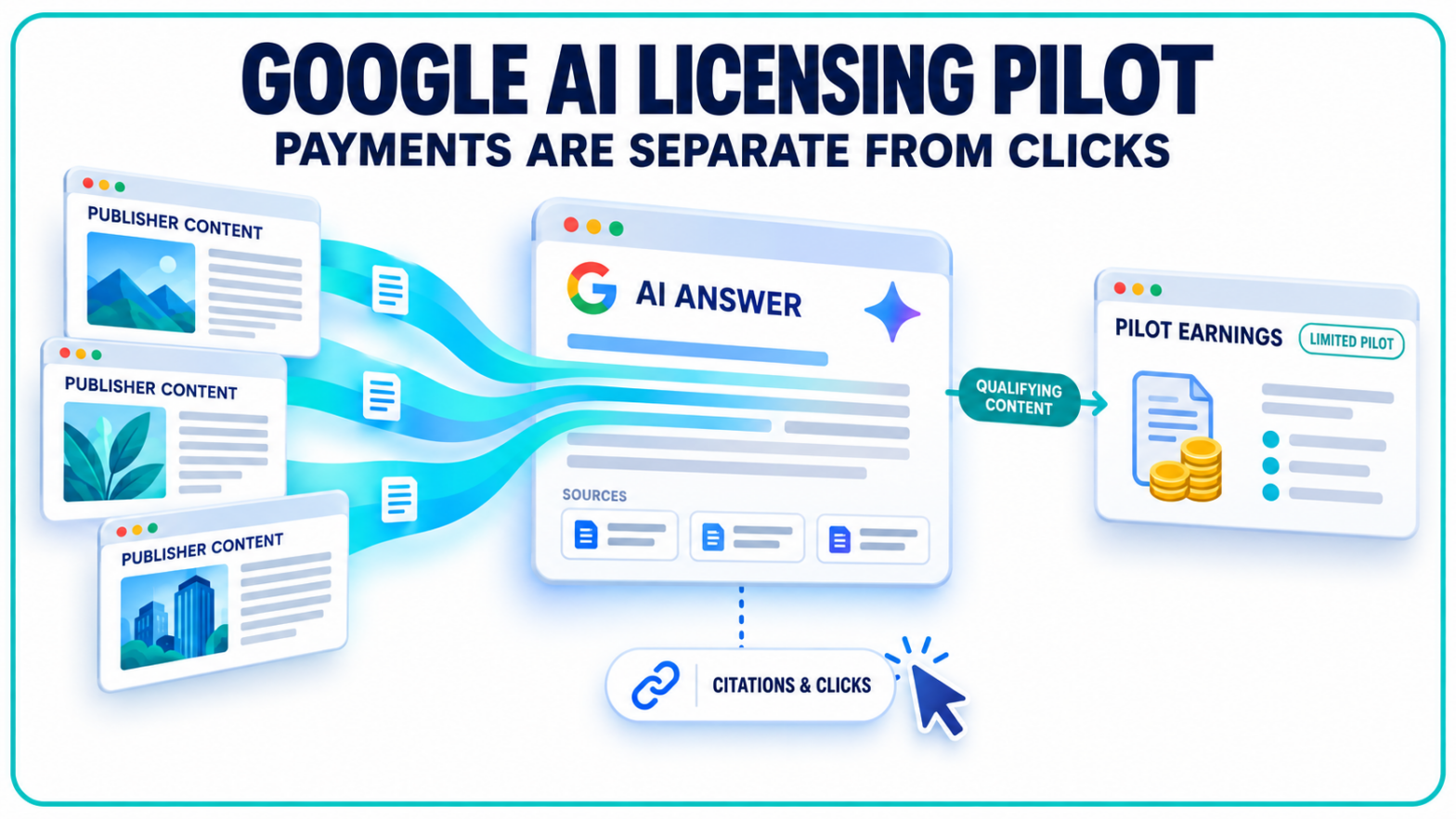
A publisher’s content can appear in Google’s AI answers without sending a reader to its website. Google is now testing a payment model for some of that content, but earning a citation and earning money are different things.
The limited AI contribution pilot covers participating publishers whose work significantly influences responses in AI Overviews, AI Mode and the Gemini app. Details emerging on September 14 show a programme built around Google’s assessment of content value, with earnings managed through Search Console.
The immediate question for publishers is what qualifies for payment. The pilot’s documentation draws a narrower boundary than simply being referenced by an AI system.
An AI Overviews Citation Does Not Automatically Earn Money
The distinction centres on when content contributes to an answer.
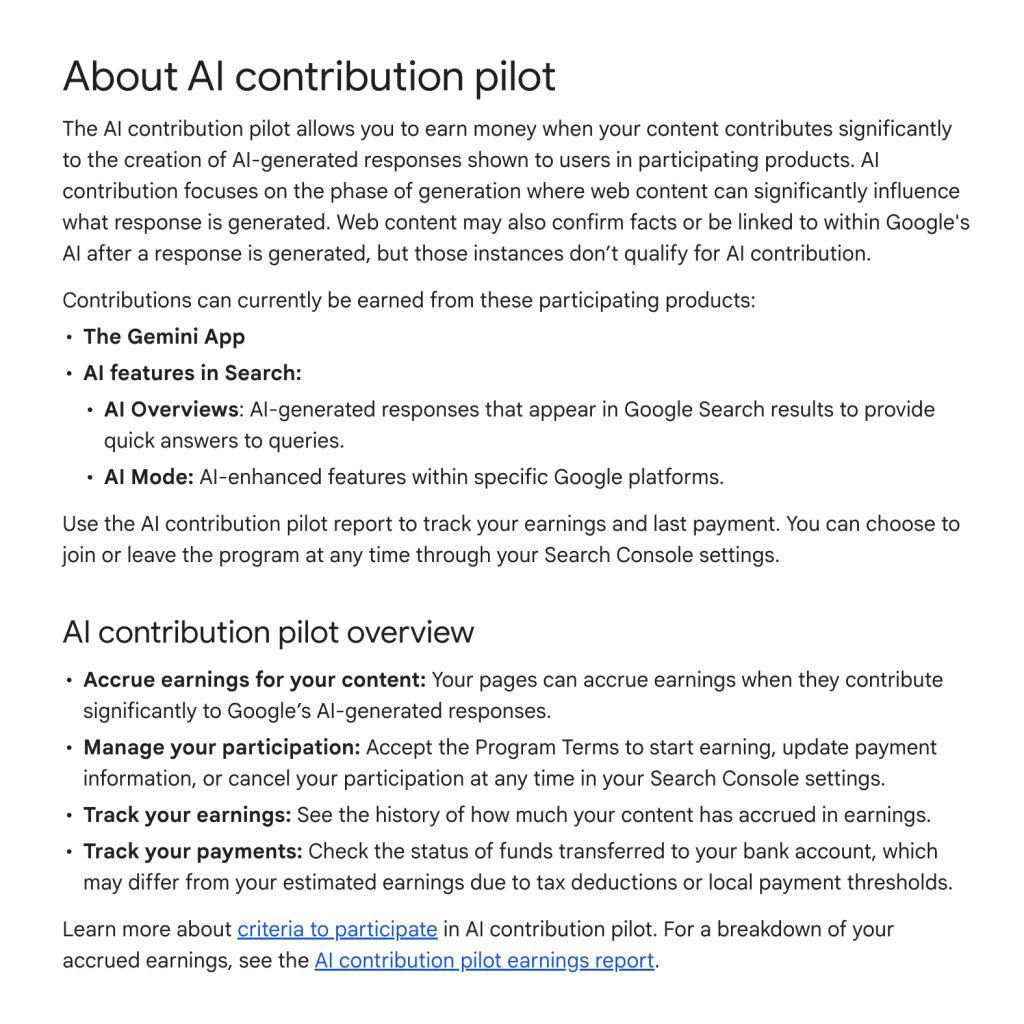
According to Google’s pilot documentation, visible in a circulated screenshot, qualifying content significantly influences the response during generation. Material used to confirm facts or linked after a response has already been generated does not qualify.
For publishers tracking appearances in AI Overviews, that creates a gap between visible attribution and payable use. A supporting link alone cannot establish that Google counted the underlying page as a paid contribution.
Google had publicly outlined the broader direction in June. In its June 18 statement on the information ecosystem, the company described a pilot extending beyond news to websites that help keep generated answers current and factual through grounding.
Grounding connects an AI response to retrieved information. Google’s Search Central guide explains that its systems retrieve relevant pages from the Search index and review their information to produce more reliable answers.
That process gives web content a role in constructing the response, even before a user decides whether to follow a link.
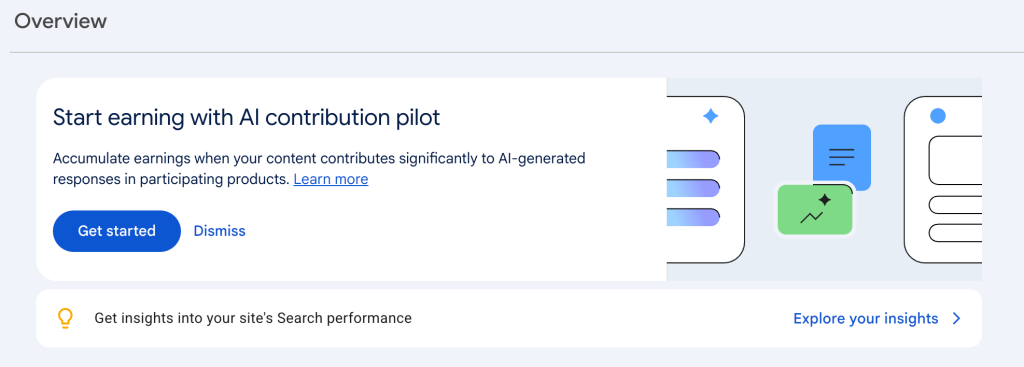
Google Search Console Adds an Earnings Record
For participating publishers, the pilot introduces a commercial function inside a tool generally used to monitor search performance.
The documentation describes an earnings report, payment tracking and account settings for accepting programme terms, updating payment information or ending participation. Estimated earnings and bank payments can differ because of tax deductions or local payment thresholds.
Those records sit alongside the wider expansion of Google Search Console into AI measurement. They serve a separate purpose.
Google confirmed in an August 31 update that its generative AI performance insights and Search participation control had reached websites worldwide. The performance insights include impressions, pages appearing in AI responses and the countries where those appearances occur.
The licensing pilot remains limited. Access to worldwide AI reporting does not establish access to publisher payments.
A further distinction concerns the figures themselves. Performance reporting records exposure. Earnings reporting records money attributed to qualifying contributions. Neither figure, on its own, measures how much revenue a publisher earns from readers who subsequently visit its site.
AI Search Visibility and Referral Revenue Answer Different Questions
The payment experiment arrives as publishers gain more information about where Google uses their pages.
Google’s August update put AI Overviews at more than 2.5 billion monthly active users and AI Mode above one billion. These are Google’s reported audience figures, rather than counts of publisher visits or compensated responses.
The scale explains the relevance of measuring AI search visibility. It does not establish the financial value of any individual appearance.
For a publisher, referral traffic supports several familiar revenue paths: advertising on the page, subscriptions, affiliate transactions and other conversions. A licensing payment creates a separate source of income. Assessing its contribution to the business requires comparing actual earnings with those existing outcomes, rather than assigning a cash value to every AI impression.
In practice, marketing and SEO teams can keep AI exposure, referral visits, conversions and licensing receipts as separate measures in reporting. That allows an increase in content use to be assessed alongside audience and revenue changes without counting the same activity as both a visit and a payment.
Google’s public materials do not establish a universal payment rate for each citation. Nor do they demonstrate that pilot income offsets any particular publisher’s traffic losses.
Google’s News Deals Follow a Different Model
AI contribution also sits within a broader set of Google publishing arrangements, making the programme boundaries important.
In December 2025, Google introduced a commercial pilot with news publishers including The Guardian, The Washington Post and Der Spiegel. The announcement described partnerships involving extended display rights and content delivery methods such as APIs.
Experiments included AI article overviews on participating publishers’ Google News pages and audio briefings, with attribution and links to articles. Google also described partnerships supplying current information for Gemini.
By June, Google said that News AI pilot included more than 200 publications worldwide. Its public statement separately listed the broader grounding collaboration, European press-content payments and Google News Showcase.
The publication counts attached to those established arrangements are not a confirmed participant total for AI contribution.
The distinction also limits what can be inferred about access. A named partner in a news programme is not automatically a confirmed participant in the contribution-based payment test.
Publishers Have Separate Controls for AI Participation
Payment eligibility is only one part of a publisher’s relationship with Google’s AI products.
Website owners can use the Search Console control to manage participation in generative Search features. Google says opting out removes traffic and impressions from those experiences, while the setting is not used as a ranking signal outside generative Search.
Gemini has another relevant control. Google’s crawler documentation describes Google-Extended as governing specified uses of crawled content for future Gemini model training and grounding in Gemini Apps and Vertex AI. It does not affect inclusion or ranking in Google Search.
These controls address content use across different products. The AI contribution pilot adds commercial terms for eligible participants.
As of September 15, Google has not publicly confirmed a general launch date or a complete participant count for AI contribution. Its publicly accessible announcement describes a pilot, while the available programme documentation leaves joining and leaving to participating publishers through Search Console settings.