

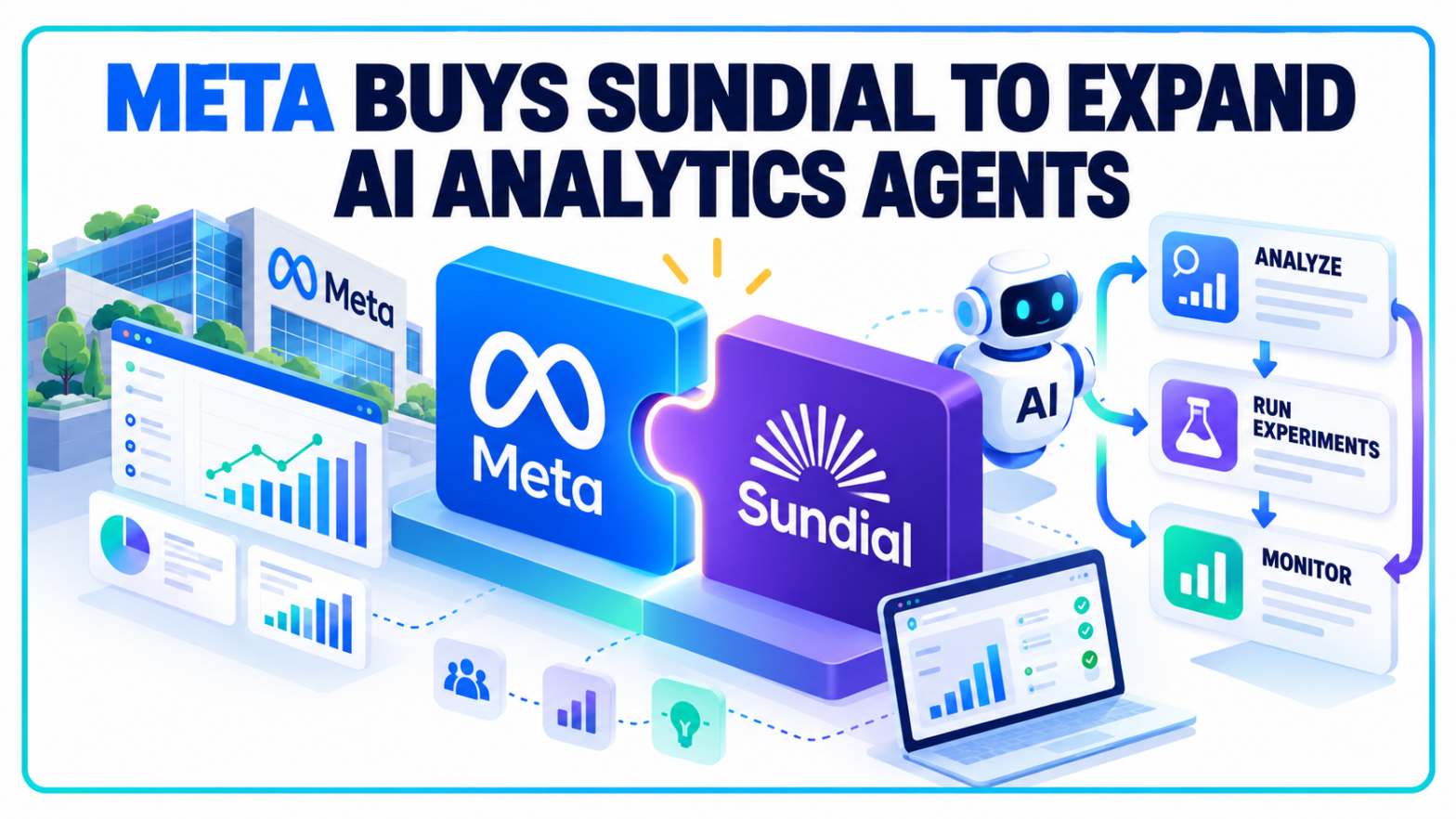
Meta wants artificial intelligence doing more than answering questions about its business. It wants AI helping decide which questions to ask, which experiments to run and when the results require action.
The company has acquired Sundial, an AI-powered analytics startup built by former Meta executives Julie Zhuo and Chandra Narayanan. The deal brings Sundial's technology and team into Meta's expanding data organization, where the company is developing AI systems that can analyze information, coordinate experiments and monitor performance.
Meta confirmed the acquisition on October 23, 2026. Financial terms were not disclosed.
The acquisition comes as Meta reorganizes its internal analytics operations under chief data officer Alex Schultz, who has outlined plans to connect data analysis with automated experimentation and monitoring.
Sundial's AI Analytics Technology Is Moving Inside Meta
Sundial was founded by Zhuo, Meta's former vice president of product design, and Narayanan, who previously held analytics leadership positions at Facebook, Instagram and Sequoia Capital.
Both founders are returning to Meta, along with other Sundial employees, including John Maier, Stanley Watt and Asa Levi.
In an October 23 LinkedIn announcement, Schultz confirmed that Narayanan will lead Meta's data analytics tooling and agents work.
The team joins Meta's Data Analytics Tooling & Agents organization, known internally as DATA. Schultz took charge of the company's data strategy in July 2026 when Meta appointed him its first chief data officer.
Sundial will also stop serving external customers once the acquisition closes, shifting its focus from selling analytics software to businesses toward developing capabilities for Meta's own operations.
That makes the transaction different from buying a software company to expand a commercial product lineup.
Meta is bringing an established AI analytics team into its internal infrastructure.
Sundial had raised $23 million in funding before the acquisition, including a $16 million Series A round announced in July 2025.
Neither company has disclosed the acquisition price or a timetable for integrating Sundial's technology across Meta.
Meta Wants AI Agents to Connect Analysis, Testing and Monitoring
The most revealing part of the acquisition isn't the chatbot technology Sundial developed.
It's what Meta intends to build around it.
Schultz's announcement describes an internal AI analytics system organized around three connected capabilities: descriptive analysis, experimentation and monitoring.
Descriptive analysis would identify patterns in business data and surface questions that teams might otherwise overlook.
The experimentation component is more ambitious. Schultz describes AI proposing tests, carrying them out, interpreting the results and deciding what should happen next.
Monitoring would then identify meaningful changes in performance and feed those observations back into future analysis.
His description of the intended system was concise:
"Done right, they become one loop.”
That loop would connect activities often handled separately by analysts, product managers, engineers and experimentation teams.
A system monitoring a product feature, for example, could identify a performance change, suggest an experiment to investigate it and use the findings to inform subsequent decisions.
Schultz has described this as the direction of Meta's analytics development, not as an already completed deployment across the company.
The distinction matters because allowing AI to recommend an experiment is different from allowing it to execute changes automatically.
Meta has not specified how human approval, testing safeguards or operational oversight would work within the proposed system.
For now, the confirmed development is the acquisition of Sundial's technology and the appointment of Narayanan to lead the relevant analytics and agent work.
Sundial Built Its Platform Around More Than Chatbot Answers
Sundial's existing product explains why its technology fits Meta's plans.
According to the company's official platform documentation, Sundial uses AI agents to let employees investigate business data using natural-language questions.
Instead of requiring every department to request a report from an analytics team, employees can ask questions directly and receive explanations, supporting information and visualizations.
The software works with existing data warehouses and analytics tools. It also builds a semantic layer that connects raw data with the definitions and context a business uses to interpret its metrics.
That context is central to the platform.
Two departments might calculate the same metric differently. An AI system that doesn't understand those definitions can generate a convincing answer using the wrong interpretation.
Sundial addresses that problem through data-quality checks, shared business definitions, analytical playbooks and confidence indicators.
Its platform distinguishes between answers supported by governed definitions and those derived from less certain analysis.
The company also developed evaluation tools designed to detect errors when underlying data models or business definitions change.
Those capabilities extend beyond a conversational interface.
Sundial's September 2026 updates introduced more granular controls over which databases and metrics different user groups can access. Earlier releases added scheduled analysis routines, integrations with workplace applications and tools for inspecting how metrics are connected.
The technology is designed to support repeated analytical work, rather than generate isolated answers.
For Meta, which operates products and AI systems across multiple platforms, the ability to maintain consistent definitions and evaluate analytical accuracy is particularly relevant to Schultz's proposed experimentation system.
A flawed metric can produce an incorrect report. If an automated system uses that report to initiate another experiment, the consequences extend beyond the original calculation.
Meta's Internal AI Push Is Separate From Its Advertising Tools
The Sundial acquisition arrives during a broader expansion of Meta's AI capabilities, including tools already available to advertisers and content creators.
Earlier this year, Meta introduced additional conversational analysis features that let small businesses connect advertising and social account information to Meta AI.
Those features allow businesses to examine campaign performance and ask questions about creative effectiveness, audience behaviour and advertising budgets.
Meta has also introduced an AI analytics assistant for Instagram creators through its Edits application.
The assistant examines performance signals such as views, engagement and audience retention, then helps creators understand differences between their content.
These are customer-facing applications.
Sundial's acquisition, by contrast, is focused on Meta's internal analytics infrastructure. The company has not announced that Sundial's platform will be integrated into Ads Manager, Instagram Insights or Meta AI's existing business features.
The distinction prevents a misleading interpretation of the transaction as an immediate advertising product update.
Meta's existing AI advertising strategy already involves automated ranking, creative generation and campaign optimization.
Its January 2026 business update described improvements to AI-powered advertising models, including systems used to select relevant ads and optimize delivery.
Sundial adds capabilities intended for a different part of the organization: interpreting business information, investigating performance and supporting internal decisions.
The two areas are related, but Meta has not established a direct connection between the acquisition and a specific change to advertising delivery or campaign measurement.
Faster Internal Analysis Doesn't Mean New Meta Ads Controls
For digital marketers, the immediate practical implications are limited.
The Meta Sundial acquisition does not introduce a new campaign objective, reporting metric, audience option or optimization setting. Advertisers can continue using Meta's existing campaign management and performance measurement tools without changing their workflows because of the transaction.
The broader context is Meta's increasing use of AI across its advertising operations.
The company has been expanding automated delivery and AI-assisted business workflows while adjusting certain manual controls.
Internal AI analytics could eventually support decisions about product development, system reliability or experimentation. Meta has not announced a direct advertising capability resulting from Sundial's acquisition, however.
Marketers assessing Meta's automated recommendations still need to distinguish platform-reported performance from business outcomes measured outside the platform, including qualified leads, customer value and incremental revenue.
The acquisition does not alter that measurement distinction.
For Sundial's existing enterprise customers, the more immediate consequence is the planned end of its external service. No public timetable or detailed transition arrangements have been confirmed.
Meta's next phase of integration will take place within its DATA organization, with Narayanan overseeing analytics tooling and agents under Schultz.
The company has not announced when the first systems developed using Sundial's acquired technology will enter production.