
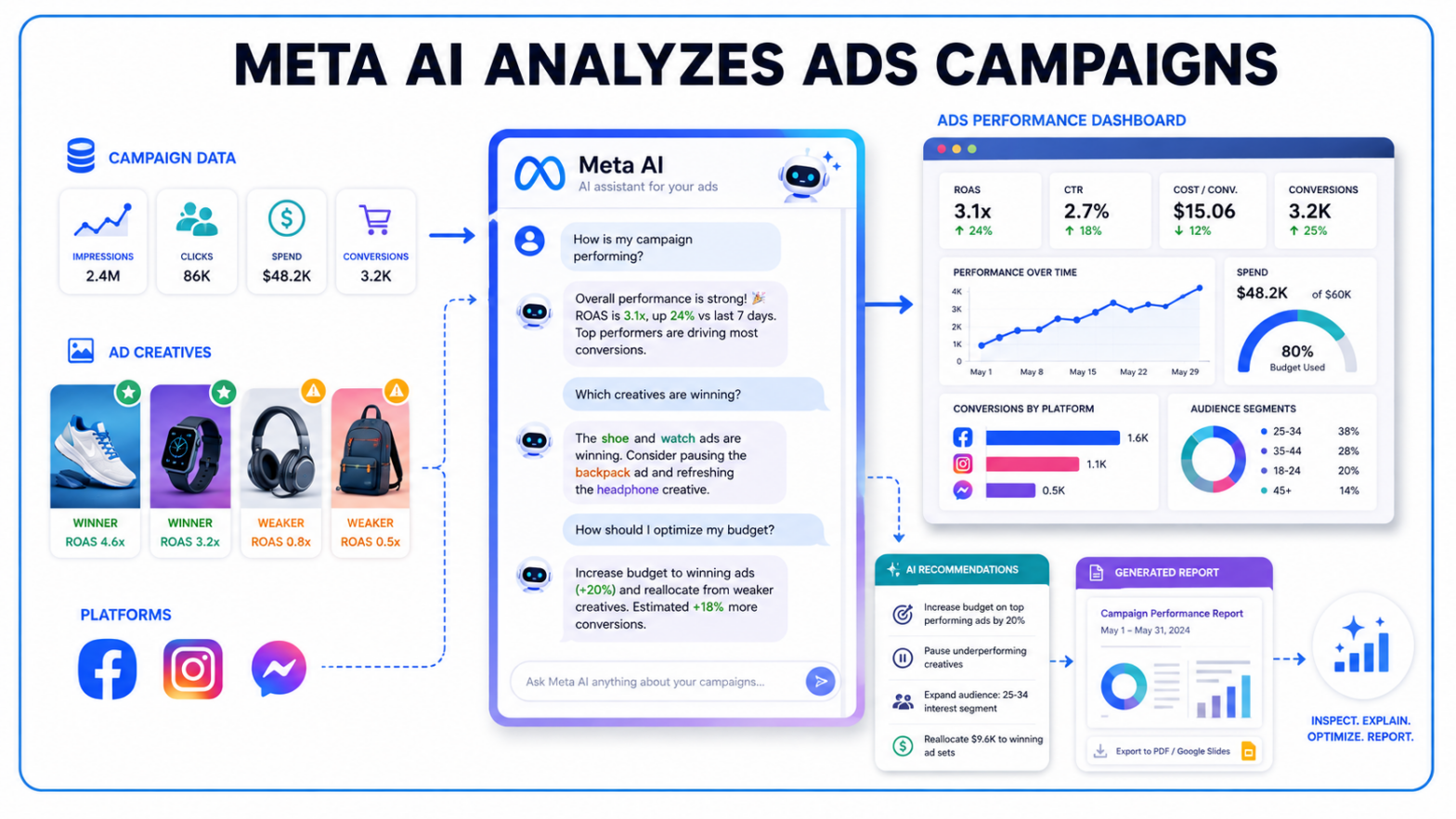
Meta is taking another piece of paid media work out of the dashboard.
Small businesses can now connect advertising, social performance and business data directly to Meta AI, giving the assistant enough context to inspect campaigns, find patterns in creative performance and recommend where advertisers may want to adjust spend.
The shift is bigger than adding another reporting shortcut. Meta AI is moving closer to the point where campaign data becomes a decision.
Meta confirmed the expansion as part of its new Meta AI tools for small businesses, which are beginning to roll out across meta.ai, mobile and desktop experiences.
Meta AI Can Now Read the Campaign Before Answering
Most AI marketing assistants have faced the same limitation: they can explain advertising strategy, but they do not necessarily know what happened inside a specific account.
Meta is narrowing that gap.
Businesses can connect their Meta ad campaigns along with Facebook and Instagram account data. The assistant can then respond to conversational questions using actual performance information rather than relying only on general marketing knowledge.
That puts Meta AI deeper into the same automation push TechWyse has already tracked as Meta expands AI across customer-facing and business workflows. Meta's earlier Business Agent rollout focused on automating conversations with customers. The new small-business functions operate on the other side of the business, helping the person reviewing performance.
An advertiser could ask the assistant to audit recent campaigns, identify the strongest audiences or explain why one group of creatives is outperforming another.
Meta says the system can also benchmark aspects of a business's performance against comparable brands using publicly available information.
That changes the role of the chat interface. It is no longer separated from the account being discussed.
Creative Analysis Is Shifting From Ranking Ads to Explaining Them
Advertising dashboards already make it easy to find the highest and lowest numbers.
Knowing why those numbers moved is harder.
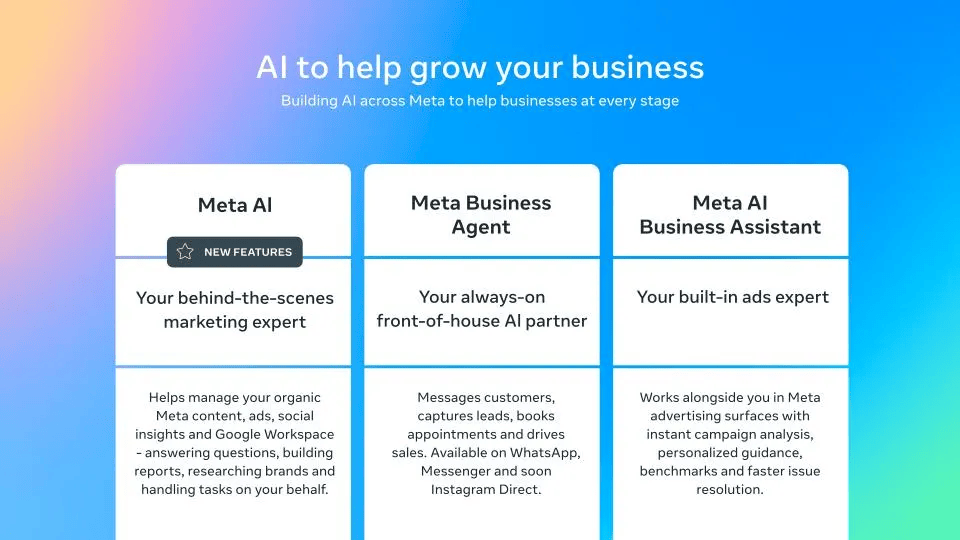
Meta AI can now look across better-performing creative and identify common patterns. It can also flag ads that appear to have stopped resonating and provide an explanation of what may distinguish winning content from weaker variants.
That diagnostic layer arrives as Meta is simultaneously adding more AI to the production side of advertising.
TechWyse recently reported on Meta's expansion of AI-generated creative tools, including plans to bring Muse Image into Advantage+ creative. Taken together, the direction is becoming clearer: Meta wants AI involved both when an ad is made and after performance data starts coming back.
For paid social teams, campaign analysis can therefore become conversational. Instead of exporting creative reports and manually comparing groups of ads, a marketer can ask which creative themes repeatedly correlate with stronger results and use that output as a starting point for the next testing cycle.
The output still depends on the signals available to Meta. An ad with a low cost per lead inside the platform, for example, may not necessarily produce the best downstream customer quality.
The distinction matters once AI starts recommending action rather than merely displaying data.
Budget Recommendations Put Meta AI Closer to Media Buying
Creative is only part of the update.
Meta AI can examine how advertising budgets are performing and identify areas where Meta believes spend could be allocated more effectively. It can surface audiences generating stronger results, identify weaker areas and suggest possible changes based on account performance.
That pushes Meta Ads optimization further toward automated interpretation, not just automated delivery.
Meta has spent years increasing the role of machine learning within campaign targeting, placement and creative optimization. The latest change places an AI interface above those systems, allowing advertisers to ask questions about what the underlying automation produced.
The broader advertising market is moving in the same direction. Google, for example, has also been turning its advertising dashboards into AI-assisted workspaces. TechWyse recently covered how Google added AI-generated insights and conversational reporting to Ads and Analytics.
The competitive line is no longer simply which platform automates bidding more effectively.
It is also which platform can explain performance quickly enough that advertisers act on its recommendations.
Google Workspace Gives Meta AI Context Beyond Meta
Meta is not restricting the assistant to data generated inside its own ecosystem.
Businesses can connect Google Workspace services including Gmail, Docs, Sheets and Slides, allowing Meta AI to use information from those sources alongside Facebook, Instagram and advertising data.
The integration expands what the assistant can produce.
Meta says businesses can turn analysis into decks, documents and spreadsheets, reducing the handoff between diagnosing performance and preparing material for a team, manager or client. Recurring tasks and reminders can also be configured, opening the door to repeated performance reviews without requiring the same prompt to be entered every time.
A small business could, for example, review several months of campaign performance and ask Meta AI to turn the findings into a short presentation.
That is a different category of automation from automated bidding.
It targets the administrative layer around advertising: analysis, reporting and communication.
For agencies and in-house teams, AI advertising tools are increasingly reaching work that traditionally sat outside the campaign engine itself. TechWyse has also tracked that expansion through AI ad disclosure and creative provenance changes across Meta and Google, another sign that AI is becoming part of the operating infrastructure around paid media rather than a standalone generation tool.
The Platform Is Starting to Interpret Its Own Performance Data
The practical implications are fairly immediate. Marketers can use Meta AI to accelerate first-pass campaign audits, creative comparisons and reporting, particularly where the alternative involves exporting data across several interfaces. Budget or optimization recommendations still need to be checked against business-level measures such as qualified leads, revenue, margins and incrementality that may sit outside Meta's view of campaign success.
There is also an important structural change underneath the feature.
Meta already controls the auction, delivery system, optimization algorithms and much of the measurement environment for ads running across Facebook and Instagram. Meta AI now gives the company a conversational layer that can interpret those same results for the advertiser.
That does not automatically make the recommendations inaccurate. It does make independent measurement more important whenever a recommendation affects spend.
Meta says the small-business AI functions are starting to roll out across meta.ai, its mobile application and its desktop experience, with further integrations and capabilities planned.
The dashboard is not disappearing.
But advertisers may increasingly reach it by asking a question first.