

Instagram’s feed is becoming less of a black box.
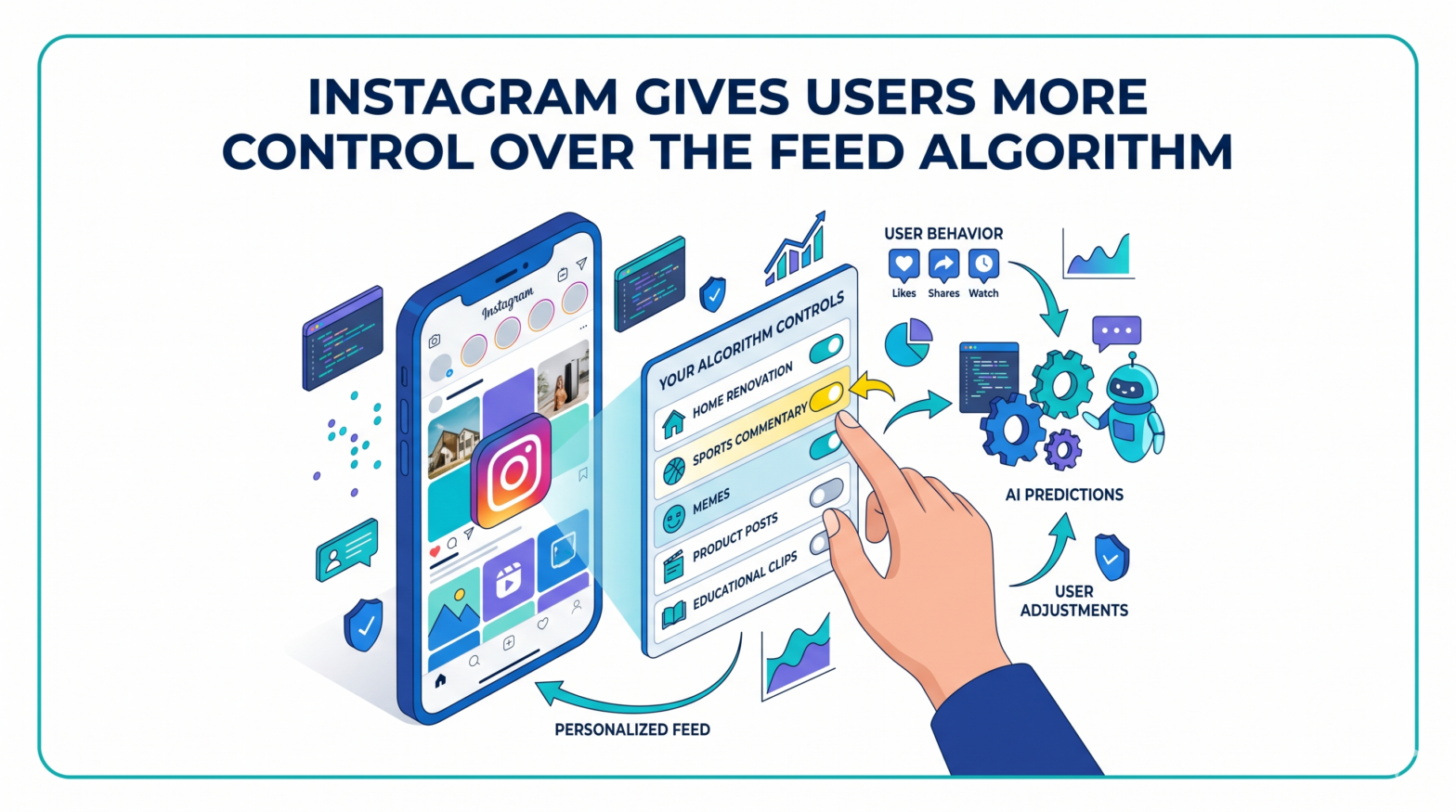
The platform is expanding its “Your Algorithm” controls to the main feed, giving users a direct way to adjust the topics Instagram believes they want to see. For a product built around invisible ranking systems, that is a meaningful shift. Not a full reset. Not a chronological feed revival. But a new control layer between users and the AI recommendations shaping what appears when they open the app.
The Feed Is No Longer Just A Follow Graph
For years, Instagram’s main feed was simple to explain, even when the ranking was not. Users followed accounts. Posts from those accounts appeared, with ranking layered on top.
That model has been fading for a long time.
Recommended content now plays a larger role across Instagram, especially as Meta leans on AI systems to match users with posts, Reels, creators, and topics they may not have explicitly chosen. The main feed is no longer just a record of who someone follows. It is a prediction surface.
The new Your Algorithm expansion gives users a way to inspect and edit some of those predictions. Instagram will show topic areas it believes a user is interested in, based on activity inside the app. Users can then adjust those topics, adding or removing signals that influence what they see across major parts of Instagram.
That distinction matters for social media marketing teams. The feed is not being handed back to users in a broad, manual sense. Instagram is still ranking, recommending, and personalizing. The change is that users now get a limited vocabulary for telling the system when it has read them wrong.
Instagram has already tested this type of control in Reels and Explore. Bringing it to the main feed extends the feature into the app’s most familiar surface, where casual browsing, creator discovery, brand posts, recommended content, and advertising often sit side by side.
“Your Algorithm” Turns Interest Signals Into Something Users Can Edit
The Instagram algorithm has always depended on behavioural signals: what people watch, skip, like, share, save, comment on, and send through DMs.
Most users never see those signals as a list.
Your Algorithm changes that presentation. Instead of asking users to infer why they keep seeing certain content, Instagram is surfacing topic labels and letting users revise them. The feature currently focuses on topics, but Instagram head Adam Mosseri said the company is working toward support for more inputs, including people, moods or vibes, content types, and other preference categories.
That is where the update becomes more interesting than a settings tweak.
Mosseri framed the change as part of a wider effort to restore user agency inside recommendation-heavy social products. In his public post, he argued that recommendations are a technical achievement, but that they also created a cost for users because the system learned from behaviour without giving people enough direct ways to respond. His line was blunt: “The system learns from what you tap, watch, and share, but you don’t really get to tell it what you want.”
The new control does not replace passive signals. Instagram will still learn from behaviour. But it adds an explicit layer on top of those signals, which may help the platform correct interest assumptions faster when a user’s recent activity does not reflect lasting intent.
A user who watches three home renovation clips because they are helping a friend move may not want months of renovation content. A user who engages with one viral sports controversy may not want their feed flooded with sports commentary. Algorithmic systems often treat attention as preference. Your Algorithm gives users a way to push back.
AI Recommendations Are Getting More Legible
Meta has been clear about the strategic direction: AI is central to how its apps rank content, recommend posts, and improve advertising performance.
In a January company update, Meta said AI was driving stronger engagement across its family of apps, including ranking improvements on Facebook and Instagram. The company also said it increased the prevalence of original content in U.S. Instagram recommendations by 10 percentage points in Q4 2025, with 75% of recommendations coming from original posts.
That context helps explain why Instagram is adding user controls now.
AI recommendations have become more powerful, but power without visibility creates frustration. If a user cannot understand why content keeps appearing, every strange recommendation feels arbitrary. If a creator cannot understand why distribution changes, every reach drop feels like punishment. If a brand cannot tell how Instagram categorizes its content, social media strategy becomes harder to diagnose.
Your Algorithm appears designed to make at least part of that system more legible.
Mosseri has also pointed to large language models as a reason these controls are more feasible. Older ranking systems were difficult to translate into plain language. Newer AI systems can cluster content and describe those clusters in terms people understand. That makes it easier for Instagram to show users categories like topics, rather than exposing raw ranking signals or machine-learning features.
There is still a gap between “legible” and “transparent.”
Instagram is not publishing a complete map of how Feed ranking works. It is not giving users full control over distribution. It is exposing editable interest labels within a recommendation system that remains Meta-owned, Meta-optimized, and largely automated.
For marketers, that is the practical reading. The platform is giving users more input, not giving brands a deterministic playbook.
Topic Clarity Becomes Harder To Ignore
This update puts more pressure on content to be clearly understood by Instagram’s ranking systems.
For creators, publishers, and brands, vague content may become even less reliable. If Instagram is clustering content into topics that users can edit, the system needs to understand what a post is about quickly and consistently. Captions, on-screen text, visual subject matter, audio context, engagement patterns, and account history all become part of how content is categorized.
That connects with a broader shift across AI recommendations. Platforms are no longer only evaluating whether a post generated engagement. They are also trying to map content to interest graphs that can be reused across Feed, Reels, Explore, Search, and ad delivery.
TechWyse has seen the same pattern emerge across other AI-mediated discovery channels. Google Discover’s recommender systems increasingly behave less like traditional search and more like personalized content matching, where articles must be both high-quality and clearly aligned with user interests. A similar logic now applies inside Instagram’s AI-powered feed environment, even though the signals and surfaces differ.
For social teams, the practical implication is straightforward: content strategy needs stronger topical discipline. A brand account that jumps unpredictably between memes, product posts, founder commentary, trend reactions, educational clips, and unrelated lifestyle content may confuse both users and ranking systems. A clearer content architecture gives Instagram more consistent signals to classify, recommend, and match to audience interests.
That does not mean every post should look the same.
It means the account’s editorial lanes should be visible.
Marketers May See More Audience Self-Selection
The most immediate impact for marketers is likely subtle. Most users may not spend much time editing algorithm preferences. Some will. The users who do are likely to create cleaner preference signals, especially around topics they actively want more or less of in the main feed.
That could sharpen audience self-selection over time.
If users remove topics they find repetitive, low-quality, or irrelevant, weaker content in those areas may face less passive exposure. If users add or reinforce topics they genuinely care about, brands with clear relevance in those categories may benefit from better alignment between content and audience intent.
This is not a reason to chase topic labels mechanically. Instagram has not provided a public list of all available categories, and the system will likely evolve. The stronger move is to treat social content as a set of recognizable editorial signals. What is the account known for? What problems does it help solve? What visual and textual patterns reinforce that identity? What audience behaviour confirms that the match is working?
The same issue appears in paid media and AI advertising. Meta’s AI systems are increasingly responsible for matching creative, audiences, and placements, while marketers are being asked to provide better inputs: stronger creative, cleaner conversion data, sharper messaging, and more reliable account signals. TechWyse recently covered Meta’s AI Business Agent rollout across WhatsApp, Instagram, and Messenger, another sign that Meta is building more AI assistance into business-facing workflows.
The shift is also visible in Meta’s creator tools. The company’s AI Creator Assistant for Facebook points to the same platform direction: more automated guidance, more AI-assisted content workflows, and more emphasis on helping creators operate inside recommendation-driven systems.
Your Algorithm is the user-facing side of that same operating model.
Better signals in. Better recommendations out.
The Main Feed Is Becoming A Negotiation
Instagram is not moving away from AI recommendations. The company’s own updates point in the opposite direction.
The platform is making the system more interactive.
That creates a different kind of feed: one shaped by behavioural data, AI classification, platform ranking goals, and now a small but visible layer of user correction. The old follow graph still matters, but it no longer carries the full weight of the experience. The Instagram feed is becoming a negotiation between what a person chose, what they did, and what the system thinks those actions mean.
For brands, the lesson is not to optimize for a new button in settings. It is to understand where Instagram is going.
Distribution will depend less on broad follower accumulation and more on whether content can be categorized, recommended, and repeatedly validated by audience behaviour. That includes watch time, shares, saves, comments, and the quieter signals that tell Instagram whether a topic match is useful or disposable.
Brand safety and audience segmentation remain part of that equation. Instagram’s recent 13+ teen content filter expansion showed how content classification can affect what different users are allowed or likely to see. Your Algorithm works differently, but both changes point to a feed environment where platform interpretation of content carries more distribution weight.
This also changes how marketers should read performance. A post that reaches fewer people but lands with a more defined interest group may be more valuable than a broader post that collects shallow impressions. In AI-shaped feeds, relevance is not only a creative goal. It is a distribution condition.
Instagram’s new feed controls do not give users the final word over the algorithm. They give users a clearer way to talk back to it.