
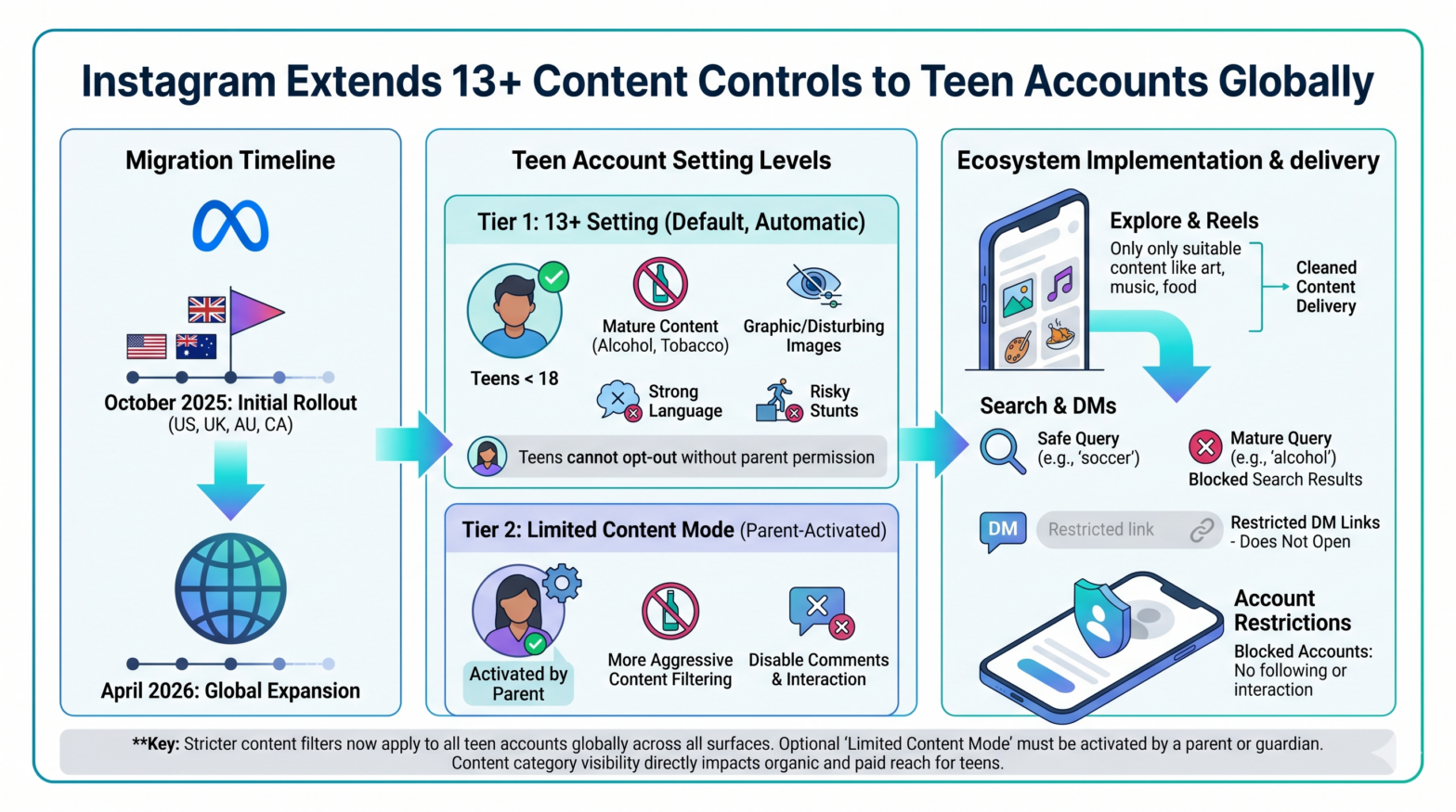
Instagram's content enforcement rules for users under 18 now apply beyond the four markets where they launched, with direct consequences for advertisers and organic social strategies worldwide. Meta announced the international expansion of Instagram's age-appropriate 13+ content rating and Limited Content setting, building on the rollout in the UK, US, Australia, and Canada in October 2025.
The October 2025 Foundation
The new Teen Account settings began rolling out in October 2025 in the US, UK, Australia, and Canada, with full implementation expected by the end of that year. Meta described the update as the most significant change to Teen Accounts since it introduced the programme the previous year.
Teens under 18 were automatically placed into an updated 13+ setting, and they cannot opt out without a parent's permission. In addition to longstanding policies that already hide or prohibit recommendation of sexually suggestive content, graphic or disturbing images, and adult content such as tobacco or alcohol sales from teens, the updated policies go further. The expanded restrictions cover strong language, certain risky stunts, and content that could encourage potentially harmful behaviour.
Meta also updated its technology to proactively identify age-inappropriate accounts. Teens can no longer follow accounts found to regularly share such content, and if they already follow those accounts, they will no longer be able to see or interact with their posts, send them direct messages, or view their comments. Beyond existing blocks on suicide, self-harm, and eating disorder terms, Instagram now filters content results for mature search queries such as "alcohol" or "gore," with misspelling detection to close workarounds. If someone sends a teen a link to restricted content via direct message, it will not open.
The Limited Content Setting
Parents who prefer stricter limits can choose a new Limited Content mode, which filters out additional material and removes the ability to comment or see comments on posts. This setting is distinct from the default 13+ tier and must be activated by a parent or guardian. Under both tiers, teens under 18 are automatically placed into the updated 13+ setting and cannot opt out without a parent's permission.
The PG-13 Naming Dispute
When Meta first announced the October 2025 rollout, it described Teen Accounts as being "guided by PG-13 movie ratings." That framing prompted a formal legal challenge. The Motion Picture Association sent a notice to Meta ordering it to stop using the MPA's PG-13 movie rating to describe Instagram's framework for teen settings, calling the use of the PG-13 moniker "literally false and highly misleading."
The Motion Picture Association, which runs the film rating system established nearly 60 years ago, said it was not contacted by Meta prior to its announcement. The MPA argued that Meta's statements implied a "false equivalency" between its human-generated ratings and Meta's AI-based content filtering, stating that Meta's content restrictions "literally cannot be 'guided by' or 'aligned with' the MPA's PG-13 movie rating" because Meta does not follow the MPA's curated process, and instead appears to rely heavily on artificial intelligence or other automated technology measures.
The MPA sent a cease-and-desist letter demanding that Meta stop using the term, and Meta has moved away from the branding since then. In the latest communication, Meta refrains from "PG" language entirely, instead describing the revamped Teen Accounts as "inspired by 13+ movie ratings criteria and parent feedback."
Existing Advertising Restrictions on Teen Audiences
The April 2026 global expansion does not introduce new paid targeting parameters. Structural ad restrictions for teen audiences on Instagram have been in place for several years. Beginning in February 2023, Meta confirmed that advertisers would only be able to use age and location to reach teens, removing gender as a targeting option, and specifying that teens' previous engagements across Meta's apps - such as Instagram posts and Facebook pages they had liked - would not inform what ads they see.
In July 2021, Meta had already added restrictions on Facebook and Instagram that stopped advertisers from targeting teens with ads based on their interests and activities. The result is that personalised advertising to users under 18 on Instagram currently draws only on age and location data.
Implications for Paid Media and Organic Strategy
The April 2026 global expansion reinforces content-level enforcement at the delivery layer across all surfaces, including Explore, Reels, In-Feed, Search, and AI-generated recommendations. Meta says it is now applying stricter ranking and filtering across feeds, search, and recommendations to ensure that teens are shown content broadly suitable for a 13+ audience by default.
For paid media buyers running campaigns with broad audience definitions that include users under 18, the content enforcement changes carry implications for delivery. Creatives containing strong language, references to alcohol or other flagged categories, or content depicting risky behaviour are subject to suppression in teen-facing surfaces. For organic social strategies, brands operating in categories adjacent to restricted content - including alcohol, cannabis, fitness supplements, strong-language entertainment, or stunt-driven creator content - should assess whether existing content libraries are consistent with the updated 13+ framework, as follower counts among under-18 audiences may no longer translate to reach or engagement where content is flagged. Teams managing comment-dependent community strategies should also evaluate whether that approach remains viable for teen-skewing accounts in newly covered markets.
International Rollout Scope
Instagram is rolling out its content restrictions for teen accounts globally, after previously limiting them to four countries, meaning teens worldwide now have stricter limits on violent, sexual, and drug-related content by default. The latest announcement expands this framework globally and deepens its integration into Instagram's recommendation systems.
Meta acknowledged in its April 2026 announcement that "just like you might see some suggestive content or hear some strong language in a movie rated for ages 13+, teens may occasionally see something like that on Instagram," and stated that "no system is perfect" and that the company is committed to improving over time.