Warranty information is moving out of the fine print and into Google’s product data. For retailers selling regulated goods in Quebec, the timing is particularly important.
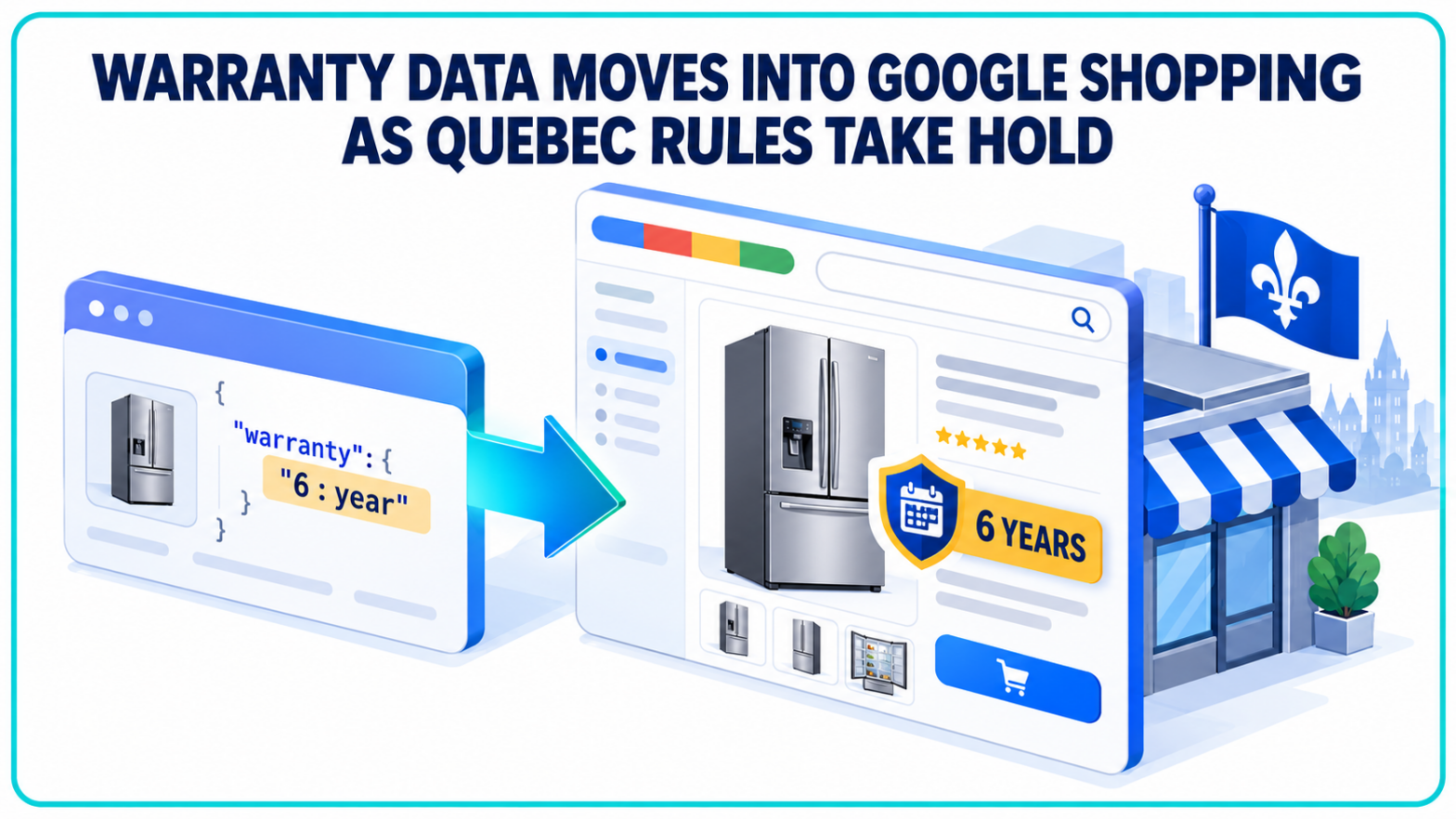
Google has added a warranty attribute for general products appearing in Google Shopping ads and free listings. The field gives merchants a standardized way to submit a warranty period alongside the pricing, availability and other data already carried in a product feed.
The Warranty Field Arrives as Quebec’s New Rules Take Effect
The addition closely follows the October 5, 2026, effective date for parts of Quebec’s Consumer Protection Act dealing with warranties of good working order.
Under the Quebec warranty rules, merchants must prominently indicate the duration of the applicable warranty near the advertised price of a covered product. Manufacturers also have disclosure obligations for products carrying the warranty.
The rules apply to specified new appliances and electronic devices sold or leased by a merchant. The prescribed coverage periods vary by product:
- Six years for ranges, refrigerators, freezers, air conditioners and heat pumps
- Five years for washing machines, dryers and dishwashers
- Four years for televisions
- Three years for desktop and laptop computers, tablets, cellular phones and video game consoles
These warranties apply automatically to eligible purchases. They are distinct from optional manufacturer warranties and additional coverage that a retailer may offer for sale.
Google directly references Quebec’s Bill 29 in its warranty attribute documentation, describing the field as an option for products whose warranty information may need to appear in ads or free listings because of local regulations.
Warranty Duration Becomes Structured Product Data
The new field is relatively narrow. It communicates how long a warranty lasts, rather than describing every condition, exclusion or repair process attached to that coverage.
For standard products, Google’s format contains two sub-attributes:
- Duration [duration], submitted as an integer
- Duration unit [duration_unit], using either month or year
Google requires Quebec warranty periods to use year as the duration unit. A refrigerator carrying a six-year warranty, for example, could be entered in a text feed under warranty(duration:duration_unit) with the value 6:year.
XML feeds use nested duration and duration_unit values inside the warranty element. Merchants submitting catalogue data programmatically can also use the Merchant API.
The field cannot be repeated for the same product. Google recommends ASCII characters, although the attribute supports Unicode.
There is another technical limitation: the documentation lists no corresponding Schema.org property. Retailers cannot assume that warranty information marked up on a product page will automatically map to this Merchant Center field. It must be supplied through a supported product data source.
That distinction matters as Google Merchant Center becomes a broader commerce data layer. Product feeds now influence paid placements, free product listings and newer shopping experiences that depend on structured catalogue information.
An Optional Google Field Can Still Carry Legal Weight
Google classifies the warranty attribute as optional. That label describes the general product data specification, not the legal obligations that apply to every merchant in every market.
A retailer selling clothing in an unregulated market may have no reason to populate the field. A business advertising a covered appliance to consumers in Quebec faces a different question because provincial law can require warranty duration to be displayed prominently near the advertised price.
The platform documentation does not say that every submitted warranty value will appear in every Google interface. It also does not state that adding the attribute alone satisfies all advertising, ecommerce or post-purchase disclosure obligations.
Feed submission should therefore be treated as one part of compliance. Retailers remain responsible for the information shown on product pages, advertisements, written offers and transaction documents where the law applies.
Google has not published a separate enforcement schedule for the attribute or explained whether missing warranty values will produce Merchant Center warnings or item disapprovals in regulated markets. The current documentation focuses on eligibility, formatting and accurate submission.
Product Feed Management Now Needs Warranty Governance
Warranty duration may look like a simple catalogue field, but it can expose ownership gaps across ecommerce operations.
Marketing teams do not always control the source warranty data. Coverage periods may come from legal teams, manufacturers, product information management systems, commerce platforms or regional catalogue records. Those sources must agree before the information reaches Google.
Large retailers also need a way to separate products and destinations. A catalogue serving several provinces or countries may contain goods with different statutory warranties, manufacturer coverage or disclosure requirements. Applying one value across every market without reviewing those differences could create inaccurate advertising.
For marketers, the immediate practical implication is a feed audit. Teams should identify products covered by local rules, confirm the correct duration with the appropriate compliance owner, map the value into the feed and compare the submitted data with warranty language on the landing page. Existing product feed management processes should also be checked to ensure that transformations, supplemental feeds or regional rules do not overwrite the warranty value.
Accuracy is central. Quebec’s consumer protection guidance says merchants may not provide false or misleading information about a warranty’s existence, scope or duration. A correctly formatted field can still be wrong if the underlying value is outdated or describes different coverage.
Google Makes No Performance Promise for Warranty Data
Warranty details could give shoppers useful context when comparing expensive appliances or electronics. Google, however, does not claim that submitting the attribute will improve rankings, increase impressions or raise conversion rates.
The field’s immediate purpose is more concrete: it gives Google a machine-readable warranty period that can accompany products in ads and free listings where such information is relevant.
Google’s annual Merchant Center specification update in April focused on shipping fields, product video links and future image requirements. Warranty data was not included in that announcement. Its appearance in a separate help document, alongside an explicit reference to Quebec law, places regulatory disclosure at the centre of the change.
For retailers, the new attribute creates a clearer route from approved warranty information to Google’s shopping surfaces. The product page and feed will still require separate handling because Google currently provides no Schema.org mapping for the field.