
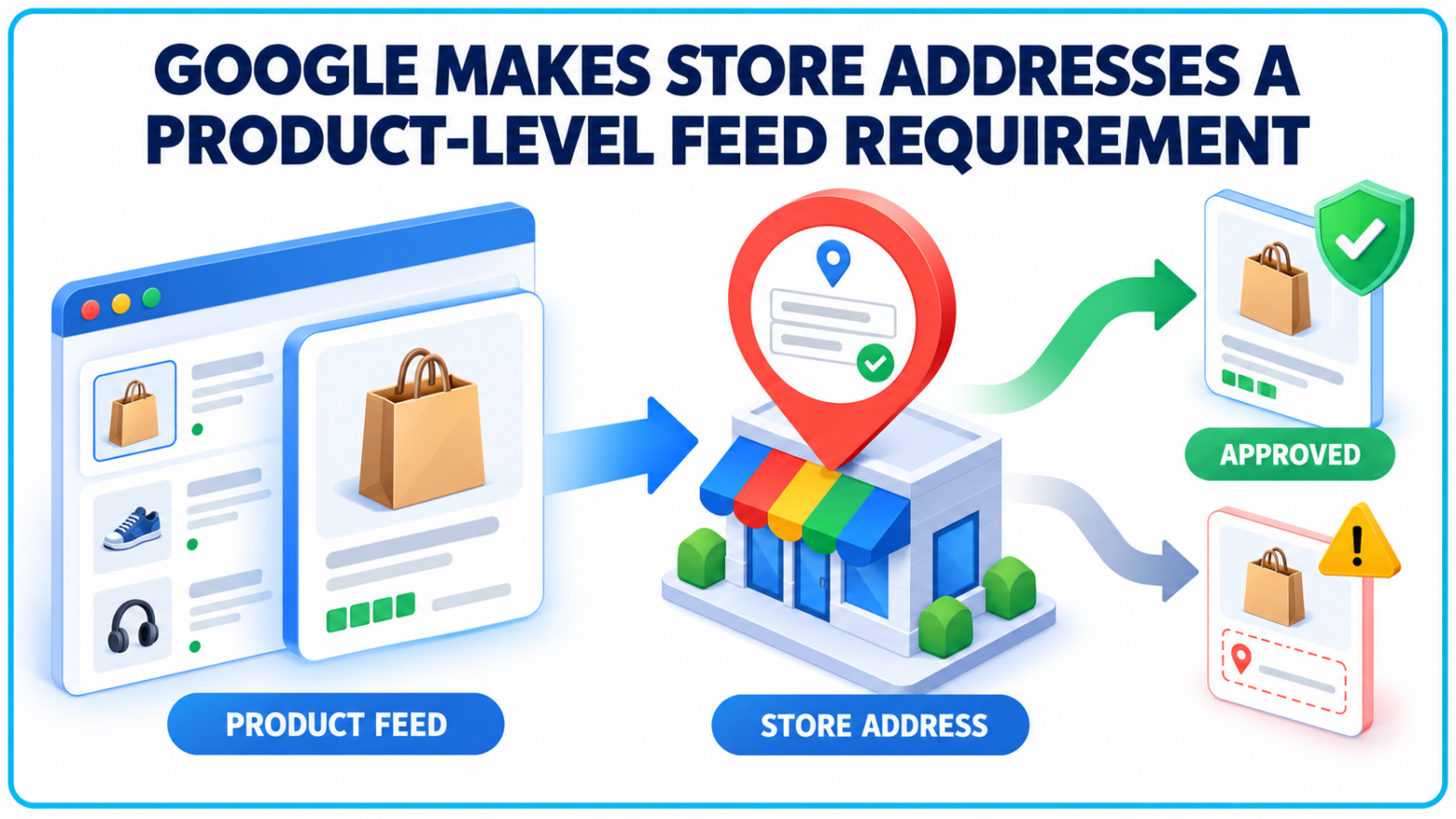
A missing postal address can now keep an in-store product out of Google’s local shopping results. Google has documented store_address as a required field for each applicable product, adding another approval check to an already complex retail data workflow.
Google Merchant Center Adds a Second Layer of Store Identity
Retailers have traditionally connected a local product to a physical location through a store code. Google matches that identifier against a linked Business Profile or another registered store source to determine where the item is available.
The newly documented store address attribute introduces the postal address itself as a required product field. Google defines store_address as a string, allows one value per submission and says the attribute has no corresponding Schema.org property.
For retailers using Google Merchant Center, the distinction is important. A valid store code identifies a location within the merchant’s data system. The address provides another piece of information that Google can use to understand and validate that location.
The underlying concept is not entirely new. Google’s Local Feeds Partnership API already requires a storeAddress value when a data provider creates a store record. That API field sits at the store level, however, while Google’s new attribute page describes store_address as required for each product.
Local Inventory Ads Still Depend on Product-to-Store Matching
The update affects products submitted for local shopping experiences, including paid local inventory placements and free local product listings. Both formats rely on accurate connections between a product, its availability and the store where a shopper can buy it.
Google’s existing store_code specification requires the code used in local inventory data to match the corresponding location in the merchant’s Business Profile or store feed. The value is case-sensitive and cannot be repeated for a single local inventory offer.
The address field adds a more recognizable location signal, but it does not replace the store code. Retailers still need consistent product IDs, store identifiers and inventory information across their data sources.
There is one unresolved documentation issue. Google’s general local inventory data specification continues to list id, store_code and availability as the required basic inventory attributes. It does not yet include store_address in that table.
Google has also not published an effective date, transition period or country-specific eligibility note on the standalone address page. The clearest official statement is that the field is required for each product and that products failing its minimum requirements can be disapproved.
Address Formatting Can Create Catalogue-Scale Disapprovals
Google requires a valid postal address without typos or encoding errors. Unicode characters are supported, although the company recommends using ASCII characters where possible and UTF-8 encoding to prevent invalid characters from entering the feed.
The prohibited data includes control characters, private-use characters, surrogate pairs and unassigned Unicode code points. Google also recommends submitting compressed files to reduce encoding problems.
Those requirements may appear routine until a retailer operates dozens or hundreds of locations. An incorrectly generated address can be repeated across every product associated with a store, turning one location-data problem into a large group of disapprovals.
The field is not repeatable. Merchants must therefore submit a single store address for each applicable product rather than combining several locations within one value. Products available at multiple stores will still require separate store-level inventory records, with each record carrying the appropriate location information.
For marketers, the immediate task is feed quality assurance. Teams should compare submitted addresses with the corresponding Merchant Center and Business Profile locations, validate encoding before upload and monitor item diagnostics after the field is added. Campaign structures do not need to change simply because the attribute exists, but address errors could reduce the pool of eligible local products.
Product Feed Management Now Includes Location Consistency
Retail feed maintenance already involves synchronizing product identifiers, prices, availability and pickup information. Postal addresses introduce another dataset that may be owned outside the advertising team.
A store opening, relocation or address correction can now affect more than a Business Profile. The revised information may need to flow through the retailer’s catalogue platform, inventory system, feed management software and any third-party data provider submitting local inventory.
That makes ownership important. A feed generated from an outdated location database could continue sending a previous address even after the public-facing store information has been corrected elsewhere.
Google says Business Profile locations can take up to 24 hours to synchronize with Merchant Center. Its local inventory guidance recommends waiting 24 hours after linking accounts, changing a store code or updating a Business Profile before uploading the related inventory feed.
Agencies using centralized product feed management will also need to determine whether address values come directly from the merchant, a commerce platform or an automated feed rule. A transformation that standardizes abbreviations may be harmless, while one that drops unit numbers, postal codes or country information could create a mismatch.
Google’s Local Retail Push Gives Feed Errors Wider Reach
The address requirement arrives as Google is giving local inventory a larger role in Shopping campaigns. Since August 31, 2026, eligible Shopping campaigns linked to Merchant Center accounts with the local inventory add-on have had local inventory ads enabled by default.
Retailers can still separate online and local products through inventory filters, but local participation is becoming a more standard part of Google’s commerce infrastructure. Product eligibility therefore depends increasingly on location data being as dependable as price and availability.
Google’s address documentation does not specify a staged rollout or deadline. It states that submissions failing the minimum requirements will be disapproved and that affected products will be identified inside the merchant’s account.