

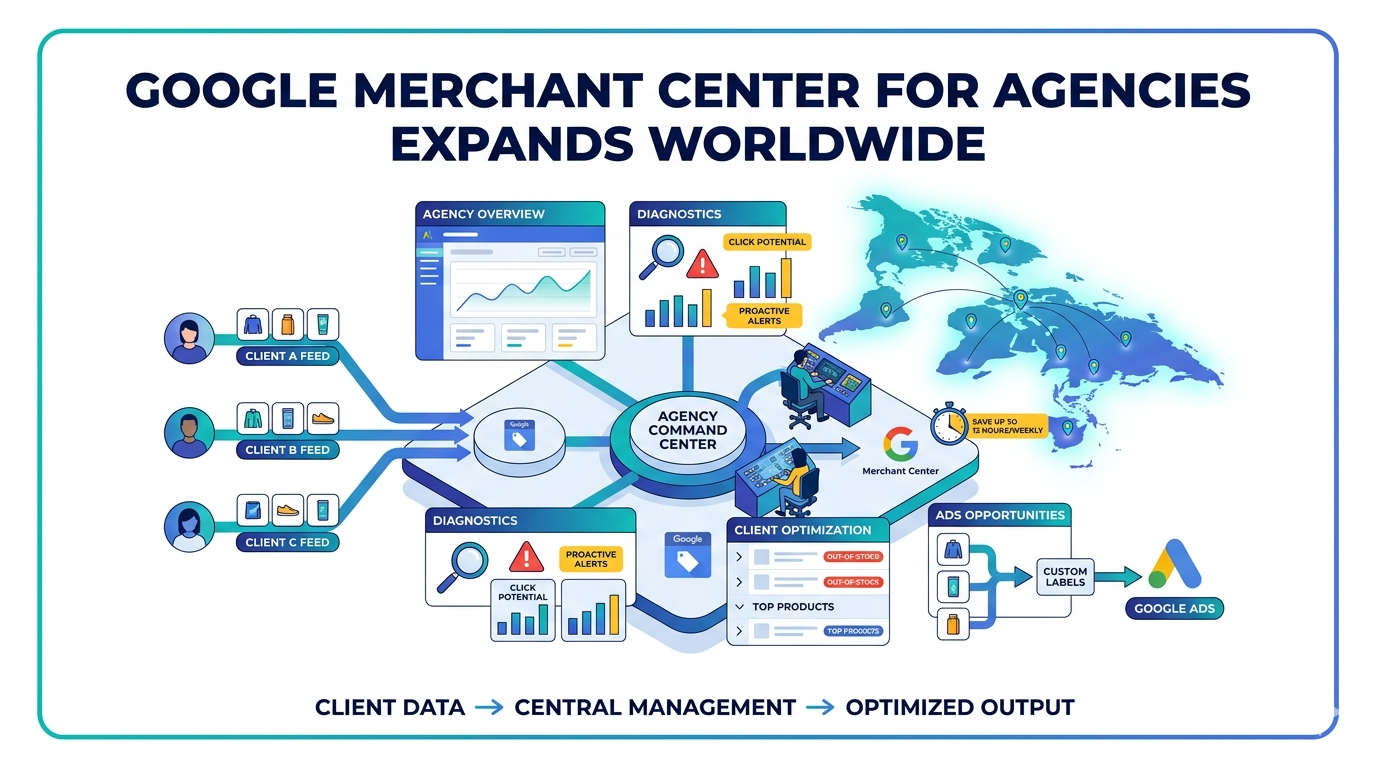
Digital marketing agencies outside the United States and Canada now have full access to Google's dedicated multi-account management platform for product feeds. Google confirmed on May 11, 2026, in its Merchant Center Help Center that the Merchant Center for Agencies is now generally available worldwide, giving agencies a dedicated command center to manage their entire client portfolio in one place.
The launch replaces the existing model, where agencies relied on Multi-Client Accounts (MCA) to manage product data across several clients, a structure that placed the burden of account navigation and issue tracking on individual users moving between accounts manually. The new platform consolidates that workflow into a purpose-built environment.
From North America Pilot to Full Global Release
Google officially launched Merchant Center for Agencies as a generally available product in the United States and Canada on March 11, 2026. After a pilot phase that began in late 2024 and a broader rollout that started in October 2025, the platform had been open to all eligible agencies in those two markets, with a global pilot running in parallel for agencies in other regions. The May 11 announcement in Google's Merchant Center Help Center removes that geographic restriction entirely.
The platform is designed to make it easier for agencies to onboard clients, optimize product listings across Google, and drive successful shopping campaigns. Access is restricted to agencies that manage Google Merchant Center accounts for other businesses. Individual merchants and in-house e-commerce teams do not qualify for the specialized interface.
What the Platform Includes
The architecture of Merchant Center for Agencies centers on four functional areas: an agency overview page, a diagnostics page, a client optimization page, and an ad opportunities page. Each serves a distinct operational purpose, and their combination differentiates this interface from standard multi-account access.
Proactive diagnostics surface critical alerts across all client accounts automatically. Rather than checking each account individually for feed errors, disapprovals, or policy violations, the system flags issues that need attention. The diagnostics section introduces a metric called "click potential", an estimate of how many additional clicks could be recovered by resolving a given issue. Click potential was previously used at the product level to help individual merchants prioritize fixes. Merchant Center for Agencies extends that logic to the agency tier, enabling teams to rank issues across their entire portfolio by estimated traffic impact rather than treating all warnings as equal.
A Client Optimizations tab gives agencies the ability to view promotions, top out-of-stock products, store quality, and shipping and return information. Key data from each client's top products, such as out-of-stock items and paid and free click data, is displayed in an accordion format by client.
The Ads Opportunities page includes a campaign integration feature that connects Merchant Center product data directly to Google Ads campaigns. Through a labelling workflow, agencies can identify low-traffic products in Merchant Center, apply custom labels, and export those labels into supplemental data sources that sync with Google Ads, allowing agencies to filter for and target underexposed products directly in their Shopping campaign setup.
Access and Performance Benchmarks
Existing Merchant Center users can access the agency dashboard at merchants.google.com. New users can request an agency account by contacting Google. The product is separate from the standard Merchant Center interface. Agencies that currently manage client accounts through individual logins will need to set up agency-level access to use the consolidated dashboard and diagnostics features.
Digital marketing agency Socium Media piloted the product ahead of the 2025 holiday season, using it to monitor client promotions, inventory, and feed diagnostics from one place, and reported 50% faster resolution on monitoring tasks as a result. The broader reported time savings benchmark across the platform is the ability to save up to 12 hours weekly through the simplified single-view interface.
Operational Implications for Agency Teams
For agencies managing multiple e-commerce clients on Google Shopping or Performance Max, Merchant Center for Agencies centralizes feed health monitoring, issue triage, and promotion management that would otherwise require logging into each client account separately. The diagnostics prioritization by click potential, in particular, enables teams to make data-informed decisions about which feed errors to resolve first, framing account maintenance as a revenue-protection activity rather than a technical checklist. The platform does not replace campaign performance reporting; it is an operational management tool and does not show campaign-level data such as ROAS, CPA, or ad spend. For that, agencies still need to connect Google Ads data to Merchant Center data on a per-client basis.
Amazon's advertising console already supports multi-account management for agencies, and Meta Business Suite has offered agency-level account management for years. Google's addition of proactive diagnostics and merchandising tools that connect directly to Ads campaigns is designed to keep agencies operating within its commerce ecosystem as competition for retail ad budgets intensifies.