
Retailers can control the product feed. They can approve the landing page. They may no longer control every sentence that appears between them.
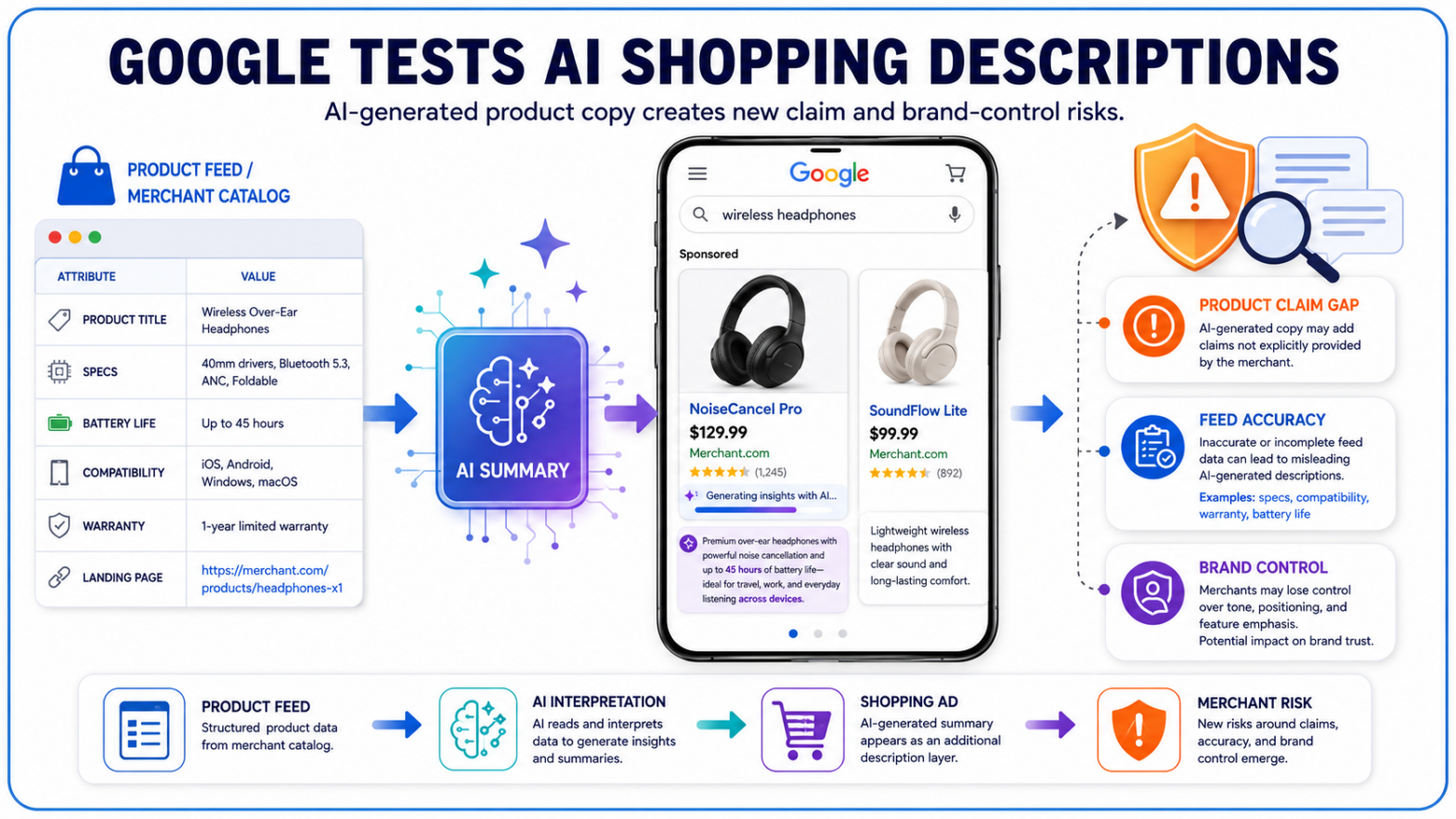
Google is testing AI-generated descriptions beneath sponsored product listings on mobile Search. The added text appears after the Shopping ads load, giving Google another opportunity to interpret a product before a shopper clicks.
For e-commerce brands, that interpretation is not harmless interface copy. A generated sentence can contain a product specification, compatibility claim, performance statement or implied promise that the merchant never approved.
Google Shopping Ads Are Gaining a Second Description Layer
The test was observed on July 29 in a mobile search for wireless Bluetooth headphones. Product cards initially displayed a “Generating insights with AI...” message beneath their standard information. Google then replaced the loading message with short descriptions summarizing product features.
One generated description referred to Bluetooth 5.4, active noise cancellation and up to 78 hours of playback. Another summarized microphone, calling and battery features for a separate product.
Those sentences occupied a prominent position inside the sponsored product unit. They were not simply hidden metadata used to determine ad eligibility or match a query.
Google has not formally announced the Shopping test or documented how products are selected for it. The company previously confirmed a related experiment involving AI-generated context in conventional Search ads, describing it as “a small experiment to see if adding AI-generated context to Search ads helps people make more informed decisions.” The Shopping implementation appears to extend that idea into product advertising, but Google has not said whether it will expand beyond the current test.
That distinction matters. This is an observed experiment, not a confirmed global rollout.
Still, the test shows where Google Shopping ads are heading. A product card may increasingly contain a mix of retailer-supplied data, platform-selected attributes and AI-written interpretation.

The Product Feed May No Longer Be the Final Copy
Shopping ads have traditionally been assembled from information submitted through Merchant Center. Product titles, prices, images, availability and descriptions provide the structured data Google uses to create ads and match products with relevant searches.
That arrangement gives merchants a familiar chain of responsibility.
A retailer writes or imports the product information. The feed is validated against the landing page. Google then selects which approved details to display.
AI-generated ad descriptions introduce another step. Google can take those inputs, interpret them and write a new sentence that does not appear verbatim in either the feed or the product page.
The difference is easy to miss when the generated text is accurate. A summary such as “wireless earbuds with built-in microphones” may simply compress existing product data.
The risk appears when the model connects details incorrectly.
A battery specification could be applied to the wrong usage mode. Water resistance could be described as waterproofing. A limited manufacturer warranty could become a general warranty claim. An accessory listed as compatible might be presented as included.
Product catalogues are full of these distinctions.
Google’s own product data specification tells merchants to describe relevant attributes such as materials, dimensions, intended use, special features and technical specifications. The description should match the product and avoid promotional or unrelated information.
Strong product feed optimization can give an AI system better evidence. It cannot guarantee that the system will preserve every qualification when converting that evidence into consumer-facing language.
Google’s Existing Review Controls Do Not Cover This Test
Google already generates creative assets in several campaign environments. Those tools usually include some form of advertiser control.
Suggested assets, for example, can be reviewed, added or dismissed inside Google Ads. Google says advertisers can manually approve suggested assets before they appear, while accounts using fully automated optimization can inspect newly created assets through reporting.
Google’s guidance for generated images is even more direct. Advertisers should review generated or suggested assets to confirm that they are accurate, not misleading and compliant with advertising policies and applicable laws before publishing them.
The Shopping description test appears to operate differently.
The text is generated inside the search result after the products load. No public documentation currently explains whether advertisers can preview the descriptions, exclude individual products, opt out, correct a generated statement or see which versions were shown.
That creates a control gap.
A paid media team may review every approved feed field and still be unable to reproduce the exact message a shopper saw. Customer service staff could receive questions about a claim that does not exist in the company’s catalogue. Compliance teams may not know a sentence appeared until someone captures it in the wild.
Google acknowledges more broadly that generative AI is experimental and can produce inaccurate or offensive content. It also states that AI-generated advertising content remains subject to the same policy review and enforcement standards as other ad content, including rules against misrepresentation.
In this test, however, the platform is not merely checking advertiser copy. It is writing additional copy of its own.
Product Claims Still Land Back on the Merchant
Google’s Shopping policies prohibit offers that portray a merchant or product in a way that is inaccurate, unrealistic or untruthful. Product descriptions and specifications must also remain relevant to the advertised item and consistent with the associated landing page.
Those policies can lead to product disapprovals or broader account enforcement when Google identifies inaccurate information. Merchant Center documentation tells retailers to correct affected product data and websites before requesting another review.
Google has not stated how enforcement would work if its own generated description introduced the inaccurate claim.
Nor has it said that merchants automatically assume legal liability for every sentence created by this experiment. Legal responsibility would depend on the claim, jurisdiction, consumer harm and the contractual relationship between the parties.
The practical exposure is less ambiguous.
The shopper purchases from the retailer. The retailer processes the payment, fulfils the order and handles returns or warranty disputes. A customer who buys headphones based on an incorrect battery-life statement will probably contact the store, not the model that wrote the sentence.
That is why AI-generated ad copy becomes a brand safety problem even when Google owns the generation system. Platform authorship does not stop the merchant from facing complaints, refund requests, policy reviews or questions from consumer regulators.
E-Commerce Brand Safety Now Starts at the SKU
Retail brand governance has usually focused on approved visual identity, pricing language, promotional terms and prohibited claims. This test pushes that process down to individual product attributes.
Specifications that appear harmless inside a database can become risky when an AI system turns them into fluent marketing copy.
Retailers should be able to trace battery life to a specific testing condition, warranty language to a documented policy and compatibility statements to the exact models supported. Ambiguous feed fields, inherited manufacturer descriptions and contradictory product-page details give a generative system more room to produce a confident but incomplete summary.
In practice, paid media teams should begin capturing live Shopping ad variations for high-risk products, particularly electronics, health-related goods, children’s products and items with detailed warranty or compatibility limits. Feed descriptions and landing pages should also use matching qualifications rather than relying on one channel to supply missing context.
That is not a guarantee against hallucination. It creates a cleaner record of what the merchant actually provided.
Google’s experiment is still limited, and no rollout timetable has been announced.
The unresolved issue is no longer whether Google can write Shopping ad copy. The test shows that it can. What merchants still lack is a way to approve, audit or challenge that copy before a product claim reaches the customer.