
Google Ads automation is crossing a line agencies have been able to avoid until now.
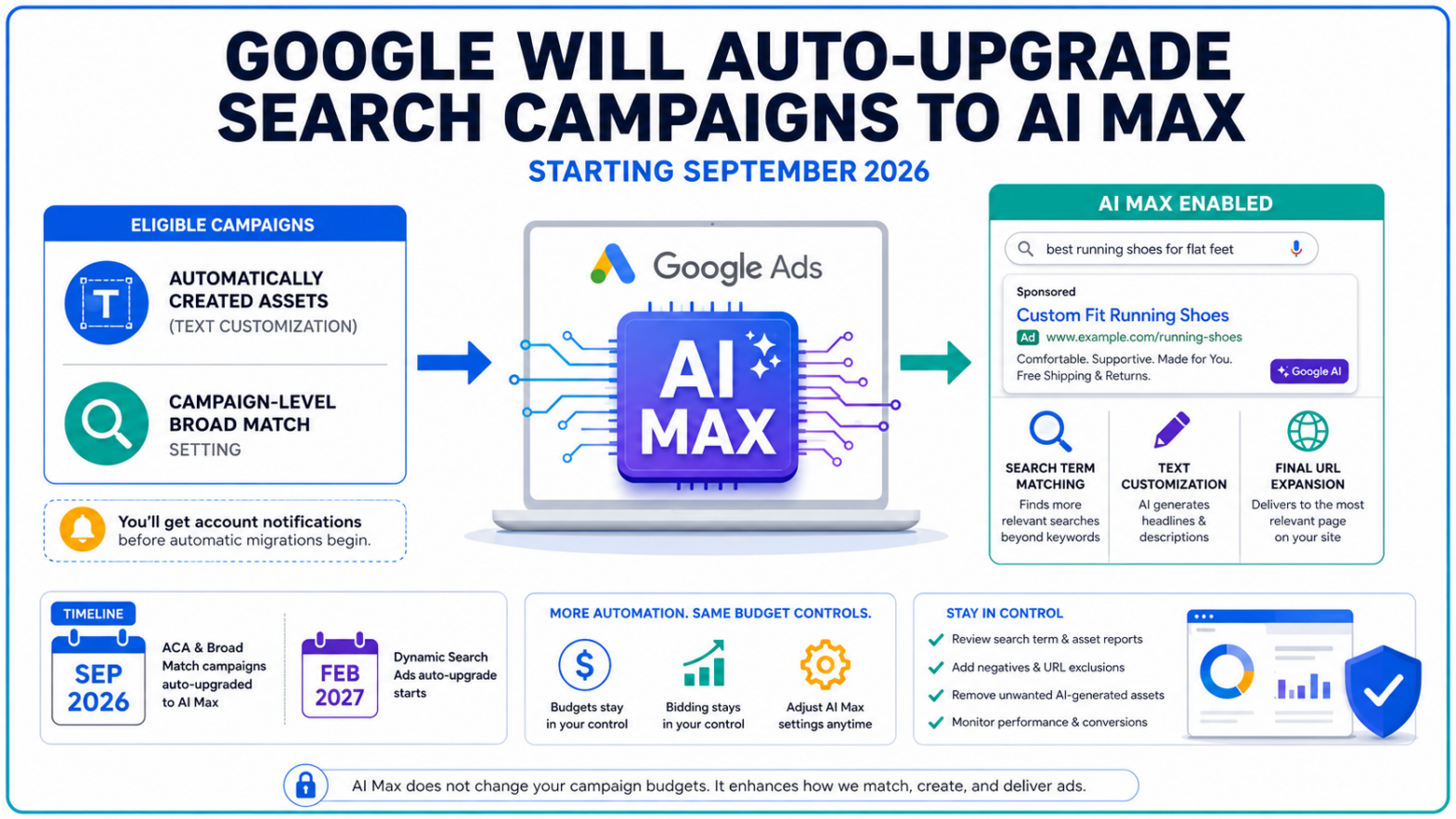
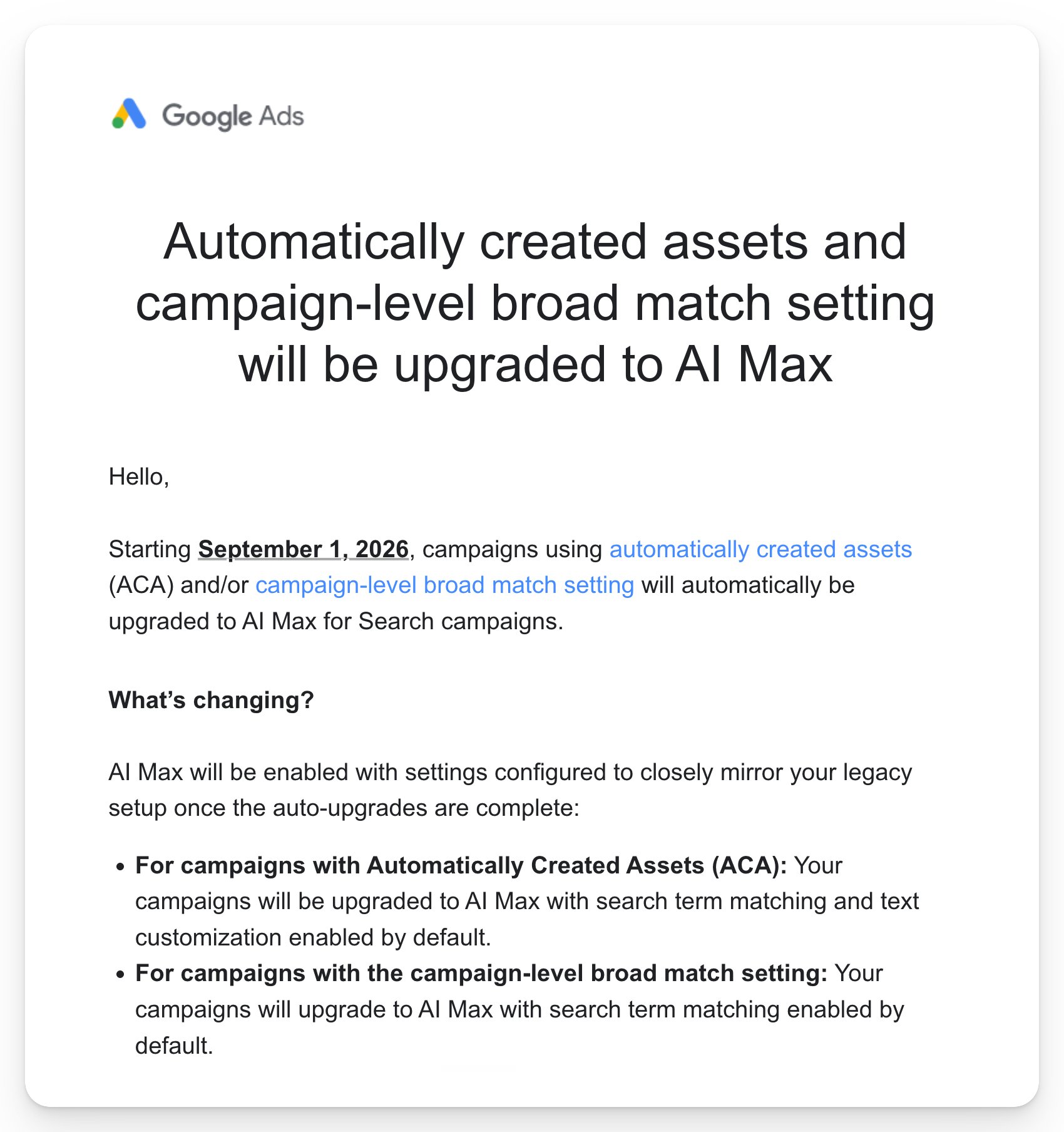
Starting in September 2026, eligible Search campaigns using Automatically Created Assets or Google's campaign-level broad match setting will be moved into AI Max automatically. Advertisers do not need to manually switch those campaigns over first.
The change does not give Google unrestricted control over an advertiser's budget. It does, however, move more of the decisions around query matching and ad creation into Google's AI Max system. For agencies managing mature Search accounts, that is enough to justify an account-level audit before the rollout begins.
September's AI Max Upgrade Is More Targeted Than It Sounds
Google first announced a broad migration plan in April that included Dynamic Search Ads, Automatically Created Assets and campaigns using the campaign-level broad match setting. The company later changed part of that schedule.
Dynamic Search Ads will not begin their automatic migration until February 2027 after Google extended the deadline in June. The September 2026 rollout still applies to campaigns using Automatically Created Assets, now called text customization, and the campaign-level broad match setting.
That distinction matters for agencies trying to determine which client accounts actually require attention now.
An account running traditional keyword-based Search campaigns without either of those legacy settings is not automatically being converted wholesale into AI Max in September based on Google's current documentation. Eligible campaigns with the affected settings are.
Google says advertisers will receive account notifications before automatic migrations begin.
“We strongly recommend transitioning to AI Max now to maintain full control over your campaign setup.”
The practical issue is not whether AI Max suddenly replaces every Search campaign. It is whether an account manager knows which existing settings make a campaign eligible for the migration.
TechWyse has already tracked the broader AI Max for Search campaigns transition as Google folds older Search features into one automation layer.
September is when part of that consolidation stops being voluntary.
Legacy Settings Will Decide What Google Turns On
The most important detail is how Google's migration maps old campaign settings into AI Max.
Campaigns using Automatically Created Assets will move into AI Max with search term matching and text customization enabled by default. Campaigns using Google's campaign-level broad match setting will move over with search term matching enabled by default.
Those are not cosmetic changes.
AI Max search term matching expands beyond an advertiser's existing keyword list using broad match and keywordless technology. Google says the system uses signals from keywords, creative assets and URLs to determine additional searches that may be relevant.
Text customization gives Google additional authority over creative. It can generate headlines and descriptions using the campaign's landing pages, existing ads, domain and keyword context. Google identifies these generated assets as “Google AI” in asset reporting.
For campaigns that are manually upgraded into the full AI Max feature set, Final URL expansion can also allow Google to select a different relevant page from the advertiser's domain instead of always sending traffic to the originally supplied final URL. The feature is enabled by default when advertisers opt into AI Max, although it can be turned off.
That is a wider decision surface than conventional keyword management.
Google increasingly treats intent, rather than a fixed keyword-to-ad-to-landing-page chain, as the operating unit inside paid Search. TechWyse has seen the same shift in Google's changing treatment of Google Ads search terms, where query interpretation is moving further toward inferred intent.
AI Max Does Not Automatically Take Over the Budget
There is an important limit to the agency-risk narrative.
The September migration should not be described as Google taking direct control of client budgets.
AI Max is an optimization layer inside an existing Search campaign, not a new campaign type. Its primary controls concern search term matching, generated creative, landing-page selection and related targeting functions. Advertisers can also disable AI Max after it has been activated or adjust individual AI Max settings.
Budget and bidding decisions remain separate campaign controls.
That does not make the migration insignificant. Automated query expansion can change where campaign spend is distributed within the available budget. Generated creative can change what users see. URL expansion, when active, can change where those users land.
For an agency, those are material controls because they affect the path between an advertiser's budget and the conversion it is supposed to generate.
Google is pushing automation into other parts of that path as well. Google Ads Smart Bidding already allows automated bidding systems to explore a broader range of eligible opportunities while optimizing toward conversion or value targets.
AI Max pushes that logic further upstream. It can influence which queries qualify, what message appears and, depending on the settings, which page receives the click.
A campaign can still obey its assigned budget while behaving differently inside it.
The Reporting Layer Becomes the Agency Control Layer
AI Max reduces some manual campaign decisions, but Google has also expanded reporting intended to show what the automation is doing.
Search term reports can identify AI Max traffic and show the search terms, headlines and landing pages involved in a customer journey. Keyword reports separate AI Max expanded matches from landing-page matches that occurred outside the advertiser's original keywords.
Landing-page reports also show whether a destination URL was selected by AI Max. Advertisers can add negative keywords or URL exclusions when automated matching produces unwanted traffic. Generated text assets can be reviewed and removed.
Google recommends allowing at least two weeks after AI Max activation before making certain optimization changes so the system can learn. It also recommends reviewing search terms regularly after that initial period.
For agencies, that changes what oversight looks like.
A tightly managed Search campaign used to concentrate much of its governance in keyword lists, match types, ads and bids. AI Max requires more attention to post-delivery evidence: the queries Google found, the copy it generated, the URLs it selected and the conversions those combinations produced.
That same automation philosophy is now spreading beyond Search. TechWyse recently reported on AI Max for Shopping campaigns, where Google is similarly using AI to expand matching, adjust creative and influence landing-page selection.
Search is simply further along the migration path.
Agencies Have a Short Window to Audit the Settings That Trigger Migration
The immediate operational task is not to disable AI Max everywhere.
It is to identify which campaigns will change without someone manually making that decision.
Agencies can review client Search campaigns for Automatically Created Assets or text customization, campaign-level broad match settings and Dynamic Search Ads. The first two categories remain scheduled for September 2026 automatic upgrades. DSA has a longer runway, with automatic migration currently scheduled to begin in February 2027.
Campaign exclusions, brand controls, conversion tracking and landing-page coverage also become more consequential when targeting expands beyond manually selected keywords. Google's AI Max reporting provides controls for brand restrictions, URL inclusion and exclusion, search-term analysis and asset removal.
For marketers, the practical implication is straightforward: existing Search campaign settings now have migration consequences. Account reviews need to cover not only budgets, bids and performance but also whether legacy ACA or broad match settings will place a campaign inside AI Max automatically.
Google's direction is already visible across AI-powered search advertising. More campaign decisions are moving from explicit advertiser instructions toward systems that interpret intent and optimize dynamically.
September 2026 adds another concrete step.
Automatically Created Assets and campaign-level broad match are being folded into AI Max first. Dynamic Search Ads follow in February 2027. The campaigns are not disappearing, and their budgets are not being handed over wholesale, but the machinery controlling how that budget reaches a searcher is changing.