

Legal disclosures have never fit comfortably inside a Search ad.
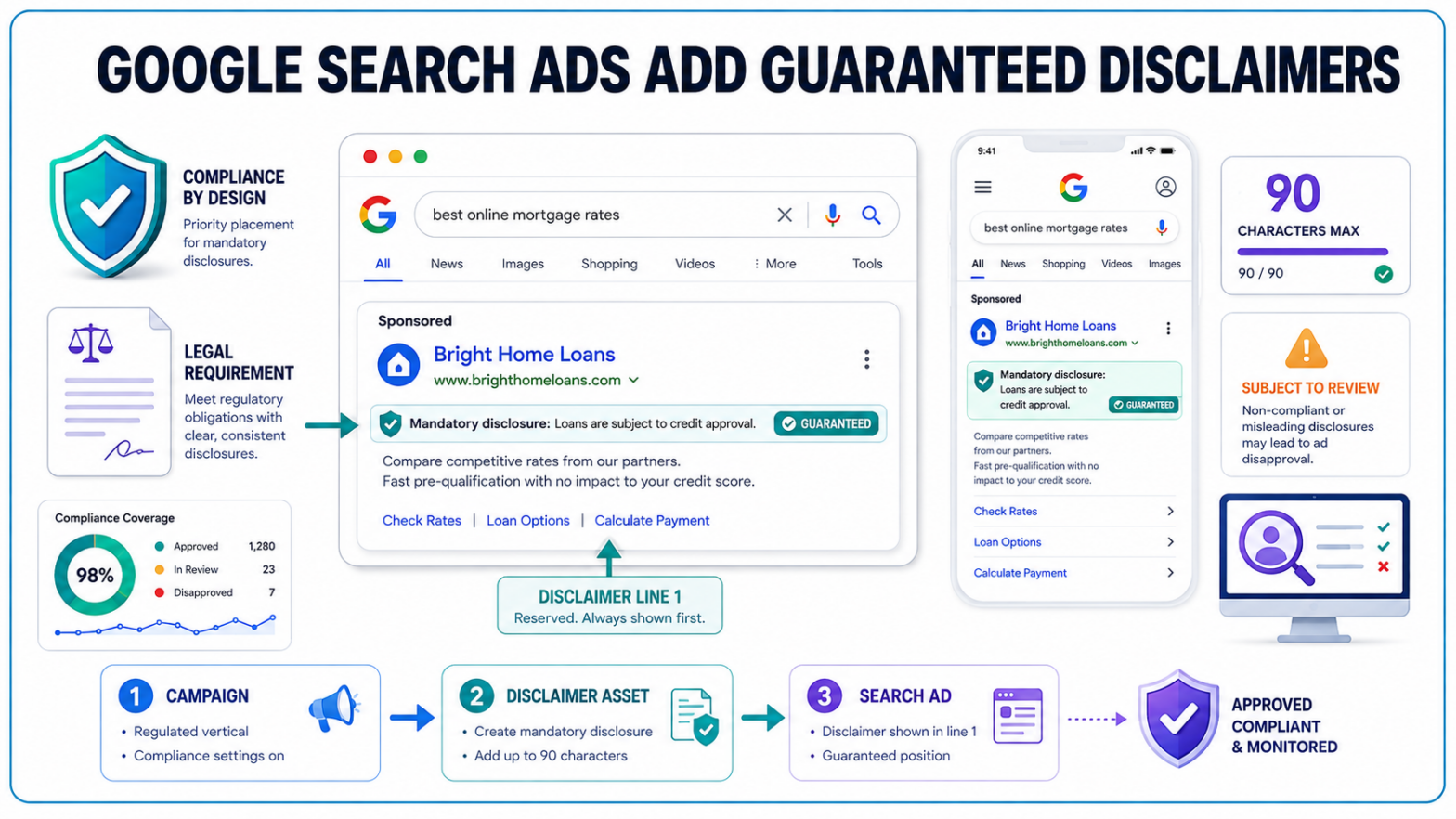
Now, Google is giving regulated advertisers a dedicated place to put them, with a new text disclaimer asset that takes priority over standard description copy in responsive search ads.
The feature is designed for businesses that must display specific terms, conditions, or disclosures directly in their advertising. Finance, insurance, healthcare and legal advertisers stand to gain the most, but the asset will be available globally to all Google Ads accounts.
There is an important distinction, though. A rejected disclaimer does not automatically stop the entire ad from running.
The Disclaimer Will Take Over Description Line One
Google’s text disclaimer asset is not another optional extension that may or may not appear.
Once approved and attached to a campaign, the disclaimer is guaranteed to display across that campaign’s eligible desktop and mobile Search ads. Google places it in the first available description space, giving it priority over existing copy.
That priority changes how advertisers will need to build responsive search ads.
Any standard description pinned to position one will be overridden while an approved disclaimer is active. If Google moves a headline into the beginning of the description field through its responsive ad flexibility systems, the disclaimer will appear immediately after that headline.
The disclosure is no longer competing with promotional descriptions for rotation. Google has effectively reserved the most prominent description position for required language.
For regulated brands, that solves a persistent problem. Responsive search ads are assembled dynamically, so relying on ordinary description assets does not guarantee that legally required copy will appear in every impression. The new asset removes that uncertainty.
It also makes Google Ads compliance part of the campaign structure rather than something advertisers attempt to manage through pinning alone.
Ninety Characters Must Carry the Full Disclosure
Advertisers do not get additional space for using the new format.
A text disclaimer is limited to 90 characters, the same maximum length as a standard responsive search ad description. It can only be added after both the campaign and its responsive search ad have been created. Advertisers cannot configure the disclosure during the initial campaign setup.
That creates a narrow drafting constraint for legal and compliance teams.
Required language may need to include licence information, eligibility conditions, rate qualifications, geographic restrictions, risk notices or other category-specific terms. Some disclosures that work on a landing page will not fit into a 90-character ad field without being rewritten.
The shorter version still needs to satisfy the advertiser’s regulatory obligations.
Google does not determine whether a disclosure is legally sufficient for a particular product, jurisdiction or profession. The platform provides the placement mechanism. Responsibility for the wording remains with the advertiser.
Campaign teams may need to involve legal reviewers earlier in the ad production process, particularly when one campaign covers multiple services or regions with different disclosure requirements. A single general disclaimer may not be appropriate across every ad group even when the campaign shares a common budget and bidding strategy.
That makes campaign architecture a compliance decision, not just an account-management preference.
A Rejected Disclaimer Does Not Automatically Pause the Ad
The enforcement risk is more nuanced than a full campaign shutdown.
Google states that if a disclaimer asset is disapproved during policy review, the disclaimer will not serve. The underlying responsive search ad may continue running with another description asset, including a description pinned to position one. If no description is pinned there, Google can select another standard description from the ad.
In plain terms: the ad can stay live while the required disclosure disappears.
That may create a more serious problem for a regulated advertiser than a visible Google Ads disapproval. A campaign could remain active even though its approved compliance language is no longer appearing.
Advertisers should not assume that continued impressions confirm the disclaimer is healthy.
Disclaimer performance and serving data will be available through the Google Ads assets report. Teams can open the Disclaimer summary card under the Associations tab to review metrics such as impressions.
That reporting should become part of routine policy monitoring for affected accounts. Google already weighs advertiser history and policy compliance when making broader serving decisions, and its expanding Search ad trust restrictions give clean account management added importance.
A disclaimer rejection may not immediately stop lead generation, but it can leave the business advertising without language it considers mandatory.
Guaranteed Placement Still Has Display Limits
Google describes approved disclaimers as guaranteed to appear, but that guarantee has edge cases.
The company says disclaimer text may occasionally be truncated when users increase font sizes for accessibility. Truncation may also occur in certain languages because of character and display limitations.
Advertisers therefore need to put the most critical information first.
A disclosure that depends on its final few words may not communicate the intended qualification in every rendered version. Legal teams accustomed to reviewing complete text in a fixed layout will need to account for the variable presentation of Search ads.
The disclaimer also occupies space that could otherwise carry a benefit, offer, differentiator or call to action. That trade-off may affect click-through rates, particularly for ads already working within tight copy limits.
Google says adding the asset will not affect Ad Strength. It is also compatible with AI Max features, including Final URL Expansion and text customization.
That compatibility is notable because Google is giving automated ad systems more freedom while simultaneously creating a fixed field that those systems cannot rotate away. Advertisers using AI Max for Search campaigns can retain automated copy and landing-page capabilities while keeping required disclaimer language present.
The creative system stays flexible. The compliance text does not.
Compliance Reviews Now Need an Asset-Level Check
For marketers managing regulated Google Search ads, the practical change is straightforward: disclosure approval and disclosure serving must be checked separately from the status of the responsive search ad.
The new workflow should include confirming that the disclaimer is attached to every relevant campaign, approved, receiving impressions and still accurate for the service being advertised. Teams should also review any description copy previously pinned to position one because it will be displaced whenever the disclaimer serves.
This is not limited to campaign launches.
Interest rates change. Licensing details expire. Eligibility terms are revised. Professional regulations differ by province, state and country. A disclaimer that passed review when an ad was created may become outdated while the campaign continues to run.
Google’s wider advertising system is already moving toward tighter controls around sensitive data, advertiser trust and personalized targeting in regulated categories. The disclaimer asset addresses a different part of that environment: the language users must see before they click.
Advertisers can create the asset from the Assets section of an existing campaign by selecting Text Disclaimer, choosing the applicable campaigns and entering the required copy. Once Google approves it, the disclosure takes precedence in the ad’s description field.
For brands that depend on mandatory ad disclosures, the key status is no longer simply “Eligible.”
The disclaimer itself must be eligible too.