

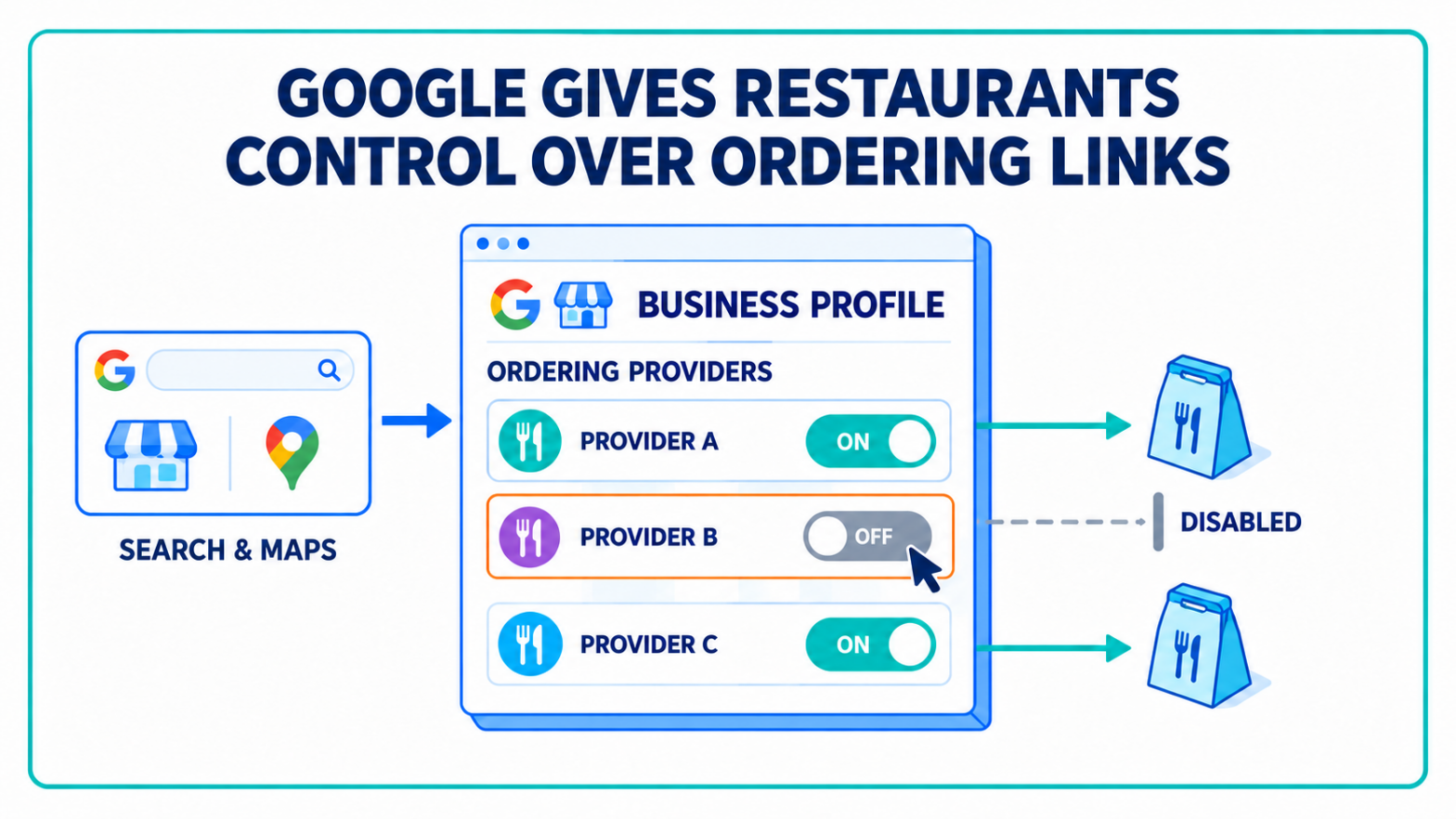
Restaurants can now decide which third-party ordering providers appear on their Google profiles without waiting for each platform to process a removal request. The change gives operators more control over where customers go after finding them on Search and Maps.
Google’s Lisa Landsman confirmed the capability in a public announcement, saying restaurants can manage and opt out of individual providers directly through their dashboard. The immediate change concerns ordering destinations, rather than how prominently a restaurant appears in search results.
For operators, that distinction puts the focus on what happens after discovery: which businesses receive the customer’s next click.
Restaurant Ordering Links Become an Operator-Controlled Choice
Previously, requesting a provider’s removal and having that removal completed were separate steps. A restaurant could initiate the process through Business Profile, but the provider remained responsible for acting on it.
Landsman’s announcement of direct provider controls describes a different arrangement. Restaurants can now disable a specific provider through their dashboard instead of submitting individual requests to delivery platforms to disconnect a feed.
The change affects restaurant ordering links displayed on Google Search and Maps. It gives operators a way to adjust their public ordering options when a particular integration no longer fits their business.
Landsman also cautioned against treating fewer providers as an automatic improvement. Customers may prefer platforms where they already have subscriptions or saved payment details, she said.
That leaves restaurants with a choice, not a prescribed ordering strategy. The control allows an operator to remove an unwanted route while retaining providers it still wants customers to use.
A Preferred Link Is Different From a Disabled Provider
Google already offers several ways to manage ordering destinations. They do different jobs.
Its online ordering guidance allows restaurants to mark a provider or custom link as preferred for pickup, delivery or both, where those services are supported. Selecting a preferred option identifies the restaurant’s choice; it is not the same action as disabling another provider.
There is also a broader switch for accepting orders through the profile. Turning that off hides third-party ordering options and links the business has added.
The newly announced provider-level control sits between those choices. A restaurant can decide against one integration without treating every ordering destination as unwanted.
Custom links remain part of the setup. Google’s local business links documentation explains that businesses can add transaction links and choose a preferred destination when several are present. Third-party service links can also appear automatically and be maintained by partners.
Those different sources explain why a restaurant’s ordering options may extend beyond the links its own team entered. Managing the listing involves both selecting destinations and understanding where they came from.
Default-On Integrations Still Need an Authorized Relationship
More direct control for restaurants does not remove the obligations placed on ordering providers.
Google’s Ordering Redirect compliance requirements, last updated October 19, state that partner integrations are enabled by default. Merchants can enable or disable an integration through product controls.
The same policy requires partners to have a direct contractual relationship with every merchant included in their integration feed. Providers must remove merchants that no longer have that relationship or that request removal from the feed.
Google also specifies a five-business-day removal requirement for merchants that suspend or discontinue a provider’s service.
The distinction is important. A restaurant’s ability to disable an integration is a product control. A provider’s responsibility to maintain an eligible merchant feed is a separate policy obligation.
Default availability is therefore not permission for a provider to list any restaurant it chooses. Google’s contractual requirements still apply, and its policy allows enforcement against integrations that breach those requirements.
The update adds another owner-facing control to Google Business Profile, while leaving providers responsible for the business relationships behind their listings.
Local SEO Teams Face a Documentation Gap
The announcement and Google’s customer-facing instructions are not yet fully aligned.
At the time of review, the ordering help page still describes selecting a provider under Food ordering and choosing Remove link. It says providers must remove third-party links within five business days of a request and offers an escalation route when they fail to act.
That guidance does not yet explain the newly announced direct provider controls. The continued presence of removal-request instructions should not be read as evidence that the dashboard capability has replaced every feed-removal process.
For local SEO teams, the practical change is to review ordering destinations alongside the restaurant’s current services and provider relationships, then check the public listing after making an adjustment. Profile visibility, clicks and completed orders remain different measures; changing an available destination does not, by itself, establish a ranking or revenue improvement.
The announcement does not establish bulk-management support or explain whether agencies can operate the new controls through the Business Profile API. Those details matter for teams managing restaurant groups, where a dashboard action at one location does not demonstrate a chain-wide workflow.
Google’s existing guidance also notes that ordering options can appear differently by country or region: some profiles group them under an Order online button, while others display Place an order links separately.