
Gmail isn't suddenly an open book for advertisers. But Google has changed the rules around when information from someone's inbox can influence the advertising they see.
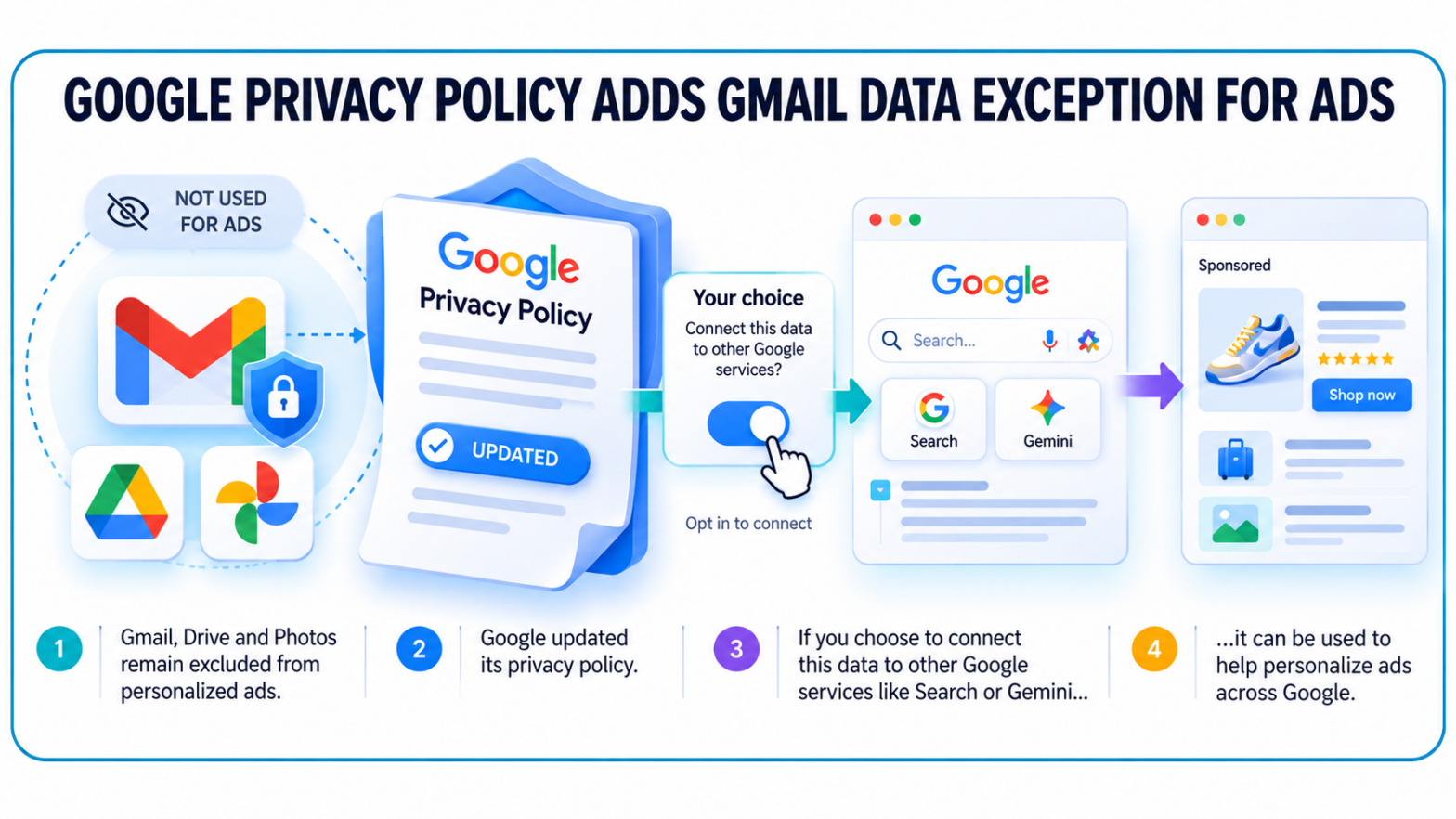
An update to the company's privacy policy, effective October 16, 2026, introduces an exception to its longstanding restriction on using Gmail, Google Drive and Google Photos content for personalized ads. The exception applies when users choose to share information from those services with other Google products that support advertising.
The distinction matters. Google isn't allowing advertisers to read private emails or browse photo libraries. It's allowing certain information derived from connected accounts to influence advertising within its own services.
Google's Privacy Policy Now Makes an Exception for Connected Data
For years, Google's privacy policy explicitly excluded Gmail, Drive and Photos content from personalized advertising. That protection remains in the revised policy, but it now comes with an important qualification.
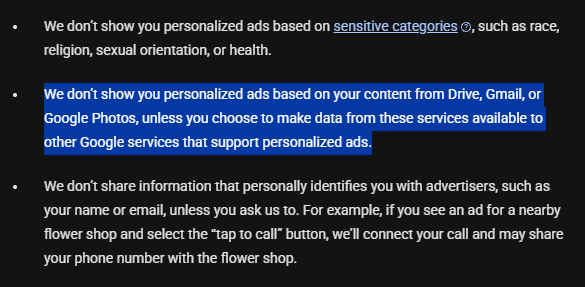
The updated Google Privacy Policy states that the exclusion applies:
"unless you choose to make data from these services available to other Google services that support personalized ads.”
Google also explains that services such as Search and Gemini may access information from other Google products when users permit those connections. Search can then process some of that information to personalize its content, including advertisements.
The change establishes a clearer relationship between Google's AI personalization features and its advertising business.
Previously, the policy presented Gmail and Photos content as separate from ad personalization. Now, that separation depends partly on whether the account holder has authorized another Google service to access the information.
The permission is not automatic. Simply having a Gmail account does not mean its contents will be used for targeted advertising.
Google's documentation also distinguishes between what its general privacy policy permits and which app connections are currently supported. Although the policy mentions Drive, its Search Help documentation presently lists Gmail, Google Calendar and Google Photos among supported connected-content sources, with availability varying by region.
Personal Intelligence Is the Connection Between Gmail and Search Ads
The policy change is closely tied to Google's Personal Intelligence features, which began rolling out in January 2026.
Personal Intelligence allows Google's AI products to draw on information from connected applications to generate responses tailored to individual users.
A person looking for restaurants near an upcoming holiday destination, for instance, could receive suggestions informed by hotel reservations in Gmail. Someone researching products could receive recommendations influenced by previous purchases or preferences found in their connected account.
Those capabilities were introduced primarily to make Google's AI responses more personally relevant.
Advertising introduces another use for the same context.
According to Google's Search Help documentation, Search may draw on summaries, excerpts and inferences from connected applications to personalize a user's experience. The documentation confirms that the information may also influence the ads shown to that person.
The connection extends beyond a single AI conversation. Google says enabling content-app connections for Search services can permit access across products including Search, Maps, Shopping, Discover and other supported services.
That creates a broader scope than someone might expect when connecting Gmail to improve an AI-generated answer.
Google has also expanded access to Personal Intelligence since its initial paid-subscription launch. Its current support documentation includes Canada among eligible regions for connected-content functionality, although individual features and app connections remain subject to regional availability.
Advertisers Still Cannot Access Gmail Messages or Photos
Google's updated policy does not create a direct Gmail targeting tool for advertising campaigns.
The company says advertisers cannot access connected Gmail inboxes or Google Photos libraries. It also maintains that advertisements are not based directly on those underlying collections.
Instead, Google's systems can process information from connected services and use relevant context when personalizing the user's experience.
Consider someone who asks AI Mode for travel recommendations. If connected data helps Google establish the destination or travel dates, that context could influence which commercial results or advertisements are relevant to the conversation.
It does not give a hotel advertiser access to the person's booking confirmation.
This distinction also applies to Google AI Mode ads, where sponsored content can appear alongside AI-assisted search experiences.
Google's advertising systems already consider factors such as search queries, contextual relevance and user interests. Connected-app information introduces another potential source of context for opted-in accounts.
The company continues to prohibit personalized advertising based on sensitive categories, including race, religion, sexual orientation and health.
Nor does the new policy establish that every AI Mode advertisement uses connected-app data. Google's documentation permits the use of certain information but does not disclose how frequently it contributes to ad selection.
There is also a difference between personalized search recommendations and paid advertising. Earlier research into Gmail signals in Google AI Mode examined how connected information could influence brand recommendations. Those findings concerned AI-generated recommendations, not direct evidence of paid-ad targeting behaviour.
Disconnecting Gmail Doesn't Automatically Erase Search History
Google's privacy controls give users the option to disconnect content applications, but there is another distinction in its documentation: disconnecting an app does not necessarily remove information that Search has already retained.
For eligible personal accounts, users can manage connections through Google's Search Services Personalization settings.
The controls allow users to manage Personalized Recommendations and choose which supported applications are connected. Google also provides separate controls for advertising personalization through My Ad Centre.
These settings govern different activities. Turning off a connected app prevents that connection from supplying additional context, while advertising preferences determine how Google uses eligible information to personalize ads.
Google's support documentation states that disconnecting a content app, or deleting information from the original app, does not automatically delete data already saved in Search Services History.
Previously processed information may remain available for other permitted purposes, including improving Google's services.
Users can review and delete eligible saved activity through Google My Activity.
The retention distinction extends to generative AI development. Google says its Search systems do not train models directly on complete Gmail inboxes or Photos libraries, but certain summaries, excerpts and other information produced during personalized interactions may be used for training.
That is a separate data-processing practice from advertising, governed by its own documentation and controls.
Google Ads Campaigns Get No New Gmail Targeting Option
For digital marketers, the policy clarification concerns how Google may determine advertising relevance rather than a change to the targeting controls available inside Google Ads.
Google has not announced a new advertising audience built from Gmail messages, a connected-photo targeting option or a campaign report identifying impressions influenced by Personal Intelligence.
Advertisers still work through existing campaign settings, bidding systems, creative assets and conversion measurement.
The distinction is relevant to AI Mode advertising, where Google has already been testing additional ways for eligible Search campaigns to appear within AI-driven results.
More personalized responses could create different contexts around otherwise similar searches. However, the revised privacy policy does not establish a measurable improvement in campaign performance or grant advertisers access to the underlying personal information.
For campaign managers, the immediate implications remain limited to existing practices: maintaining accurate product information, aligning ad creative with search intent, monitoring available performance data and following Google's personalized advertising policies.
The new privacy language concerns the data Google's systems may use internally, not a new set of advertiser-controlled targeting signals.
Google's October 16 policy remains explicit on two points: connected-app access is a user choice, and advertisers do not receive direct access to Gmail or Google Photos content. What has changed is the policy's acknowledgement that information shared across Google's services can also become part of its advertising personalization process.