
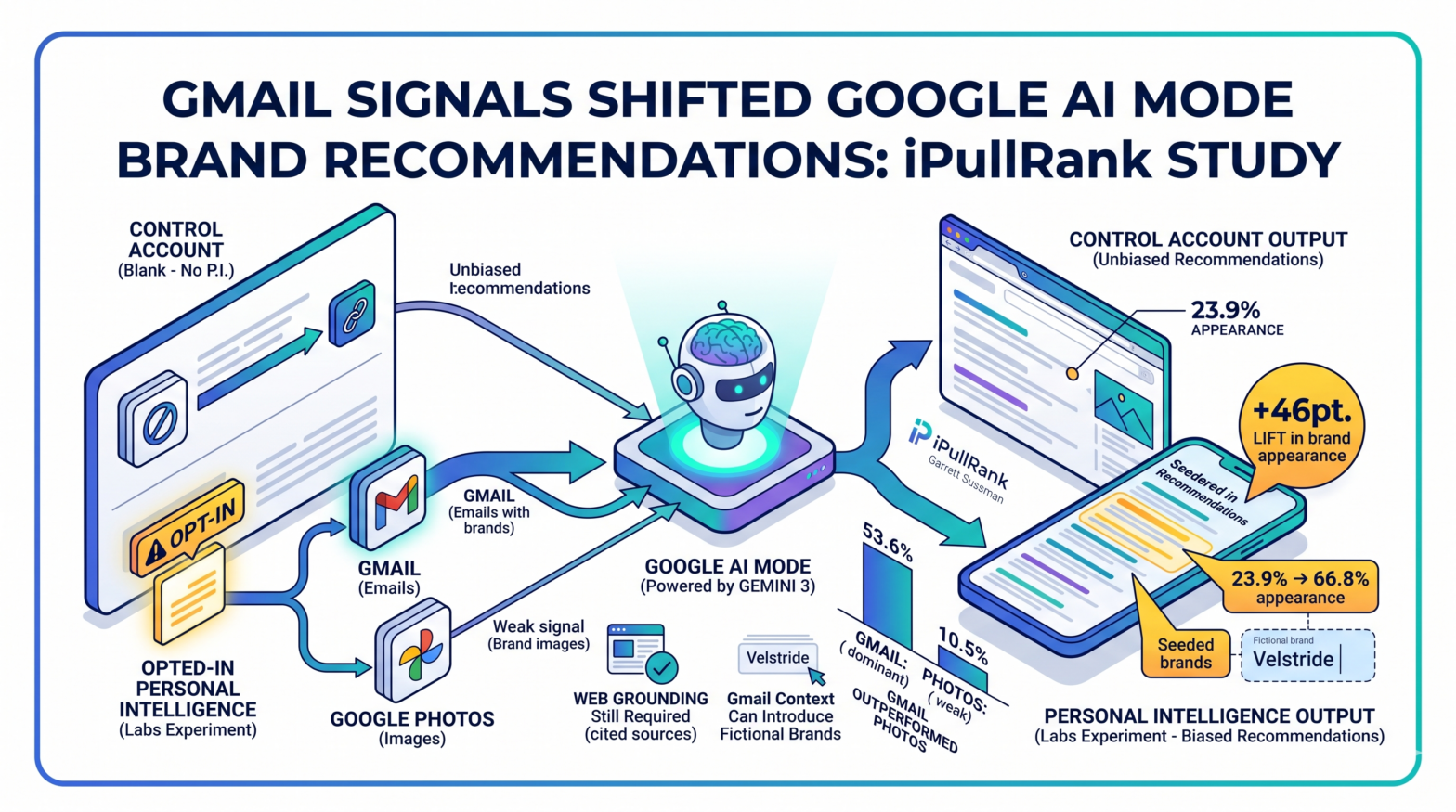
Brands introduced through Gmail were measurably more likely to appear in Google AI Mode recommendations when users had enabled Personal Intelligence, according to a controlled study published by SEO agency iPullRank in May 2026. Analyzing 1,922 AI Mode responses collected between March 30 and April 15, 2026, the study found a 46-percentage-point lift in brand appearance rates in opted-in Personal Intelligence accounts compared to a blank control account with no Personal Intelligence connection.
Google made Personal Intelligence available to AI Pro and AI Ultra subscribers on January 22, 2026, as a strictly opt-in feature, meaning no connection to Gmail or Google Photos is activated unless a user explicitly enables it. Google's product blog states that AI Mode uses Gemini 3 to power the feature and does not train directly on users' Gmail inboxes or Google Photos libraries. The feature remains a Labs experiment with no announced timeline for general availability.
What the Study Measured
iPullRank constructed a three-account test design. One account was a blank control with no Personal Intelligence connection. A second blank account was linked to Personal Intelligence and seeded with brand-related signals via Gmail and Google Photos. The third was a personal account belonging to the study's author, Garrett Sussman, carrying years of accumulated Google history.
The test covered eight product and service categories, including coffee machines, running shoes, banks, and streaming services, with each category tested across six prompt types per category using both Gmail messages and Google Photos images.
The study tracked brand appearance rate, share of voice, top-3 and top-10 placement, citation rate, and what the researchers termed coverage-aware rank, a metric that assigns a rank of 20 to any response where the seeded brand did not appear, penalizing brands with low overall presence rather than masking their absence in averaged-rank calculations.
Seeded Brands Appeared Significantly More Often
The primary finding was a sharp divergence between the Personal Intelligence-connected account and the control. Brand appearance rates in the Personal Intelligence account rose from 23.9% to 66.8% after seeding. In the control account, appearances moved from 21.9% to 18.9% over the same period.
Top-3 placement improved from 4.5% to 24.9% in the seeded Personal Intelligence account, and top-10 placement improved from 17.7% to 54.6%. The control account showed no comparable movement in either metric.
The time-series data reinforced the finding: the Personal Intelligence account tracked close to the control early in the study window, then diverged after seed events were introduced. That pattern reduced the likelihood that normal AI Mode volatility explained the result.
Gmail Outperformed Google Photos as a Signal
Not all seeded signals produced equal results. Gmail-based seeding was the dominant signal type in the experiment by a wide margin.
Brands seeded through email appeared in 53.6% of relevant responses, earned an average rank of 6.78 when present, and achieved a coverage-aware rank of 12.92. Brands seeded through Google Photos appeared in only 10.5% of responses, ranked 7.82 on average when present, and carried a coverage-aware rank of 18.73, close to the absence penalty built into the metric.
Email seeding also drove citation behaviour. The citation rate for email-seeded brands was 11.35%, compared to 0.54% for photo-seeded brands. The one exception was coffee machines, where photo seeding produced measurable movement, likely because the tested brand, Jura, carried existing entity recognition that the image signal reinforced.
Fictional Brands Appeared After Gmail Seeding
iPullRank ran a secondary stress test using fictional brand names, including Velstride, Northpeak SEO, HarborTrust, Brewform, Greyfen Apparel, Ironclad Mobile, Streamwell, and Kavro, seeded through Gmail in the same recommendation-style format as the real-brand email seeds.
The test was designed to determine whether Personal Intelligence-connected Gmail context could introduce a brand association into AI Mode recommendations for a brand with no real-world footprint. The fictional brands appeared in 35.7% of relevant responses, compared to 55.8% for real email-seeded brands. Since the fake brands were fictional, the researchers did not expect AI Mode to cite public web sources for them, and the citation rate for fictional brands was 0%.
The researchers interpreted the finding as evidence that Gmail context can introduce a novel brand association into the recommendation set, while real brands retain an advantage through their external web presence, entity signals, and citation availability.
Brand Lift Varied by Category and Prompt Framing
The lift was not uniform across all eight categories tested. Consumer product categories with clear preference signals, coffee machines, hoodies, running shoes, and smartphones, showed stronger share-of-voice gains than trust-heavy or expertise-dependent categories such as banks, productivity tools, streaming services, and SEO agencies.
The prompt structure also changed the results. Constrained recommendation prompts asking AI Mode to "recommend 3" produced stronger seeding effects than broad "best right now" queries. Prompts using risk-reduction or dependability framing, such as "safest choices" or "most reliable", generated higher-confidence recommendation language more frequently than generic prompts.
Personalization Did Not Replace Web Grounding
Despite the Personal Intelligence signal influence, AI Mode continued to ground brand recommendations in public web sources. For product categories, Google Shopping carried significant weight as a citation source. For categories such as banks, streaming, productivity tools, and SEO agencies, brand-owned sites and other brand sites were the primary citation sources.
The study also found that uncited brand mentions decreased after seeding, meaning that as Personal Intelligence-connected accounts surfaced more seeded brands, those mentions were more frequently tied to external sources, not less.
The researchers concluded that personalization does not remove the need for a strong web presence; it may raise the bar, requiring brands to be visible in the user's context and legible to AI systems through the broader web simultaneously.
Scope and Limitations of the Study
iPullRank's study does not reveal Google's internal ranking logic for Personal Intelligence-connected accounts. The team had no access to retrieval processes, model weights, or the Personal Intelligence decision layer, and the test ran across only three accounts over 17 days.
The 17-day study window limits conclusions about the persistence and decay of the observed brand lift. The study also applies only to opted-in Personal Intelligence conditions. The data covers opted-in Personal Intelligence only, not default AI Mode, which Google says is not connected to Gmail or Photos unless a user explicitly enables it.
iPullRank says it plans to test signal decay, email behaviour variants such as opened versus unopened messages, and more product categories, with prompt phrasing identified as another variable for future testing.