
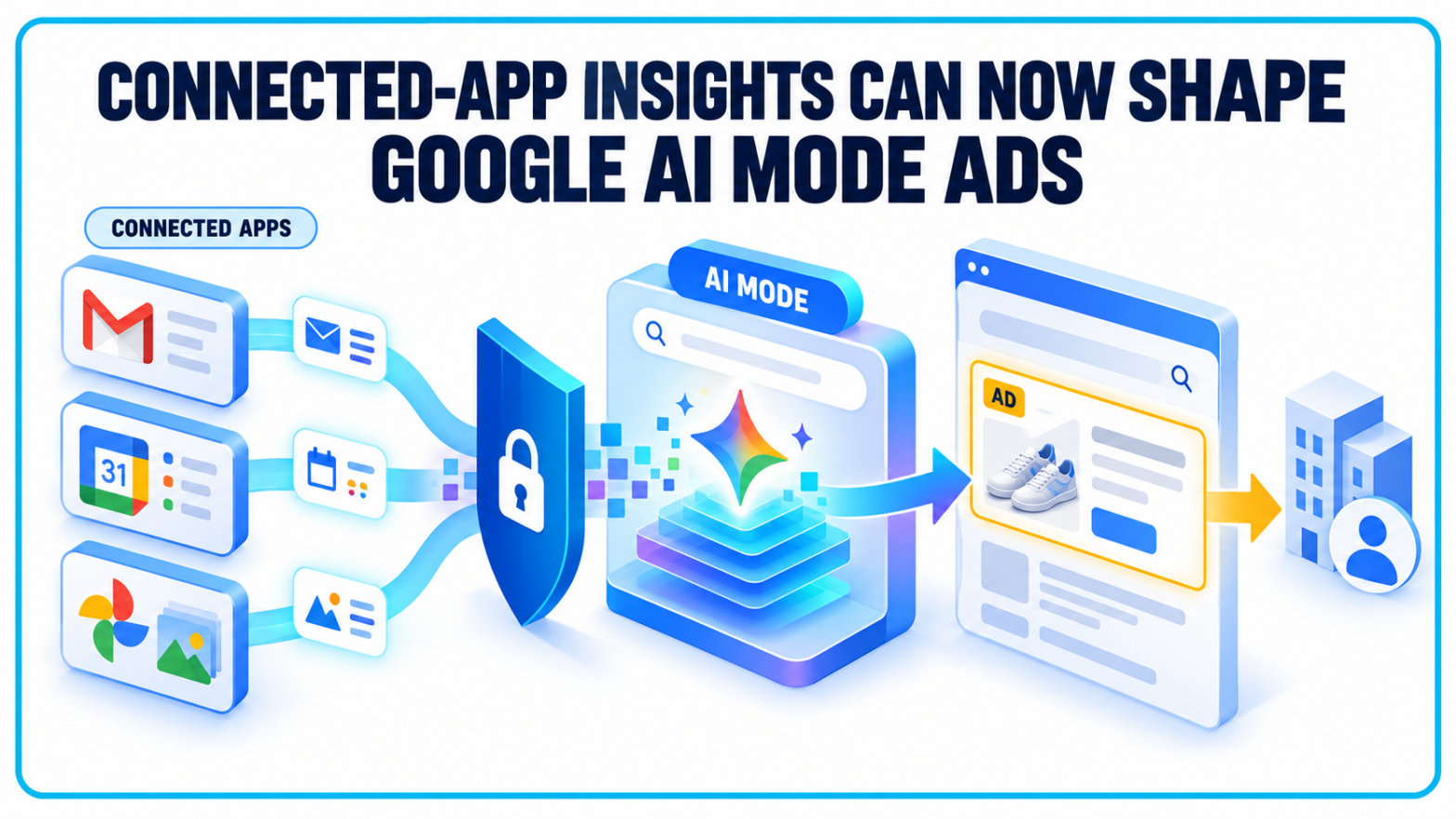
Google’s most personalized version of Search is no longer insulated from advertising. Connected-app insights that tailor AI Mode responses may now also influence the ads shown to opted-in users.
The change brings advertising into a part of Google Search built around personal context from services such as Gmail, Google Calendar and Google Photos. It also creates a careful distinction: advertisers do not receive access to that content, but Google may use information derived from it when deciding which ads are relevant.
Connected-App Context Can Now Influence AI Mode Ads
Google’s updated Search Help guidance says Search services may reference summaries, excerpts and inferences from connected content apps to personalize a user’s experience. Those signals can help AI Mode understand details such as travel plans, previous purchases, calendar commitments and individual preferences.
The same derived information may now contribute to ad personalization.
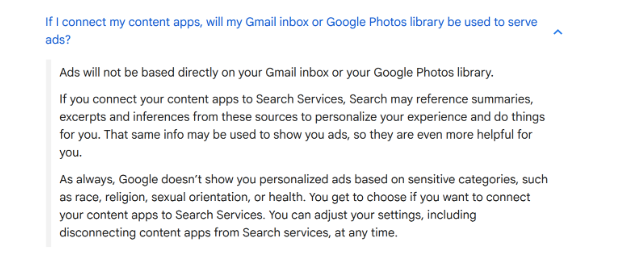
“That same info may be used to show you ads, so they are even more helpful for you.”
This expands the role of Google AI Mode ads. An advertisement can already reflect the user’s query, the surrounding AI-generated response and other recognized interests. For people who connect content apps, Google can potentially interpret the request with a deeper layer of personal context before selecting an ad.
A query about clothing for an upcoming trip, for example, could be interpreted alongside an itinerary found in a connected email. A request for a restaurant might be shaped by previous reservations or preferences. Google has not documented precisely how individual signals are weighted during the ad-selection process.
The Inbox Is Not a Direct Advertiser Targeting Tool
Google draws a firm line between personal content and the information used by its advertising systems.
Ads will not be based directly on a person’s Gmail inbox or Google Photos library, according to the company. Advertisers will not be able to access either service through Google Ads, and Google says it does not share personally identifying details such as a user’s name or email address with advertisers unless the user takes an action that requires it.
The distinction rests on processing. Google may extract summaries, excerpts or inferences from a connected app to personalize Search services. Those processed signals may then influence advertising, even though the underlying inbox or photo library is not exposed to the advertiser.
Google also says sensitive categories, including race, religion, sexual orientation and health, are excluded from ad personalization. Those restrictions sit alongside Google’s broader rules for personalized advertising, including additional limitations for housing, employment and consumer-finance campaigns.
The company’s privacy policy, effective October 16, 2026, now addresses this data path more explicitly. It says users may allow services such as Search to access information from Gmail, Drive and Google Photos, and that Search may process permitted data to personalize content, including ads.
Personal Intelligence Has Expanded Beyond Its Initial Test
Google introduced Personal Intelligence in AI Mode in January 2026. The first release was limited to eligible Google AI Pro and AI Ultra subscribers in the United States and required users to opt into a Search Labs experiment.
That footprint has since grown substantially.
At Google I/O in May, the company said it was expanding Personal Intelligence to nearly 200 countries and territories across 98 languages, with no paid subscription required. Current eligibility documentation says users must be at least 18, signed into a personal Google Account, have the Personalized Recommendations setting enabled and connect one or more supported content apps.
Workspace business, education and enterprise accounts are not part of the consumer feature. Availability can also vary by country, language and app connection as Google continues its rollout.
Participation remains optional. Users can choose whether to connect content apps and can disconnect them through their Google settings. Google warns that AI Mode may draw incorrect connections between information or misinterpret personal context, leaving users to correct the response or provide feedback when personalization misses the mark.
Advertisers Get More Context but No New Targeting Switch
The update changes how Google may select an ad, not how an advertiser configures a campaign.
Google’s consumer documentation does not introduce a new Personal Intelligence audience, connected-app targeting option or bid adjustment. It also does not offer advertisers access to the summaries or inferences used during ad selection. No dedicated report has been announced to show whether an impression was influenced by connected-app information.
That keeps the intelligence inside Google’s systems.
The direction fits Google’s broader approach to AI search advertising. Campaign eligibility, automated matching and AI-generated search experiences give the platform more room to interpret intent without exposing every input behind an auction. Personal Intelligence adds another potential context layer, but advertisers still work through existing campaign types, assets, feeds, bidding systems and conversion signals.
In practice, marketers should not treat connected Gmail or Photos data as a selectable audience segment. The immediate work remains grounded in accurate product feeds, relevant landing pages, compliant creative, dependable conversion tracking and clear consent practices. Those inputs give Google usable campaign information without assuming access to personal content that advertisers cannot see.
Privacy Settings Now Carry Commercial Consequences
Connecting an app was initially presented as a way to make AI Mode answers more useful. The advertising test adds another consequence to that decision.
Someone who enables Personal Intelligence is allowing Search services to interpret permitted information across connected apps. That context may affect recommendations, generated answers and, now, the commercial messages placed alongside them. Users can separately manage ad personalization through My Ad Centre, but the combination of Search personalization, connected-app permissions and advertising settings makes the resulting experience dependent on several controls.
Google has not disclosed the size, geographic scope or duration of the ad test. It has also not said whether every eligible Personal Intelligence user may encounter personalized ads or when the experiment could become a wider rollout.
For now, the documented action remains with the user: connect a supported content app, keep Personalized Recommendations enabled or disconnect the app to remove that source from Search services. Advertisers continue to operate through existing Google Ads controls without access to the inboxes, photos or connected-app details behind the personalized result.