
Google Shopping account access has always carried a quiet risk. One wrong user permission, one outdated login, one client account tied to the wrong person, and a routine agency workflow can turn messy fast.
Google is now tightening that layer inside Merchant Center for Agencies with two new access roles built specifically for teams managing multiple client accounts.
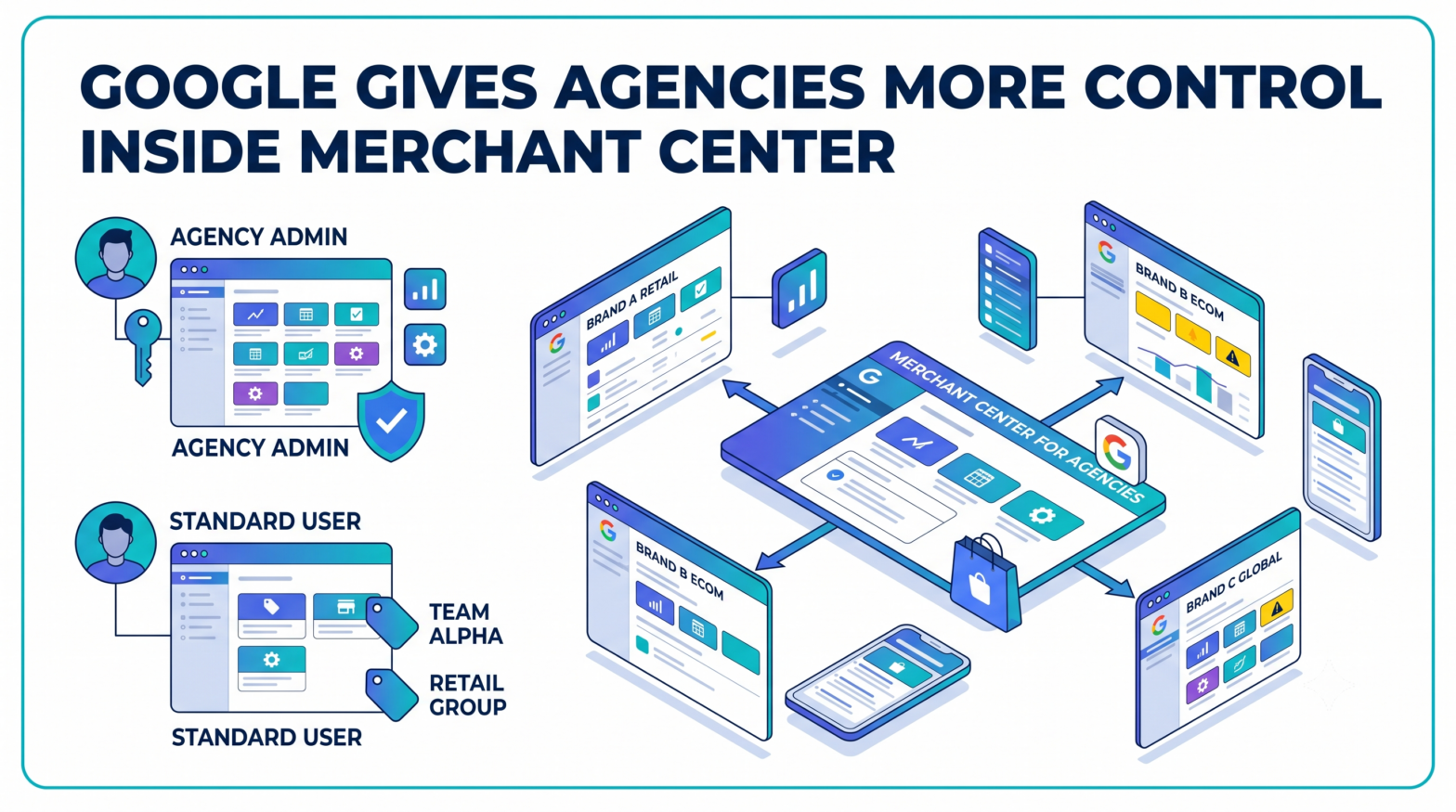
According to Google Ads liaison Ginny Marvin, Google is rolling out Agency Admin and Standard roles in Merchant Center for Agencies to “help streamline workflows and improve security.” The change gives agencies a more centralized way to link clients, assign users, group accounts, and control who can touch what inside a multi-client Merchant Center environment.
For ecommerce teams, this is not a campaign feature. It does not change bids, feeds, Shopping ads, or Performance Max delivery by itself.
It changes the operating system around them.
Client Access Is Moving Away From Individual Users
The core shift is simple: clients can now be linked directly to an agency rather than to individual users.
That matters because agency teams are rarely static. Account managers move across portfolios. Feed specialists join and leave. New hires need limited visibility before they need full access. Clients change agencies. Someone eventually forgets to clean up permissions.
Under the new model, Merchant Center for Agencies gives teams a central place to grant and remove access to client Merchant Center accounts. Google’s support page for managing user access in Merchant Center for Agencies positions the feature around agency-level control, rather than scattered user-by-user access management.
Marvin described the change as “smoother client linking,” with clients connected directly to the agency and access managed from one centralized place. That is the practical heart of the update.
For agencies managing Google Shopping, the access layer has become more important as Merchant Center has grown beyond a basic product feed upload tool. Feed health, product diagnostics, store quality, promotion status, shipping settings, and account warnings all sit upstream from ad performance. When access is too broad, too narrow, or too hard to audit, small permission issues can slow down revenue-critical fixes.
The new roles are designed to reduce that friction. Check out Google's Merchant Center update from January:
Agency Admins Get The Master Controls
The new Agency Admin role is the higher-permission tier.
Agency Admins can manage access inside the agency account, link and unlink client Merchant Center accounts, and provision or modify Standard users’ access to client accounts. In Marvin’s wording, Admin users have “full control and capabilities to securely manage access within the agency account.”
That gives larger agencies a clearer administrative layer.
Instead of giving broad Merchant Center access to every specialist who may need to check a feed, approve a promotion, or review an issue, agencies can keep master controls with a smaller group. Those Admins can then decide which Standard users should see which clients.
It is a familiar governance pattern in enterprise software, but a meaningful addition for Merchant Center workflows.
Google Ads has long had manager account structures that help agencies oversee multiple advertisers. Merchant Center has been moving closer to that agency-first model, especially as product data has become more tightly connected to campaign automation. Recent Google Ads changes, including updates to Smart Bidding and target-based campaign controls, have made clean account structure and signal governance harder to treat as back-office work.
Admin-level control now gives agencies a more formal way to separate leadership, operations, and execution.
That separation is important. The person fixing product disapprovals does not always need the same access as the person linking new clients or modifying user permissions across a full agency portfolio.
Standard Users Can Be Restricted By Client Group
The Standard role gives agencies a lower-permission user type for day-to-day work.
The key addition is not just the role name. It is the ability to control which client accounts Standard users can access.
Google is adding custom labels that allow Agency Admins to group client accounts by brand, vertical, team, or another internal structure. Those labels can then be used to manage user views in bulk. Marvin noted that Agency Admins can group clients “in ways that make sense for the agency” and assign Standard users access to subsets of clients at scale.
That solves a real operational problem for agencies with segmented teams.
A retail feed specialist may only need access to ecommerce clients. A regional account pod may only need visibility into Canadian accounts. A contractor may need temporary access to three brands, not the whole portfolio. A junior team member may need restricted visibility while onboarding.
Custom labels give agencies a practical way to map Merchant Center access to how the business actually works.
For ecommerce marketing teams, that also creates cleaner boundaries around sensitive client data. Product feeds can reveal pricing strategy, inventory depth, promotion timing, store issues, and commercial priorities. Merchant Center is not just a technical repository. It is a live operating layer for retail visibility.
Giving every user broad access across every client creates unnecessary exposure.
Merchant Center Is Becoming A Governance Layer
The timing fits Google’s broader direction.
Merchant Center for Agencies has been expanding as a central workspace for agencies that manage product data across multiple clients. The product is meant to reduce account switching and surface portfolio-level issues across client accounts. These new roles extend that logic from diagnostics and workflow into access governance.
That is where the update becomes more than an administrative tweak.
Google Shopping campaigns, Performance Max, product listings, promotions, and local inventory workflows all depend on Merchant Center data being accurate, approved, and maintained. When agencies scale that work across dozens of clients, the bottleneck is often not technical knowledge. It is coordination.
Who owns the fix?
Who can see the warning?
Who has permission to act?
Who should not have access anymore?
Those questions sit behind every multi-client platform. Google is now giving Merchant Center for Agencies a more structured answer.
The update also aligns with the wider shift toward automated campaign systems. As Google Ads leans further into AI-driven bidding, campaign expansion, and lifecycle signals, operational clarity becomes more valuable. TechWyse recently covered how Google Ads is automatically classifying conversion-based customer lists, another example of Google adding more meaning to data structures that once looked like simple account settings.
Merchant Center access roles sit in the same category. They are not flashy, but they shape how safely and efficiently automated systems can be managed.
The Practical Work Starts With An Access Audit
For marketers and ecommerce teams, the immediate implication is straightforward: agencies should review who currently has Merchant Center access, which clients each user can view, and whether that access still matches the user’s role.
That review should include former employees, contractors, shared inboxes, legacy client links, and users who were granted broad permissions for one urgent task and never removed. Agencies should also define how custom labels will be used before applying them. Labels based on team, vertical, brand group, region, or service line can all work, but mixing all of them without a naming standard could create a new kind of clutter.
The access audit does not need to change campaign strategy. It should make the operating model cleaner.
A good structure gives Agency Admins control over client linking and permissions while allowing Standard users to work only inside the accounts they actually support. For larger agencies, that can reduce internal risk and speed up client onboarding. For clients, it can make access handoffs cleaner when agency teams change.
A Small Permissions Update With Bigger Agency Implications
Google’s new Merchant Center agency roles will matter most to teams already managing product feeds, Shopping campaigns, and Merchant Center diagnostics at scale.
Smaller agencies with a handful of retail clients may see it as a housekeeping upgrade. Larger agencies will likely treat it as a governance layer they should standardize quickly.
The feature does not replace client account ownership. It does not remove the need for clean feeds, accurate product data, or disciplined Google Ads management. It does, however, give agencies more control over the people and permission structures around that work.
In a multi-client retail environment, that is not a minor detail.
Merchant Center issues move fast. Access control has to keep up.