Google Ads has spent years telling advertisers where their campaigns could grow. Now it is testing a more forceful way to make the case.
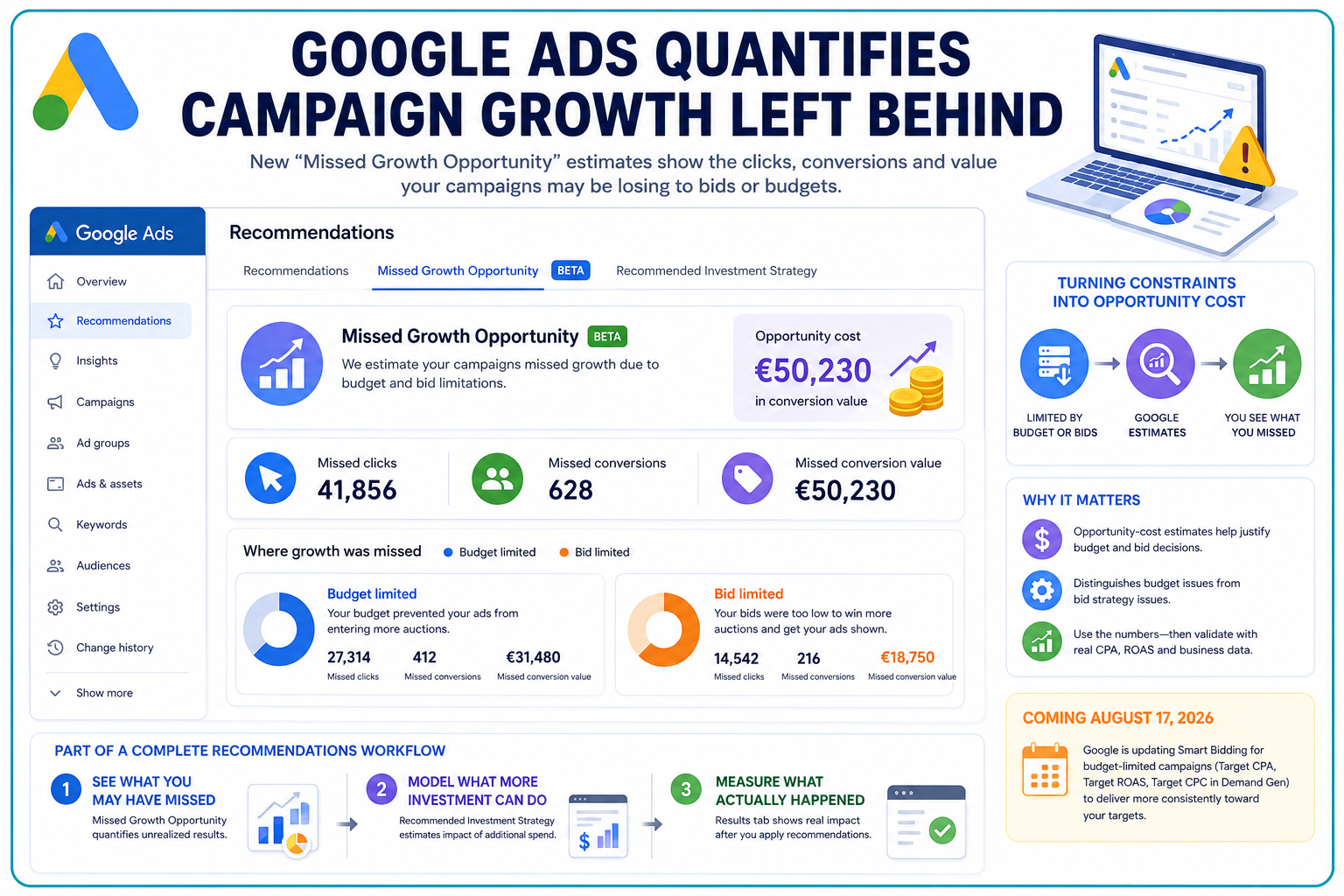
A new Recommendations tab feature estimates the traffic, conversions and conversion value an account may have missed because its bids were too low or its budgets were capped. Instead of displaying another general suggestion to spend more, the beta attaches numbers to the opportunity Google believes was left behind.
The feature, labelled “Missed Growth Opportunity,” was spotted in an advertiser account by Google Ads specialist Thomas Eccel. It appears to be moving from Google Ads Labs into the main Recommendations interface, although Google has not published a formal rollout announcement or confirmed how broadly the beta is available.
That limited release matters. The estimates may give paid media teams a clearer way to diagnose constrained campaigns, but they are still forecasts generated by the same platform asking for more investment.
Missed Growth Turns a Recommendation Into a Revenue Estimate
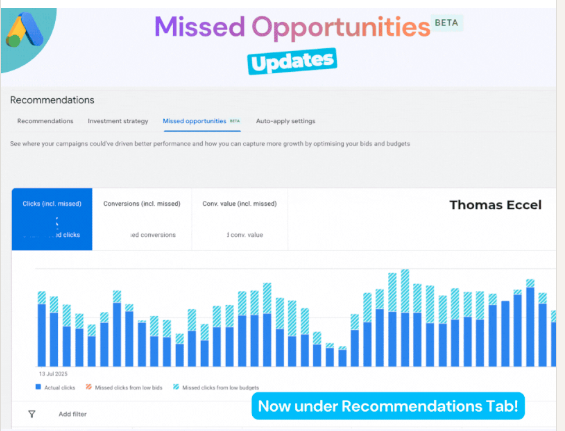
The beta shows advertisers what Google believes their campaigns could have achieved with fewer delivery constraints.
Figures may include missed clicks, missed conversions and unrealized conversion value. The interface also separates the projected loss by cause, distinguishing between growth restricted by insufficient budget and growth restricted by low bids.
That breakdown is the most consequential part of the update.
A budget-limited campaign cannot enter every eligible auction because its daily allocation is being exhausted or rationed. A bid-limited campaign may have money available but fail to compete effectively under its current bid strategy or target. Both can suppress volume, but they call for different responses.
Google’s existing Recommendations page already uses account history, campaign settings and search trends to suggest changes to bidding, keywords, ads and budgets. Its performance estimates are based partly on historical data, though Google explicitly says the page does not predict with certainty whether an advertiser’s results will improve.
Missed Growth Opportunity changes the presentation rather than the underlying principle.
“Raise your budget” is easy to dismiss. “You missed €50,000 in conversion value” is harder to ignore.
Google Is Reframing Constraints as Opportunity Cost
Most Google Ads budget recommendations have historically focused on future upside. An advertiser could increase a budget and potentially receive more clicks or conversions.
The new interface appears to work backwards.
It identifies the gap between observed campaign delivery and Google’s estimate of what might have happened without the constraint. That gives advertisers an opportunity-cost figure for maintaining their current bids or budgets.
The distinction is subtle, but commercially powerful.
Projected growth can feel optional. Missed revenue sounds like a loss that has already occurred, even when the figure is modelled rather than directly observed.
Google has not publicly explained the exact methodology behind the beta. It is therefore unclear which auction data, attribution settings, conversion delays, seasonality adjustments or confidence thresholds are used to calculate each missed opportunity.
Its other forecasting products offer some clues.
Google Ads bid simulators estimate how different bids might have changed weekly clicks, impressions, conversions and conversion value. Those simulations generally use recent campaign and auction data, often covering the previous seven days.
Performance Planner uses recent auction activity, seasonality, competitor behaviour and landing-page information to forecast the effects of campaign changes. Its forecasts are refreshed daily and commonly draw from the previous seven to 10 days.
The new estimates likely rely on related modelling systems, but that connection has not been confirmed by Google.
The Numbers Still Depend on the Account’s Conversion Data
A missed conversion estimate is only as useful as the conversion tracking behind it.
If an account counts low-value actions as primary conversions, Google may calculate substantial missed growth that has little connection to actual business outcomes. A form start, page view or imported lead can inflate projected opportunity when it is treated the same way as a completed sale or qualified enquiry.
Conversion value introduces another layer.
Ecommerce advertisers with transaction-specific revenue data may receive estimates tied relatively closely to recorded sales. Lead-generation accounts often assign static or modelled values to conversions, meaning an unrealized conversion value figure may reflect internal assumptions rather than revenue that was genuinely available.
Attribution also affects the result. Google Ads may assign value differently depending on the attribution model, conversion window and source of the imported data. Offline conversions that arrive late could leave the system temporarily evaluating campaign potential from an incomplete record.
Paid media teams should therefore read the estimates as directional forecasts, not audited losses.
The feature may still be useful. A campaign repeatedly showing substantial missed conversions due to budget limitations deserves investigation, particularly when recent cost per acquisition or return on ad spend remains within the company’s targets.
The estimate alone does not prove that increasing spend will preserve the same efficiency at a larger scale.
Recommendations Are Becoming a Budget-Planning Workspace
The Missed Growth beta is part of a broader expansion of the Recommendations section.
Google already offers a Recommended Investment Strategy tab that lets advertisers model additional weekly spending across eligible campaigns. Users can choose clicks, conversions or conversion value as the goal, then review suggested budgets and estimated changes in CPA or ROAS.
The tool generally appears when at least one campaign is limited by budget or could gain conversions through a relatively small increase in acquisition cost. Its estimates typically cover a seven-day period.
Google has also introduced guided recommendations, which prioritize up to three actions in each relevant category based on their expected importance.
Earlier this year, the company added a Results tab that shows what happened after certain bid and budget recommendations were applied. That feature gave advertisers a way to compare Google’s proposed impact with measured campaign performance after the change.
The progression is becoming clear.
Recommendations now span three stages of a decision: quantify what may have been lost, estimate what additional investment might produce and report what happened after a recommendation was accepted.
That is closer to an automated media-planning system than a page of isolated account suggestions.
Budget-Limited Campaigns Face More Scrutiny in 2026
The timing of the beta is notable because Google is also changing how some budget-constrained campaigns behave.
Starting August 17, 2026, Google will update bidding systems for campaigns that are limited by budget and use Target CPA, Target ROAS or Target CPC for eligible Demand Gen campaigns. The company says those campaigns will begin delivering more consistently toward their stated targets, including after budget changes.
The change applies across Search, Shopping, Performance Max, Demand Gen and Travel campaigns, along with certain campaigns managed through Search Ads 360 and Display & Video 360.
For advertisers whose campaigns have historically performed better than their stated targets, that update could alter the economics behind a missed growth estimate. A campaign showing unrealized conversion volume may also have an outdated CPA or ROAS target that no longer reflects what the business is prepared to pay.
Google will not automatically change advertisers’ budgets or bid targets as part of the August update. That leaves the decision with the account manager, even as the interface supplies increasingly specific arguments for spending more.
TechWyse previously examined how the August Smart Bidding change may affect budget-limited campaigns and Google’s later clarification on target-based bidding behaviour.
Advertisers Need to Validate the Forecast Before Funding It
In practice, the new figures can help marketers identify where campaign delivery is being constrained and whether the limitation comes from bids or available budget.
The next step should be validation against recent CPA, ROAS, lead quality, margins and sales capacity. Advertisers should also check whether campaigns share budgets, whether conversion values are accurate and whether the reported opportunity is based on a short-lived demand spike.
Budget constraints are not automatically problems. Google’s own documentation notes that a campaign marked “Limited by budget” can still be successful and meet its advertising goals.
Some companies deliberately cap efficient campaigns because inventory is limited, sales teams cannot process more leads or the next dollar of spend would be better allocated elsewhere.
Missed Growth Opportunity gives that decision a number.
For now, it does not settle whether the number is worth buying.