
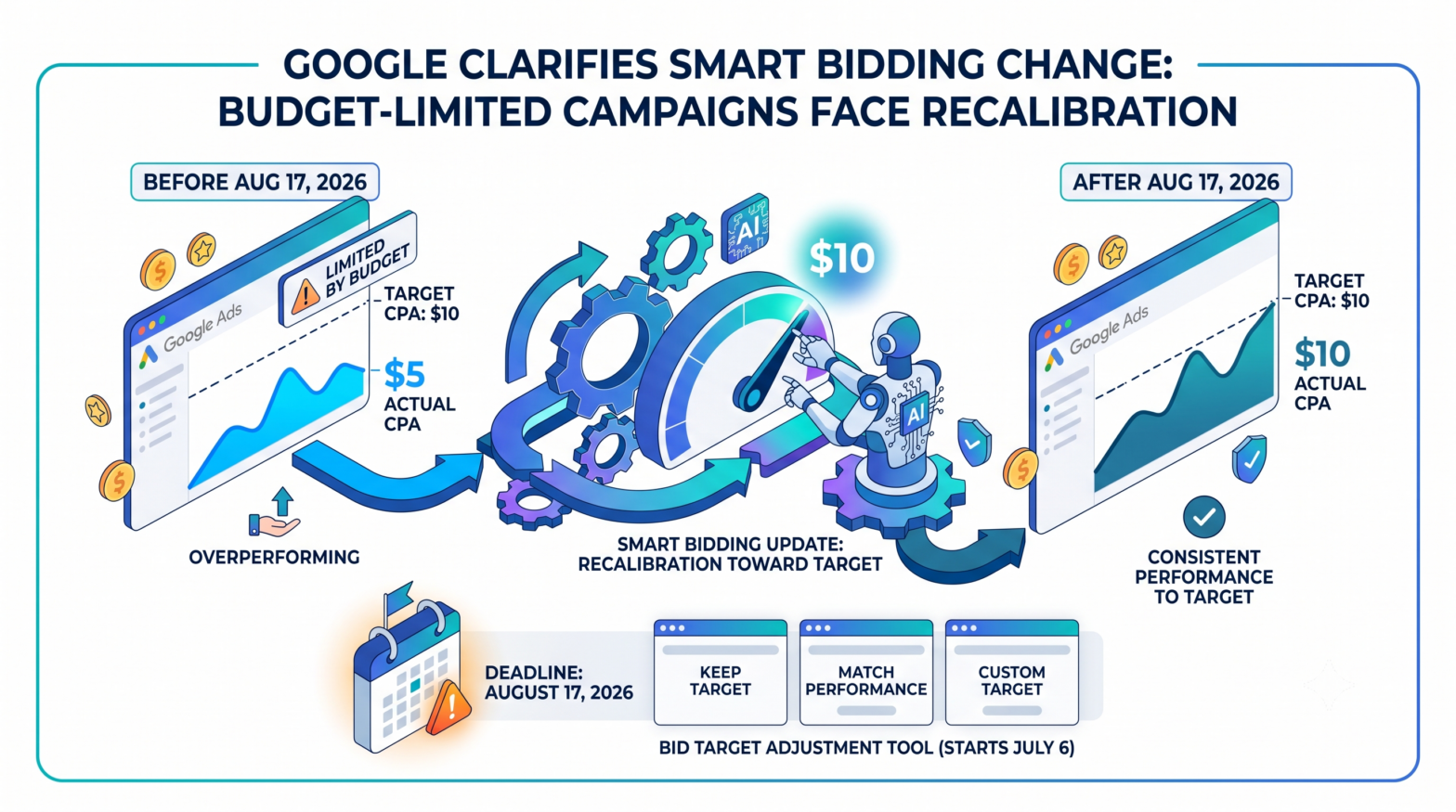
Advertisers running budget-limited Target CPA or Target ROAS campaigns face a hard deadline: without action before August 17, 2026, campaigns that have been outperforming their stated targets will automatically recalibrate upward toward those targets. Google announced the change on June 15, 2026, via Ads Product Liaison Ginny Marvin on LinkedIn and the Accelerate with Google blog. The company has since issued direct public clarifications after industry-wide concerns raised questions about whether the update would make Smart Bidding less efficient and push costs higher.
What the Bidding Change Does
Today, when a campaign carries a "Limited by budget" status and uses a Target-based bid strategy such as Target CPA or Target ROAS, some campaigns overperform on bidding targets and see performance fluctuations when budgets are adjusted. Google has confirmed that was never the intended behaviour.
After August 17, 2026, campaigns that are limited by budget and use a target-based bid strategy will more consistently perform toward their bid target, including when budget adjustments are made. The practical consequence is direct. If a campaign's Target CPA is $10 but recent actual CPA performance is $5, that campaign will deliver more closely to a $10 actual CPA starting August 17, 2026.
This is specifically a bidding change. Bids will be optimized more consistently to the target when a campaign has a limited budget. Target CPA and Target ROAS campaigns that are not budget-constrained will not change their behaviour. Campaigns with unconstrained budgets already scale performance in line with the stated target and will continue to do so after this update.
Which Campaign Types Are Affected
The update applies to Search, Shopping, Performance Max, Demand Gen, and Travel campaigns managed in Google Ads or Search Ads 360, as well as Demand Gen campaigns managed in Display & Video 360. App Campaigns, Video reach campaigns, and Video view campaigns will continue using the previous bidding behaviour. Hotel and Display campaigns already have the new bidding behaviour.
For multi-channel campaigns like Performance Max and Demand Gen, advertisers may also see shifts in how traffic is distributed across different channels.
Google's Response to Advertiser Concerns
The announcement generated significant pushback across the PPC community. Advertisers questioned why Google would voluntarily reduce the efficiency that budget-limited campaigns had been producing. Google Ads Liaison Ginny Marvin responded directly on LinkedIn, stating that claims the update amounted to advice to "let the system spend more money" were not accurate, and re-emphasized that the change will not lead to spend increases.
Marvin noted that performance has often fluctuated unexpectedly, especially in budget-limited campaigns as budgets are changed, calling it a frustrating experience for advertisers that made it difficult to scale campaigns with confidence, and stated that the change aims to address that.
On the concern that the change could push campaigns into lower-quality traffic, Marvin pushed back directly. She stated that the system sets bids to find as many conversions as possible at the ROAS/CPA target set by the advertiser, and that with this update, advertisers can expect that same behaviour in budget-constrained campaigns with targets.
Google has confirmed the change will not directly result in increased spend. Daily and monthly budget limits will always be respected. The purpose of the change is to ensure campaigns can consistently scale at a predictable target, regardless of the budget set.
The Bid Target Adjustment Tool and Account Notifications
Google is providing a specific tool and notification window to help advertisers manage the transition. Advertisers can review affected campaigns and adjust targets manually using the new Bid Target Adjustment Tool, available starting July 6, 2026.
These notifications are triggered for advertisers with any campaigns that were limited by budget in the last 12 months and use a target-based bid strategy impacted by the upcoming changes. The tool surfaces historical performance and provides three options: keep the target, match it to recent performance, or set a custom target.
Google has confirmed it will not automatically adjust daily budgets or campaign bid targets. Advertisers who take no action before August 17 should expect affected campaigns to drift toward their original, higher stated targets.
What Advertisers Need to Do Before August 17
Advertisers with a campaign that is limited by budget and has historically overachieved its stated target may experience performance volatility if no changes are made to the campaign before August 17.
Google recommends reviewing all campaigns with a "Limited by budget" status that use target-based bid strategies by August 17, 2026, with particular attention to campaigns performing better than their targets. Advertisers who want to maintain recent performance should update their target to reflect actual delivery, for example, updating a $10 Target CPA to $5 if that reflects current performance.
If current campaign targets accurately reflect business goals, no change to the bid target is required. Campaigns that were previously over-performing their targets will simply adjust their performance to deliver closer to the stated target after August 17.
For advertisers managing campaigns across multiple campaign types, the implications for campaign management practice are notable. Budget and bidding controls serve distinct functions under this updated system. Budgets control how much is spent. Target CPA and Target ROAS control the efficiency at which that spend is deployed. Advertisers who have historically relied on a conservative stated target to act as an efficiency lever, independent of the budget setting, will need to reassess that approach before the rollout date.
Advertisers whose campaigns need adjustments or who need additional guidance will see notifications in Google Ads starting July 6, where they can review historical campaign performance and quickly apply updates. Google confirmed in its "Changes to target-based bid strategies" help document, updated July 2026, that the rollout begins August 17 and will take a few weeks to complete across all eligible accounts.