
Customer Match has always started with a simple premise: give Google a list of people you already know.
Google Ads is now testing what happens when that list becomes a starting point rather than the boundary.
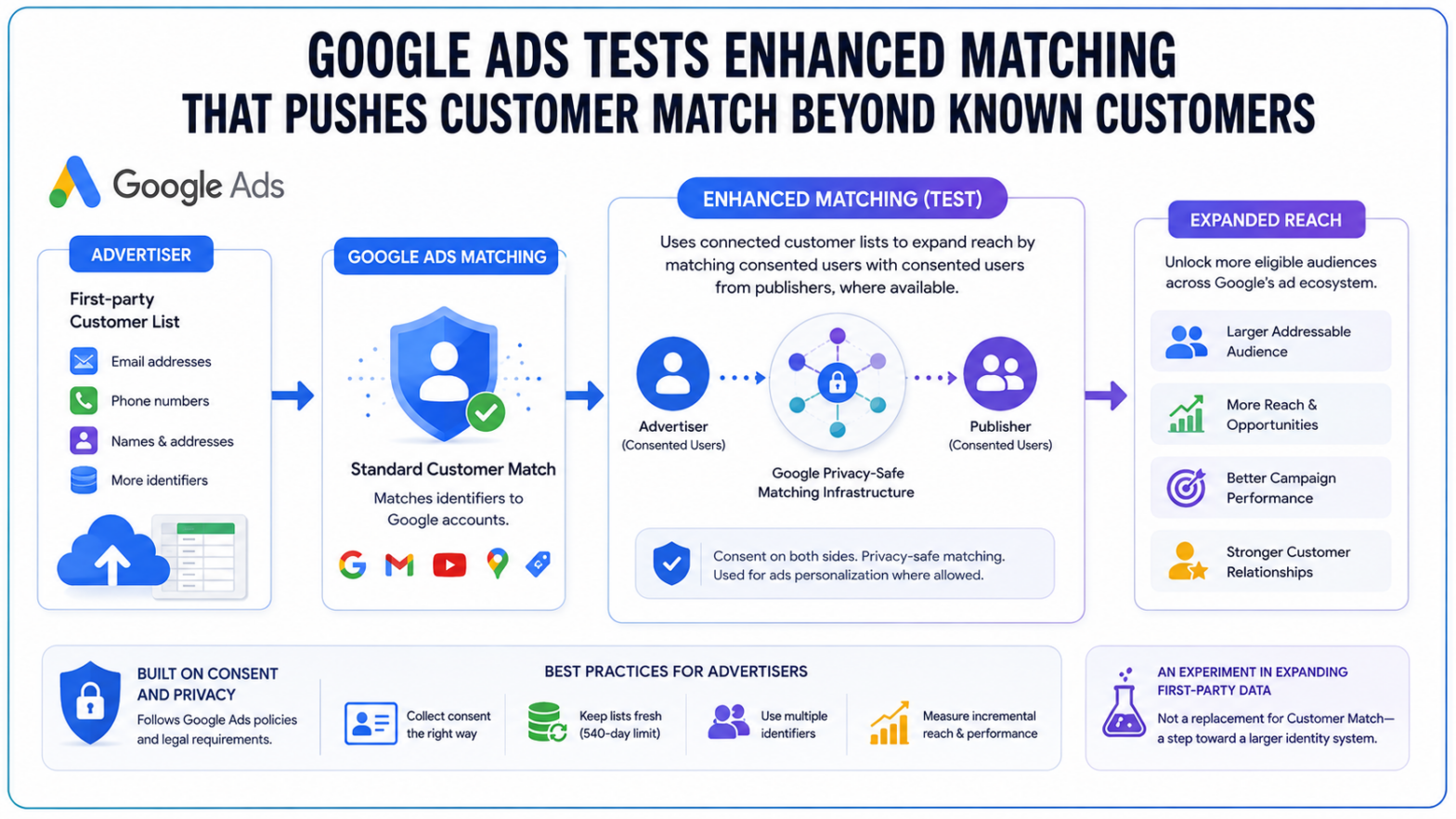
A new Enhanced Matching setting has appeared in some Google Ads accounts, giving advertisers the option to use connected customer lists to expand their reach by matching consented users against consented publisher signals where available.
The wording matters. This is not simply Google finding more accounts from another email address in an advertiser's CRM. It potentially extends Customer Match beyond the conventional advertiser-to-Google identity match and brings publisher data into the process.
Customer Match Has Traditionally Been a Direct Identity Match
Standard Customer Match is built around advertiser-owned customer information.

An advertiser uploads first-party identifiers such as email addresses, phone numbers or names and addresses. Google normalizes and hashes eligible information, then compares those identifiers with corresponding data associated with Google accounts.
When Google finds a match, that account can become part of the advertiser's Customer Match segment.
Google's current documentation is explicit about that process: uploaded customer information is used to match customers against Google accounts, with matched users becoming eligible for Customer Match targeting.
That deterministic foundation is one reason Google Ads Customer Match has become increasingly important as Google pulls advertiser data into automated bidding, customer lifecycle goals and conversion-based audiences.
Enhanced Matching appears to add another route.
The setting, first surfaced publicly after appearing inside advertiser account settings, says Google can use connected customer lists to expand reach by matching consented users with consented users from publishers when available.
Google has not yet published a standalone Help Center announcement detailing the experiment's rollout, participating publishers or expected lift in audience size.
That leaves a meaningful distinction between what Google publicly documents for standard Customer Match and what advertisers are now seeing inside the interface.
“Enhanced” Does Not Just Mean Google Found More CRM Records
Match rate has always been one of the practical limitations of first-party audience activation.
A company may have 100,000 CRM records without Google being able to associate every record with an eligible user. Formatting, identifier availability and differences between customer-provided information and Google account information can all reduce usable audience size.
Google already recommends providing multiple relevant identifiers because additional email addresses, phone numbers and other customer information can increase the likelihood of a match.
Enhanced Matching appears to approach the problem differently.
Rather than limiting matching to the advertiser's supplied identifiers against Google's account information, the test references consented publisher users. If implemented as the setting describes, the same advertiser audience could potentially gain additional addressable reach through publisher-side identity signals.
That makes the term “matching” more complicated.
It would no longer describe only whether Google recognized a CRM record. It could also describe whether Google's advertising infrastructure can establish an eligible connection between an advertiser's customer information and consented publisher data.
For advertisers, particularly those with large customer databases, the important measurement will therefore be more than the displayed match rate. Incremental audience size, campaign reach and subsequent conversion quality will need to be separated from improvements to the original deterministic match.
First-Party Data Is Becoming Input for a Larger Identity System
Google has been steadily making advertiser-owned data more operational inside Google Ads.
Customer Match lists can already be automatically included as signals for Smart Bidding and optimized targeting. Google describes Customer Match as a way for advertisers to use their own online and offline customer information across Search, Shopping, Gmail, YouTube and Display.
More recently, Google began pushing first-party data deeper into its campaign infrastructure through conversion-based customer lists. Those audiences can be created from user-provided conversion data rather than depending entirely on manually maintained uploads.
Google's Data Manager strategy moves in the same direction.
The company recommends Data Manager for new Customer Match workflows, while its Data Manager API supports audience activation using customer information and privacy-oriented matching infrastructure. Google has described the broader objective as “universal activation and measurement” across its advertising products.
Enhanced Matching fits neatly into that architecture.
The CRM list remains valuable, but its role shifts. Instead of functioning only as a finished audience, it becomes an identity signal that Google can potentially reconcile against a wider set of eligible data.
Publisher Signals Raise a Different Consent Question
The test also arrives with unusually deliberate consent language.
Google's existing Customer Match rules already require advertisers to use customer information collected through an appropriate first-party relationship. Advertisers must obtain consent where required and comply with applicable personalized advertising and user-consent policies.
For users in the European Economic Area, Google separately requires consent signals for Customer Match ad personalization.
Enhanced Matching introduces another participant: the publisher.
The interface language indicating that consented advertiser users are matched with consented publisher users suggests Google is building the feature around permission on both sides rather than treating publisher information as an unrestricted audience-expansion pool.
Exactly how those signals are reconciled has not been publicly documented.
Nor has Google disclosed which publisher environments are currently eligible, whether availability differs by region, or whether the feature relies on infrastructure related to its existing publisher-advertiser matching systems.
Those unanswered questions matter because Google already maintains strict personalized advertising rules governing how advertiser-created audiences can be used, particularly for sensitive categories.
More Reach Will Need to Be Separated From Better Matching
For paid media teams, the practical issue is measurement.
An advertiser testing Enhanced Matching should not automatically interpret a larger reachable audience as evidence that its CRM match quality improved. The feature appears capable of introducing additional publisher-based matches, which makes the source of incremental scale important when comparing performance against standard Customer Match.
Clean first-party identifiers still matter. So do consent status, list freshness and customer classification. Google limits Customer Match membership duration to 540 days and recommends regularly refreshing lists to keep them eligible.
The new setting also arrives as Google is making more Customer Match audiences available through automated conversion-based list creation, reducing the amount of manual audience administration required inside many accounts.
Enhanced Matching adds a different kind of automation.
Instead of merely helping advertisers create or maintain the audience, Google may be gaining more flexibility in deciding how that audience can be resolved across its advertising ecosystem.
For now, the feature appears limited to selected accounts and remains opt-in in the interface that has surfaced publicly. Google has not published figures for expected match-rate improvements, named participating publishers or announced a date for broader availability.
Until those details arrive, Enhanced Matching is best understood not as a replacement for Customer Match, but as an experiment in stretching what a first-party customer list can reach once Google is allowed to connect it with consented signals outside the advertiser's own CRM.