
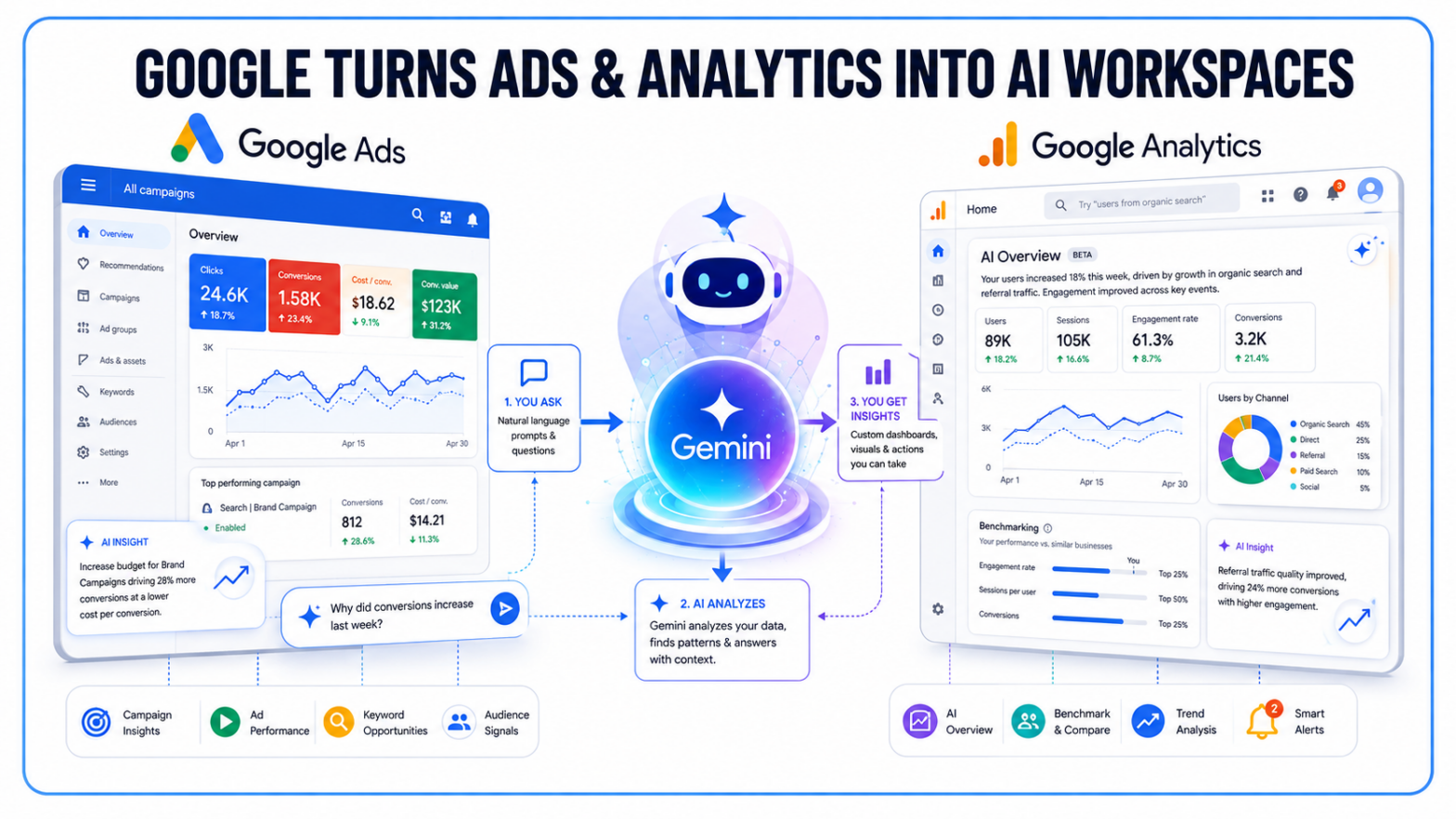
Google is taking AI out of the side panel and putting it directly in front of advertisers.
New AI-generated homepage insights, prompt-based reporting and performance benchmarking are arriving across Google Ads and Google Analytics, pushing both platforms closer to becoming active decision-making systems rather than dashboards marketers simply check.
Google announced the changes on August 10, 2026, as an expansion of Ask Advisor, the Gemini-powered marketing agent it introduced at Google Marketing Live earlier this year. Most of the new agentic features are currently available in beta for English-language accounts.
Google Analytics Will Explain What Changed Before You Start Digging
Opening Google Analytics usually starts a familiar process: find the right report, adjust the date range, compare periods and work backward until something explains the spike or drop.
Google wants to shorten that investigation.
New AI Overviews are appearing at the top of the Google Analytics homepage, automatically summarizing notable changes since the user's previous visit. Google says those summaries can identify developments such as seasonal sales peaks or shifts in website traffic.
A marketer who sees an unusual data point can send its context directly into Ask Advisor with one click and continue investigating through the AI agent.
Google is also adding optional phone and email notifications for these summaries. Users can choose how frequently they receive them rather than needing to open Analytics repeatedly to see whether an important change has occurred.
The update gives Google Analytics another AI-specific layer just months after GA4 added an AI Assistant channel to its default channel grouping. The difference is significant. AI is no longer limited to something Analytics measures as a traffic source. Google is increasingly using it to interpret Analytics data itself.
Google Ads Gets a Homepage Built Around Questions
The Google Ads homepage is undergoing a similar shift.
Google is introducing personalized AI-powered insight cards designed to surface developments that could affect an advertiser's campaigns. According to Google, those cards can identify relevant performance patterns and emerging demand without requiring advertisers to construct a report first.
There is also a prompt box above the cards.
Advertisers can ask questions about their account and generate custom insights around whatever issue they are investigating. Google's examples include examining how competitors are affecting impression share and identifying trends that could improve campaign performance.
That changes the basic interaction model.
Instead of navigating through campaign tables and report menus to find data, an advertiser can begin with a question and have Google's AI determine which information is relevant.
It fits the direction Google established at Marketing Live 2026, when it introduced Ask Advisor as an agent spanning Google Ads, Analytics and other parts of Google's marketing stack.
Ask Advisor itself is not new. Google first announced the cross-product system on May 20, describing it as an AI agent capable of coordinating information and actions across its marketing products. It can use information from Google Ads and Google Analytics together and, in some workflows, pull product information from Merchant Center while helping create a campaign.
The August release starts putting more of that capability directly into the screens marketers already use.
Dashboards Can Now Be Built With a Prompt
Reporting is also getting a generative AI layer.
Google Ads is introducing new Dashboards that can turn natural-language prompts into visual reports. Google Analytics support is planned to follow.
Rather than manually choosing dimensions, metrics and visualizations, advertisers can describe what they want to examine. The system then produces a corresponding visualization.
Google says each report also includes a real-time AI-generated summary intended to explain the context behind the numbers.
That could substantially change how routine paid-media reporting is assembled, particularly when the question is straightforward but retrieving the relevant data requires multiple steps inside the interface.
It also extends Google's broader move toward AI marketing tools that operate on advertiser data instead of simply generating creative assets.
The distinction matters. Google's early generative AI advertising features concentrated heavily on copy, images and campaign construction. These releases move Gemini deeper into analysis, reporting and account interpretation.
Human review remains part of the equation. A generated chart or explanation can make data easier to interrogate, but the underlying campaign objectives, attribution setup and measurement quality still determine whether that interpretation is useful.
Campaign Benchmarking Adds a New Reference Point
Google Analytics is also adding benchmarking through Ask Advisor.
The feature compares an advertiser's campaign performance against anonymized averages from businesses Google considers similar. Advertisers can then ask Ask Advisor to examine those comparisons and identify areas where performance differs.
Benchmarking addresses a problem that raw campaign metrics cannot solve on their own.
A conversion rate can improve while still trailing comparable advertisers. Cost per acquisition can increase while remaining relatively strong for a particular market. Without an external reference point, those numbers only describe movement inside the account.
Google's new system gives marketers another frame for interpreting them.
The company has not presented benchmarking as a replacement for an advertiser's own business targets. The comparisons are based on anonymized averages, while profitability, margins, customer lifetime value and acceptable acquisition costs remain specific to each organization.
For paid-media teams already working with increasingly automated campaign formats such as AI Max for Search and Shopping, however, the feature adds another signal they can use when determining whether automated performance is competitive.
The Reporting Workflow Is Becoming Conversational
For marketers, the practical change is less about having another AI assistant and more about where analysis begins.
Google Ads and Analytics have traditionally required users to know which report, metric or campaign view to open. The new workflow can begin with a business question instead. AI summaries flag unusual movement, prompts construct reports, Ask Advisor carries context into deeper analysis and benchmarking supplies an external comparison.
That can reduce the mechanical work involved in routine account investigation. It does not remove the need to validate attribution, understand campaign structure or determine whether Google's suggested interpretation matches the advertiser's actual business conditions.
Google says the new capabilities are built with Gemini. The company also confirmed that the AI Overviews, personalized Ads insights and related Ask Advisor functionality are currently available in beta for English-language accounts, while the new Google Ads Dashboards are rolling out ahead of equivalent dashboard functionality in Google Analytics.
Ask Advisor itself remains part of the broader cross-product system Google unveiled in May. What changed this week is where marketers encounter it: increasingly, before they have even started building the report.