

Demand Gen is no longer sitting at the edge of Google’s programmatic stack. It is being wired into the systems advertisers already use to build, manage, and automate campaigns.
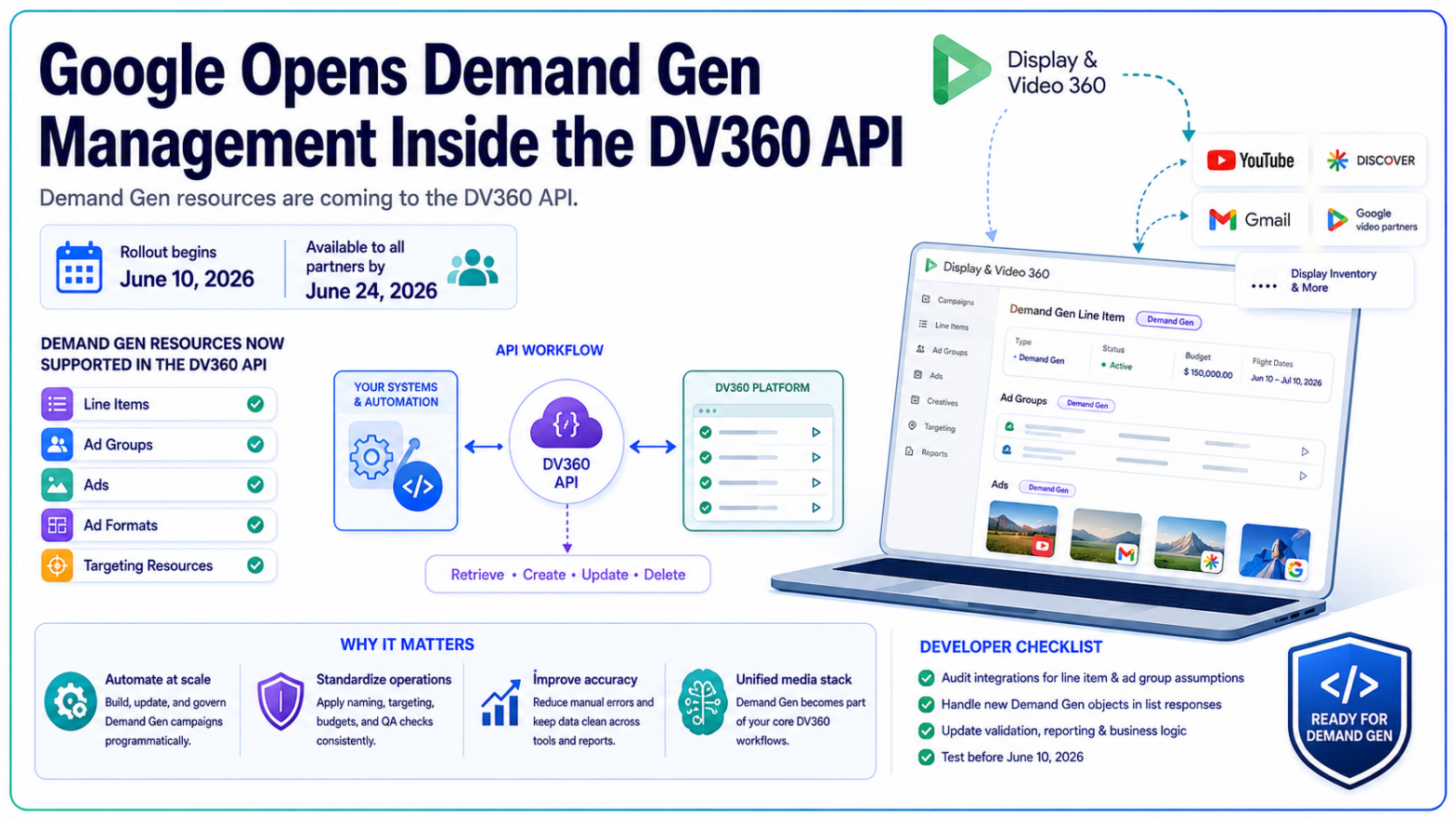
Google will begin rolling out Demand Gen resource support to all Display & Video 360 API users on June 10, 2026, with availability expected across all DV360 partners by June 24. The change gives advertisers, agencies, and ad tech teams a programmatic route to retrieve and manage Demand Gen campaign components directly through existing DV360 API workflows.
For teams that depend on automation, this is not a cosmetic update.
It changes what their systems may soon see, process, and modify.
Demand Gen Is Moving Into DV360’s Automation Layer
Demand Gen has been expanding across Google’s advertising ecosystem for more than a year, with a stronger role in visually driven placements across YouTube, Discover, Gmail, Google video partners, and newer Display inventory integrations. The API update moves that evolution into the technical layer.
Google’s rollout adds support for Demand Gen line items, ad groups, ads, ad formats, and relevant targeting resources in the Display & Video 360 API. Once the feature reaches a partner account, Demand Gen objects can appear in standard API responses alongside other DV360 resources.
That matters because many advertisers do not manage DV360 manually at scale. Large agencies, enterprise brands, platform partners, and in-house media teams often rely on API connections to build campaigns, update settings, retrieve reporting structures, manage targeting, and keep media operations aligned across internal tools.
Demand Gen’s inclusion gives those systems more direct control over a campaign type Google has been pushing deeper into its performance and discovery advertising mix.
The move also follows Google’s earlier beta support for retrieving and managing Demand Gen resources inside the DV360 API. That beta was limited to allowlisted partners. The June rollout takes the feature toward general availability, shifting it from controlled access to a standard API capability.
Developers Need To Prepare For New Objects In List Responses
The most immediate issue is not campaign creation. It is compatibility.
Google has told developers to make sure their integrations can handle additional Demand Gen line items and ad groups before the rollout begins on June 10. Once enabled for a partner, those resources may be returned in existing list responses.
That is where small assumptions can break things.
A reporting pipeline that expects only certain line item types may misclassify Demand Gen resources. A quality assurance script may flag unfamiliar ad group formats as invalid. A budget management tool may ingest the new objects but fail to apply the correct business logic. An internal dashboard may display the data without context, creating confusion for media teams reviewing live accounts.
The risk is not that the API becomes unavailable. The risk is that existing integrations receive more than they were built to understand.
Google’s documentation indicates Demand Gen ad groups use a specific ad group format field, while Demand Gen line items include settings tied to the campaign type. Developers managing DV360 through custom systems will need to account for those distinctions rather than treating Demand Gen as a renamed version of standard video or display activity.
For agencies already following Google’s broader Google Ads automation push, the timing fits a larger pattern: campaign controls, reporting, and AI-assisted management are moving closer to integrated platform workflows.
Demand Gen Is Becoming Harder To Treat As A Side Channel
Demand Gen began as a way for advertisers to reach users across Google’s more visual, discovery-oriented environments. In DV360, the format is increasingly being positioned as part of a unified media buying structure rather than a separate experimental lane.
That shift has been visible in other product moves. Google recently confirmed that Google Display Ads are moving into Demand Gen, allowing advertisers to manage GDN activity within the Demand Gen environment. TechWyse covered that transition in its reporting on Google Display Ads migrating to Demand Gen.
The API expansion adds another piece.
When a campaign type becomes manageable through the same systems that support broader programmatic operations, it becomes easier for advertisers to standardize workflows around it. Budget rules, naming conventions, trafficking processes, reporting pulls, QA checks, and optimization routines can all be brought into the same operational structure.
That does not make Demand Gen identical to other inventory types. It still has its own creative formats, surfaces, targeting considerations, and performance patterns. But it reduces the operational distance between Demand Gen and the rest of DV360.
For teams managing YouTube, Display, and discovery-style inventory through one media operation, that distance matters.
Automation Will Matter More Than Manual Access
The update gives API users the ability to retrieve, create, update, and delete Demand Gen resources once support reaches their partner account. That creates practical room for more automated campaign governance.
A media team could use internal tools to generate Demand Gen line items under approved insertion orders. A platform partner could sync campaign structures with client-side systems. An agency could apply standardized naming and targeting checks before launch. Developers could build validation layers that compare Demand Gen setup against account-level rules before ads go live.
The value is not only speed.
Manual workflows introduce inconsistency. One campaign might follow naming standards while another does not. One ad group might be configured correctly while another misses a targeting requirement. One budget update might be logged in a spreadsheet but not reflected cleanly across a reporting system.
API support gives advertisers a way to reduce those gaps when campaign volume is high.
This also connects to the broader direction of Demand Gen campaigns inside Google Ads and DV360. Google has been adding more conversion, commerce, creative, and inventory capabilities to the format, making it more relevant to performance advertisers rather than only upper-funnel media buyers.
The Practical Read For Marketers And API Teams
In practice, marketers should expect Demand Gen to appear more often in campaign planning, reporting, and QA discussions tied to DV360. API teams should audit any integration that filters, lists, labels, or validates DV360 line items and ad groups. The key operational task is making sure Demand Gen resources are recognized correctly, not ignored, duplicated, blocked, or pushed through legacy rules designed for other campaign types.
For performance teams, the change may make Demand Gen easier to manage within existing Google Ads API and platform governance processes, especially where media operations depend on automated workflows rather than direct interface changes.
The rollout does not require every advertiser to rebuild their DV360 setup. Smaller teams managing campaigns manually may notice little immediate change. The larger impact lands with organizations that connect DV360 to internal campaign management systems, reporting warehouses, third-party tools, or agency-built automation.
For those teams, the API surface is now changing.
Google Is Standardizing Demand Gen’s Place In The Stack
The June rollout gives Demand Gen a more permanent technical role inside Display & Video 360. It also narrows the gap between what advertisers can manage in the interface and what developers can manage programmatically.
Google’s timeline is tight. The rollout begins June 10 and is expected to reach all partners by June 24. Developers have a short window to confirm that their integrations can process the new resource types before those resources start appearing in list responses.
That is the quiet part of the announcement.
The feature itself expands automation. The first test is whether existing systems are ready to see Demand Gen at all.