
ChatGPT advertising is starting to look less like an experiment and more like an ad platform with plumbing.
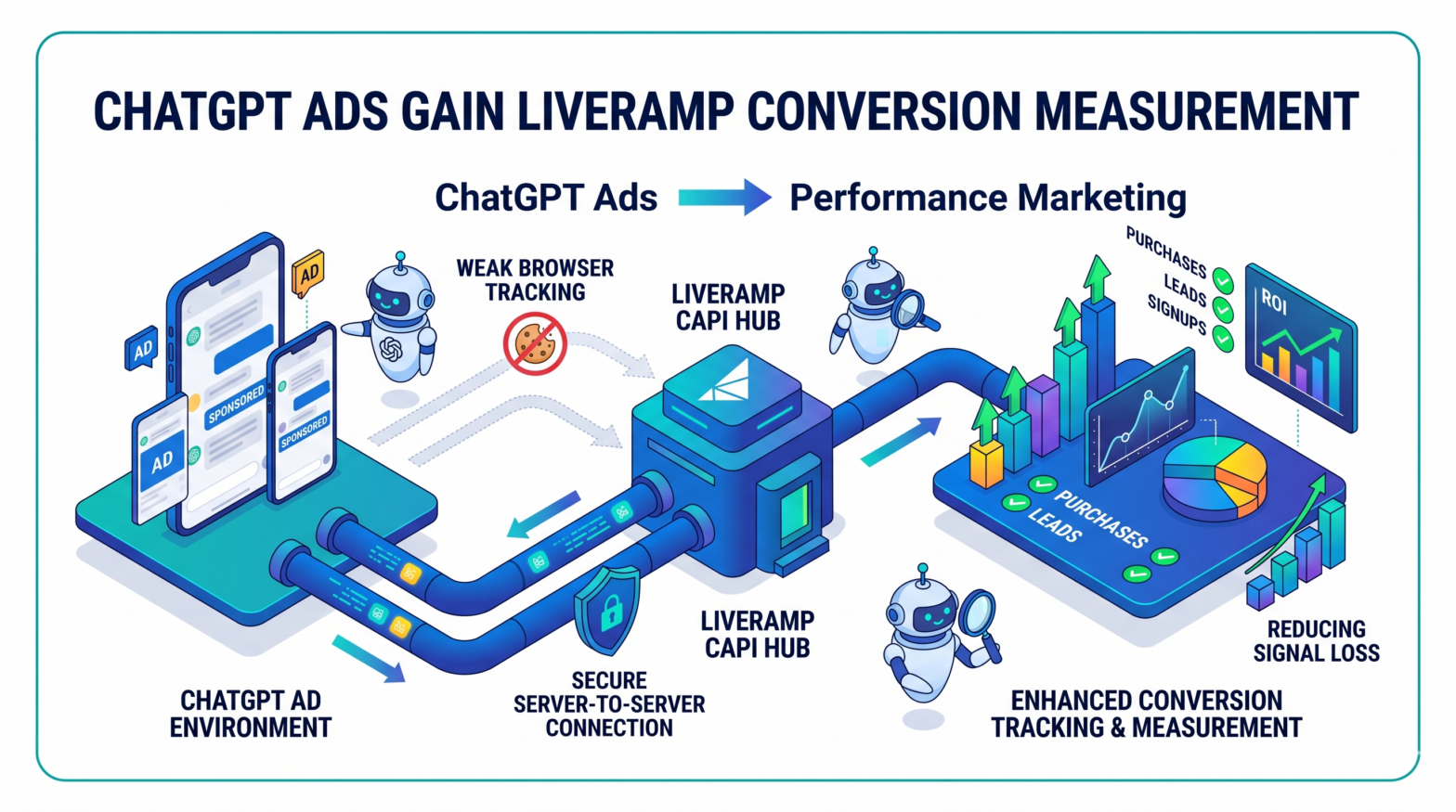
OpenAI’s ad business now has a new measurement layer through LiveRamp, giving marketers running ChatGPT campaigns another way to connect conversion events, reduce signal loss, and judge whether ads are producing business outcomes beyond clicks.
ChatGPT Ads Are Getting the Measurement Layer Advertisers Expect
LiveRamp said on June 10 that marketers with ChatGPT ad campaigns can now use its Conversions API Hub to connect conversion events into OpenAI’s advertising environment.
That matters because the early question around ChatGPT ads was never only whether people would see sponsored placements inside a conversational product. It was whether advertisers could measure enough post-click activity to justify budget.
OpenAI has already been building toward that answer. Its ads documentation says the ChatGPT advertising system supports both a conversions pixel and a Conversions API, while its Advertiser API supports programmatic ad creation and performance monitoring. The LiveRamp integration adds a third-party data collaboration and measurement provider into that stack.
The central promise is familiar to performance marketers: fewer broken signals, cleaner conversion paths, and less reliance on browser-based tracking alone.
LiveRamp said its CAPI Hub uses secure server-to-server connections, which are designed to pass conversion events more reliably than tracking methods that depend heavily on cookies or client-side browser behaviour. For marketers dealing with consent restrictions, browser changes, fragmented journeys, and gaps between online ads and offline outcomes, that is the real news.
Not a flashy ad format.
Infrastructure.
The Shift From Chatbot Placement to Performance Channel
OpenAI began testing ads in ChatGPT earlier this year with a careful message: ads would support broader free access, stay clearly labelled, and remain separate from ChatGPT’s organic answers. The company has also stated that conversations stay private from advertisers and that advertisers receive aggregate performance information, not chat histories or personal details.
That positioning was about user trust.
The LiveRamp move is about advertiser trust.
A placement inside ChatGPT may have novelty, reach, and high-intent context, but large media budgets usually require repeatable measurement. Marketers need to know what happened after the click: purchase, lead, signup, trial start, booking, or another conversion event.
OpenAI has been moving in that direction across its ad stack. TechWyse previously covered how ChatGPT ads are being pushed toward performance marketing, with conversion tracking becoming a core part of the platform rather than a later add-on.
The LiveRamp integration fits that same arc.
For brands, the practical value is not simply that ChatGPT ads can now be tracked. It is that measurement can be tied into a broader data collaboration system already used across other channels and partners. That lowers the operational friction for advertisers that already use LiveRamp to manage identity, activation, and measurement across their media ecosystem.
Server-Side Signals Become More Important in AI Advertising
Browser-based tracking has been weakening for years.
Cookie restrictions, privacy controls, mobile platform changes, and consent frameworks have all made client-side signals less dependable. Most major ad platforms have responded by pushing advertisers toward server-side conversion APIs, enhanced conversions, clean rooms, and first-party data infrastructure.
ChatGPT ads are entering the market after that shift has already happened.
That gives OpenAI a different starting point from older platforms. Instead of retrofitting measurement after years of cookie-based attribution, it is building a newer ad system in a market where advertisers already expect Conversions API support and stronger first-party data pathways.
LiveRamp’s role is to make those connections easier for marketers that want ChatGPT campaigns to sit beside other performance channels rather than live as a disconnected test budget.
The integration also brings ChatGPT ads into the same broader conversation reshaping Google, Meta, TikTok, retail media, and programmatic buying: AI advertising will only scale if the inputs are dependable. Creative automation, conversational targeting, and agentic campaign tools all need useful feedback loops. Weak conversion data weakens the whole system.
TechWyse has tracked a similar pattern in Google’s advertising ecosystem, where AI-led campaign tools are increasingly dependent on clean conversion signals, product data, and campaign feedback. The same logic applies here. An AI-driven ad platform still needs measurement discipline.
A Partnership Arriving During LiveRamp’s Publicis Transition
The timing gives the deal a second layer.
LiveRamp is in the middle of a major ownership change. Publicis Groupe announced in May that it had entered an agreement to acquire LiveRamp in an all-cash transaction with a total enterprise value of about $2.17 billion. The companies said the transaction is expected to close before the end of 2026, subject to regulatory approvals, shareholder approval, and other closing conditions.
Publicis positioned the acquisition around data co-creation, AI agents, and secure collaboration across fragmented data environments. LiveRamp said it connects more than 25,000 publisher domains and more than 500 technology and data partners across 14 markets.
That scale is relevant to OpenAI.
ChatGPT ads are not competing only on inventory. They are competing against platforms with mature buying tools, attribution models, agency workflows, and measurement partnerships. Google, Meta, Amazon, and TikTok already have deep systems for campaign optimization and reporting. OpenAI has attention. It still needs the commercial machinery that makes advertisers comfortable spending repeatedly.
LiveRamp gives OpenAI a route into that machinery without requiring every advertiser to build measurement workflows from scratch.
For agencies and enterprise brands, that is often the difference between a pilot and a media plan.
What Marketers Can Read From the LiveRamp Integration
The practical implication for marketers is straightforward: ChatGPT ads should now be evaluated less as a novelty placement and more as an emerging performance channel that will require the same measurement hygiene as paid search, paid social, and retail media.
Advertisers testing ChatGPT campaigns will need clearly defined conversion events, stable server-side tracking, consent-aware data handling, and alignment between campaign objectives and downstream reporting. Weak event setup will limit optimization, just as it does on other automated ad platforms. Stronger conversion signals give buyers a clearer view of whether conversational ad traffic is producing leads, purchases, or other measurable outcomes.
That does not make ChatGPT ads mature overnight.
It does change the checklist.
TechWyse has also covered OpenAI’s move into self-serve ChatGPT Ads Manager and its earlier rollout of cost-per-click ChatGPT advertising. Measurement partnerships are the next expected layer in that progression. Once advertisers can buy, target, track, and optimize with less manual friction, the platform starts to resemble a standard performance media environment.
The unanswered question is how much advertiser demand will follow once those tools become more broadly available.
ChatGPT has unusual intent signals because users often arrive in the middle of research, comparison, planning, and decision-making. That makes the ad surface attractive. It also makes transparency and measurement more sensitive, because the ad appears inside a product people use for personal and work-related reasoning.
OpenAI has said ads do not influence ChatGPT’s answers and are visually separated from organic responses. Its documentation and public ads materials also point toward a platform where conversion tracking, advertiser APIs, and performance reporting are becoming foundational components.
The LiveRamp integration adds another piece to that buildout.
For now, ChatGPT ads remain an early-stage channel with fast-moving infrastructure. The June 10 LiveRamp announcement shows OpenAI is no longer working only on ad placement. It is working on the measurement systems advertisers use to decide whether a new platform deserves real budget.