

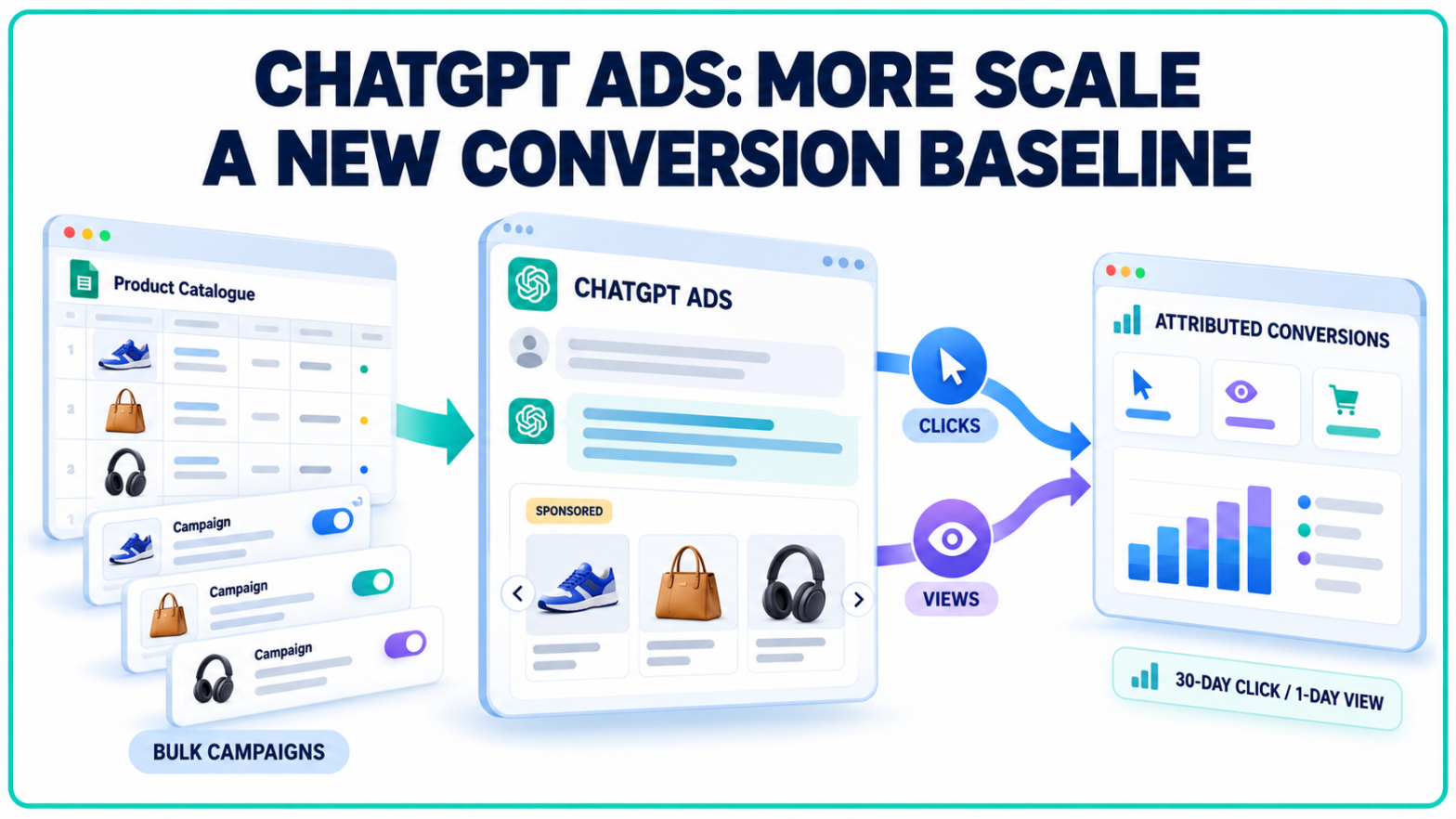
ChatGPT advertisers can now count more conversions without receiving another click. OpenAI’s latest reporting changes broaden the outcomes credited to campaigns, alongside tools intended to make product advertising easier to manage at scale.
The distinction matters as brands evaluate ChatGPT ads as a paid channel. A higher conversion total can reflect a change in attribution settings rather than a change in customer behaviour.
OpenAI’s September 30 advertiser update describes bulk creation of product feed campaigns, product review visibility and expanded API reporting. Separately, LiveRamp has introduced audience activation through its RampID identifier, connecting advertisers’ existing customer data to ChatGPT campaigns.
ChatGPT Ads Changes the Conversion Baseline
The clearest documented change sits in OpenAI’s September 30 API changelog. Advertisers can select click and view attribution windows across the four GET Insights endpoints. When settings are omitted, reports default to a 30-day click window, a one-day view window and the date of the credited ad interaction.
Conversion totals include eligible outcomes following both clicks and impressions. OpenAI says totals can differ from previous reports while impressions, clicks and spend remain unchanged.
That creates a reporting discontinuity for integrations built around earlier assumptions. A dashboard pulling the same campaign and date range can return a different conversion total under the current defaults.
OpenAI’s Ads Manager measurement guidance allows seven-, 14- or 30-day click windows. Advertisers can include one day of view-through attribution or disable it. A qualifying click takes precedence when both a click and an impression could receive credit.
These are reporting controls. Changing them does not alter bidding, billing or campaign optimization, and OpenAI describes the model as last-touch attribution.
The distinction adds another layer to the conversion reporting tools introduced during the platform’s wider expansion.
Bulk Product Feed Campaigns Meet a Documentation Gap
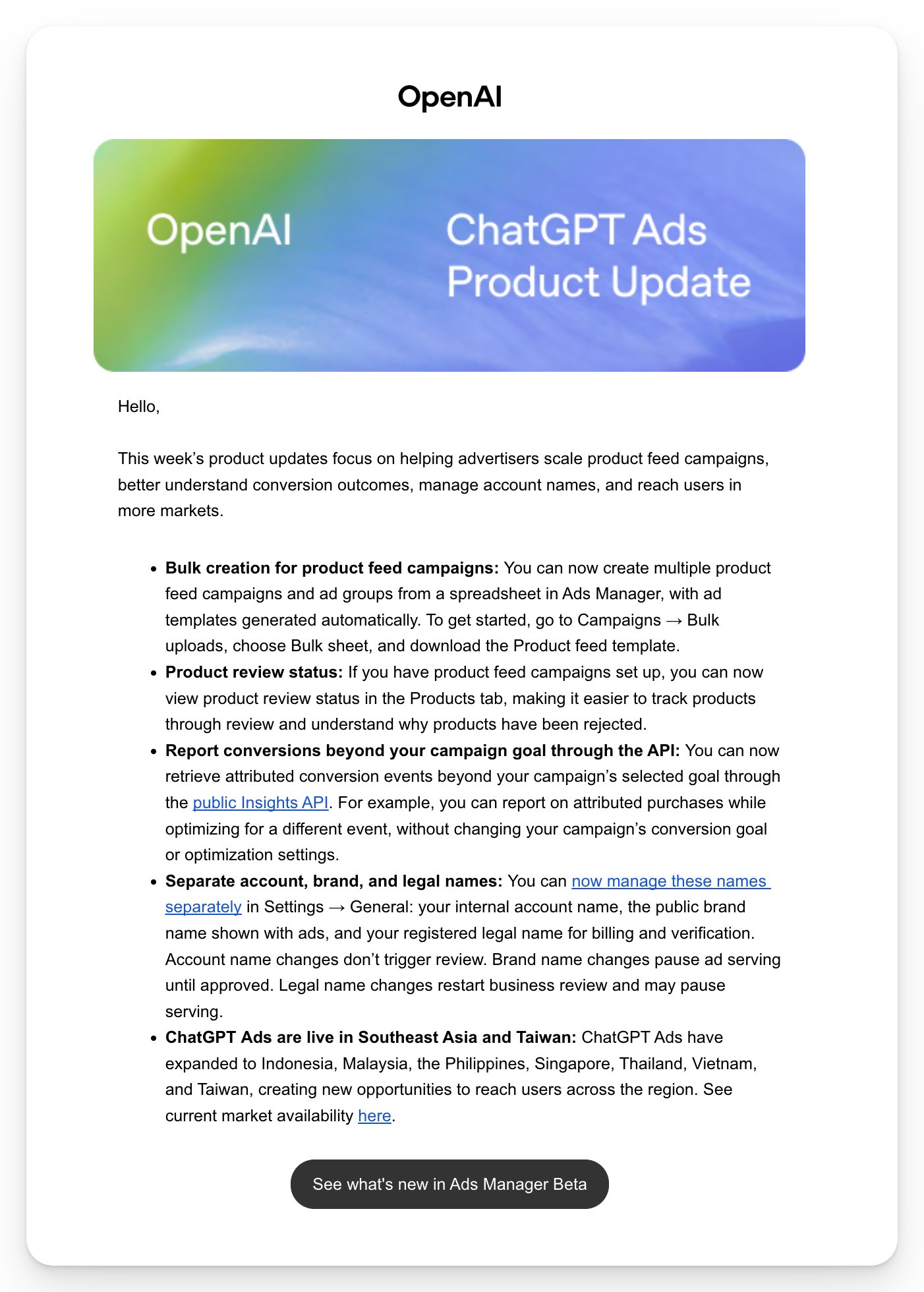
OpenAI’s advertiser update describes a spreadsheet workflow for creating multiple product feed campaigns and ad groups, with ad templates generated automatically. It also describes product review status in the Products tab, including information about rejected items.
Those capabilities address different bottlenecks: building campaigns across a catalogue and identifying products held up by review.
The public guidance is not fully aligned with the update. OpenAI’s Ads Manager overview still says:
“Ads Manager CSV upload does not currently support creating product-feed campaigns.”
The announced bulk sheet workflow should therefore be distinguished from the CSV upload described in that document; the overview does not establish that the new workflow is available in every account.
The underlying product feed campaign documentation explains how retailers upload catalogue data, choose products through filters and build an ad template. Supported import methods include file upload, a hosted URL and SFTP.
It also draws a boundary between inventory and reporting. The Products tab is described as a view populated by delivery data, rather than a complete list of uploaded products. An absent product row alone does not establish a failed upload.
For retailers already using product feed campaigns, campaign creation, product eligibility and recorded delivery remain separate stages.
Conversion Reporting Goes Beyond the Selected Goal
The expanded Insights capability lets advertisers retrieve attributed events beyond the campaign’s selected optimization goal. A campaign can report attributed purchases while optimizing for another event.
OpenAI’s reporting documentation separates campaign goal totals from additional attributed event details. An outcome does not have to become the optimization target to appear in the broader report.
That is useful when a campaign serves more than one business question. The event used to guide delivery and the outcome used to evaluate commercial value can differ, without requiring a change to the campaign’s goal.
The API also defines cost per action, attributed purchase sales and return on ad spend. Purchase value is tied to attributed order_created events. An unavailable metric is not equivalent to zero.
In practical paid media reporting, comparisons depend on consistent attribution windows, date ranges and time bases. Teams assessing ChatGPT alongside other channels need those settings recorded with the results; platform-attributed purchases alone do not establish how many sales the advertising caused.
LiveRamp Brings Existing Customers Into Custom Audiences
LiveRamp’s September 28 announcement adds another part of the advertiser workflow: activating first-party audiences through RampID.
The integration supports data from CRM systems, loyalty programmes, behavioural sources, websites and apps. Advertisers can use audiences to reach or suppress consumers, with the integration initially available in 11 markets. LiveRamp says expansion to other ChatGPT Ads markets will follow.
This extends the use of custom audiences through an existing marketing technology provider. It is a customer-data connection, rather than a new source of campaign creative or product inventory.
LiveRamp identifies Allegiance Group & Pursuant as an implementer working on behalf of a nonprofit client. Its announcement does not provide audience match rates or campaign performance results.
The market limit also matters. Availability of ChatGPT advertising in a country does not, by itself, establish availability of this particular integration.
A Brand Name Change Can Pause Ad Delivery
OpenAI is also separating three names that serve different functions: the internal account name, the public brand name displayed with ads and the registered legal name used for billing and verification.
According to its account setup guidance, separate name management has been available since September 25. Changing the internal account name does not trigger review. Changing the brand name pauses ad serving until approval; changing the legal name restarts business review and may pause serving.
The distinction is relevant for businesses whose trading name differs from their registered entity. An internal naming cleanup and a public brand change have different delivery consequences.
OpenAI’s current availability list includes Canada, Indonesia, Malaysia, the Philippines, Singapore, Thailand, Vietnam and Taiwan. Self-service access requires the legal entity being billed to be based in a supported country.
Attributed conversions can still take 24–48 hours to appear in Ads Manager. Recent totals may change as events are processed.