

The next retail media battleground is not another ad slot.
It is the conversation before the purchase.
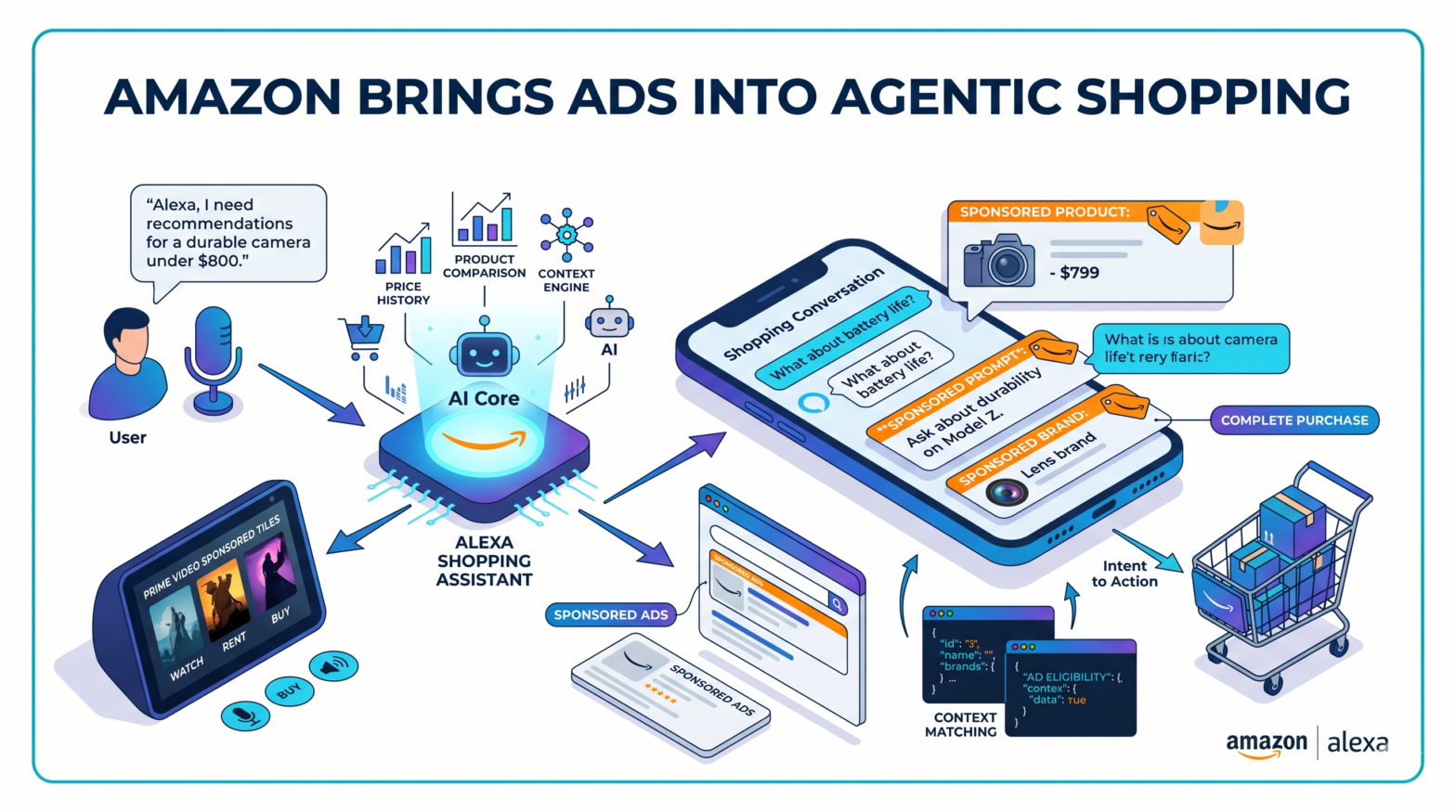
Amazon Ads is positioning advertising inside its agentic shopping experience, where customers can ask Alexa for Shopping questions, compare products, review price history, build carts, and complete purchases through AI-assisted journeys. The change puts sponsored ads, conversational prompts, Alexa+ ads, and Prime Video Sponsored Tiles closer to the moment when a shopper is asking for help rather than scrolling for options.
The Search Bar Is Starting To Behave Like A Sales Assistant
Amazon’s retail search bar is no longer only a place to type “running shoes” or “coffee grinder.”
With Alexa for Shopping, customers can ask full questions inside the main Amazon search bar, build personalized shopping guides, compare products, review category insights, check price history for up to a year, and automate deal-finding or routine purchases. Amazon says the experience brings together Rufus, its shopping assistant used by more than 300 million customers in 2025, with Alexa+ personalization across Amazon surfaces.
That matters because the shopping journey is becoming less linear.
A shopper may not begin with a product name. They may begin with a problem: a lamp for a child’s room, a laptop under a target price, sunscreen only if it drops to $10, or a gift that needs to arrive before a birthday. The assistant can interpret that request, pull context from previous conversations or shopping activity, compare available options, and move the customer toward a purchase.
Amazon Ads is now building ad participation into that environment.
The company says advertisers can appear in Alexa for Shopping through sponsored ads and Sponsored Products or Sponsored Brands prompts. On Alexa+, Amazon has introduced Alexa+ Conversational Ads and Prime Video Sponsored Tiles, extending the same idea beyond the Amazon app and website into Alexa-enabled devices.
The story is not just that Amazon has more AI features.
It is that ads are being designed for a shopping flow where the customer may never browse a familiar list of links in the old way.
Sponsored Ads Are Entering The Conversation
Amazon describes conversational advertising as a current state, not a future concept.
That is an important line for advertisers. Sponsored products are not simply being placed next to AI answers. They are being pulled into moments where shoppers ask questions, compare choices, and make decisions inside the same interaction.
In Alexa for Shopping, sponsored ads can surface relevant products and brands during natural conversations. Amazon says existing sponsored ads campaigns are automatically eligible to serve in Alexa for Shopping, which reduces setup friction for advertisers already running campaigns on the platform.
Sponsored Products and Sponsored Brands prompts go further. These AI-powered prompts can appear in shopping results and on product pages, opening conversations with Alexa for Shopping about a product or brand. Amazon says nearly 20% of shoppers who interact with a prompt continue the conversation about that brand, and adding prompts to a Sponsored Brands ad drives a 6% increase in conversions.
That is the commercial hinge.
A standard product ad asks for a click. A conversational prompt asks for a question. The customer can compare, investigate, clarify, and then purchase without leaving the assistant-led shopping flow.
For retail media, that changes the ad unit’s job. The creative has to support decision-making, not just attention. Product data, reviews, price competitiveness, availability, claims, brand store quality, and marketplace reputation become part of the same persuasion layer.
TechWyse has tracked a similar shift in Google’s AI commerce direction, where AI shopping agents are beginning to reshape product discovery and buyer assistance. Amazon’s version is different because it sits closer to the transaction and uses Amazon’s own shopping, browsing, and purchasing signals.
Agentic Advertising Compresses The Funnel
Amazon’s pitch to advertisers rests on a simple idea: the assistant can understand intent and complete the task.
That gives Amazon a different advertising surface from social feeds, display placements, or even traditional search results. A shopper talking to Alexa for Shopping may express product need, context, use case, budget, timing, and preference in natural language. The assistant can then recommend, compare, add to cart, track prices, or complete a purchase.
The funnel gets shorter.
Amazon also points to closed-loop measurement as part of the advertiser value. Since the company can connect impressions, shopping behaviour, and conversions inside its ecosystem, it can report campaign impact across the path from discovery to purchase. For performance marketers, that measurement layer is one of Amazon’s strongest retail media advantages.
Practical implications for marketers: brands advertising on Amazon will need cleaner product feeds, stronger marketplace content, clearer creative claims, and more disciplined campaign measurement. In agentic shopping, ads may be triggered by conversational intent rather than only exact product searches. Marketers should expect product titles, detail pages, reviews, pricing, inventory, brand stores, and sponsored ads strategy to work together more tightly because the assistant is evaluating the buying context before surfacing options.
The comparison with Google is unavoidable. Google’s AI Mode Checkout and Universal Commerce Protocol point toward transactions initiated by AI agents across the open web. Amazon’s advantage is different: it already owns a massive commerce environment where discovery, reviews, checkout, fulfilment, and advertising are deeply connected.
The competitive question is where the shopper chooses to ask.
Alexa+ Makes Ads Part Of Task Completion
Amazon is also expanding conversational ads through Alexa+ and Alexa-enabled devices.
Alexa+ Conversational Ads introduce brand messaging into personalized dialogue on Alexa-enabled devices when relevant to a customer’s conversation and intent. Prime Video Sponsored Tiles bring sponsored entertainment options into movie and TV recommendation queries on eligible Echo Show devices, allowing customers to subscribe, rent, or buy through voice or touch.
This pushes Amazon advertising beyond product discovery.
A customer could ask Alexa for camera recommendations, see a sponsored product, ask for more information, and add it to the cart. Another customer could ask for movie recommendations and receive a sponsored entertainment tile. The ad appears inside a task the assistant is already helping complete.
That changes the tolerance test for advertising. In conversational environments, irrelevant ads feel more intrusive because they interrupt an active request. Relevant ads may feel less like advertising because they answer the request. The quality bar rises.
Amazon is leaning on first-party signals to make that work. The company says its ad relevance benefits from trillions of shopping, browsing, and purchasing signals, giving conversational ads more context about what a shopper is actively trying to accomplish.
For advertisers, that creates a familiar tradeoff. Better targeting and measurement often come with less direct control over exactly where and how each impression appears. Amazon says advertisers with sponsored ads campaigns are automatically enrolled for Alexa+ Conversational Ads, which may accelerate adoption but also requires closer monitoring of reporting, placement quality, and downstream conversion behaviour.
TechWyse recently covered Meta’s AI Business Agent rollout, another example of large platforms placing AI assistants between brands and customers. Amazon’s move adds a retail media version of the same shift: automated conversations that can qualify intent, surface products, and move users toward action.
Amazon Is Building Agents For Advertisers Too
The customer-facing assistant is only half of the announcement.
Amazon Ads is also pushing agentic AI into campaign creation, optimization, and measurement. The company pointed to Creative Agent, Ads Agent, and the Amazon MCP server as pieces of a broader agentic advertising stack.
Creative Agent is designed to help advertisers produce ad creative through conversational workflows, from research and idea generation to scripts, storyboards, images, video, animation, voiceovers, music, and final delivery. Amazon says the tool can create professional-quality ads in hours and is powered by Amazon retail insights, advertiser product pages, brand stores, and websites.
Ads Agent focuses on campaign execution. Amazon describes it as an AI companion in the Amazon Ads console that can help plan, launch, and optimize campaigns. It can create campaign structures from media plans, adjust pacing and budgets across large campaign sets, recommend audiences, generate SQL queries, and assist with Amazon Marketing Cloud workflows. Amazon says 65% of beta advertisers saw delivery improvements when using Ads Agent for targeting recommendations, with an average 18% lower CPM and 16% lower CPA.
The MCP server points to another layer: external AI agents connecting to the Amazon Ads API through prompts, reducing the need for custom coding in some workflows.
That is where the advertising stack is heading.
Platforms are not only using AI to decide which ad appears. They are building AI systems to generate the creative, shape the campaign, select audiences, query measurement data, and connect tools through agent workflows.
Google is moving in the same direction through AI-powered ad tools and reporting. TechWyse recently reported on Google’s AI Shopping insights in Merchant Center, which are designed to show how brands and products appear across AI Mode, AI Overviews, and Gemini. The broader pattern is clear: AI commerce needs AI measurement, and AI ad systems need cleaner marketer inputs.
Retail Media Is Moving From Placement To Participation
Amazon’s agentic shopping push reframes the role of advertising inside ecommerce.
In older retail media models, the brand competed for placement: a sponsored result, a display unit, a video impression, a recommendation tile. In agentic shopping, the brand may be competing for participation in an AI-mediated decision. The assistant needs to decide which products are relevant, which brands are credible, which offers are useful, and which ad formats help the shopper complete the task.
That makes product readiness more important than isolated campaign tactics.
A weak product page can undercut a strong bid. Unclear positioning can make a product harder for AI systems to match with the right question. Thin reviews, inconsistent pricing, poor availability, or vague creative assets can weaken the brand’s case inside a recommendation environment that is trying to solve a shopper’s problem.
Amazon has not removed human choice from shopping. Customers still ask, compare, review, and decide.
But the path to that decision is changing.
The new advertising opportunity is not simply showing up beside the product shelf. It is earning a place inside the conversation that builds the shelf in the first place. As more AI shopping assistants connect discovery, comparison, price tracking, cart building, and checkout, retail media will depend less on static visibility and more on how well a brand can be understood by the system at the moment of intent.
Amazon Ads is making that transition explicit.
The assistant can answer the question. The ad now has to belong in the answer.