Google used I/O 2026 to declare the end of the chatbot era.
The 100 announcements unveiled in Mountain View all pointed toward a singular, unified vision: the transition from conversational AI to autonomous, multi-agent systems. The platform is no longer built to simply answer questions; it is built to execute complex, multi-step workflows across the web, your inbox, and your local machine without continuous human prompting.
At the center of this shift is Gemini 3.5 Flash and a new infrastructure designed to let agents talk to each other, build software, and browse the internet on your behalf.
The Engine: Gemini 3.5 Flash and Omni
The foundational models powering this shift represent a leap in efficiency. Google launched Gemini 3.5 Flash, explicitly positioning it as a high-speed, frontier-level model built for "long-horizon agentic tasks."
While flagship models historically traded latency for reasoning depth, 3.5 Flash solves the bottleneck. It outperforms previous Pro models on complex coding benchmarks while operating at a speed that allows it to execute background tasks—like auditing codebases or compiling financial documents—at less than half the cost of competing frontier models.
Alongside Flash, Google introduced Gemini Omni, a multimodal model that fundamentally changes creative production. Omni can generate any output from any input. You can feed the model a text prompt, a voice memo, and a reference image, and it will synthesize them into a cohesive, physically accurate video. The model understands kinetic energy, fluid dynamics, and gravity, shifting AI video from surrealist generation to structured storytelling. Omni Flash is rolling out immediately to Google AI Plus, Pro, and Ultra subscribers.
Antigravity 2.0 Centralizes the Agent Stack
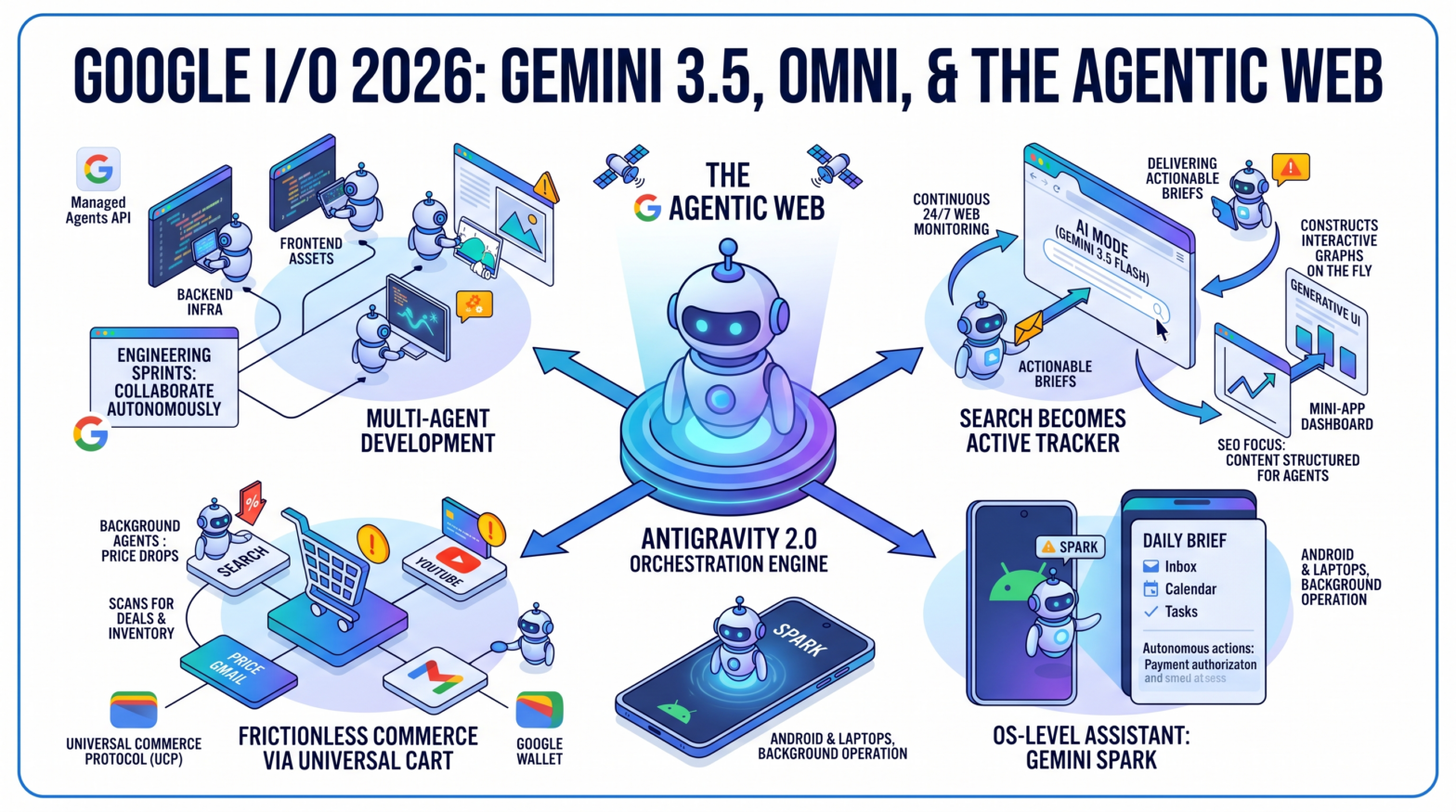
The most significant technical release of I/O 2026 was Google Antigravity 2.0.
Google is unifying its fragmented developer tools under the Antigravity banner, creating a singular, agent-first development platform. Available as a standalone desktop application, a CLI for terminal users, and an SDK, Antigravity is an orchestration engine.
Developers can now deploy multiple sub-agents to execute tasks in parallel. One agent can write the backend infrastructure of an application while a separate agent simultaneously generates the front-end brand assets using the new Google Pics tool.
Through the newly launched Managed Agents API, a single call provisions a remote Linux environment. Inside this isolated sandbox, an agent can reason, write code, execute tools, and browse the live web. Google is collapsing multi-day engineering sprints into minutes by allowing agents to collaborate autonomously within these environments.
Search Becomes an Active Tracker
The traditional Search Engine Results Page (SERP) is being dismantled. AI Mode, which now defaults to Gemini 3.5 Flash globally, has surpassed one billion monthly users. The search box itself has been upgraded to natively accept images, files, videos, and Chrome tabs alongside text.
The paradigm shift, however, is the introduction of Information Agents. Search is no longer a one-time transaction. Users can spin up dedicated agents that operate 24/7 in the background, monitoring the web, news sites, and real-time data feeds for specific topics. Instead of repeatedly searching for updates on a project or market trend, the agent synthesizes changes and delivers actionable briefs.
For complex queries, Search will now utilize Antigravity to build custom Generative UIs on the fly. Rather than returning a list of links, the engine will assemble interactive graphs, tables, or simulations specifically designed to answer the user's question. For ongoing projects, users will soon be able to generate custom "mini-apps" and dashboards directly within the Search interface to track long-term tasks.
The OS-Level Assistant: Gemini Spark
Google's vision for an autonomous future extends directly to the local device. Gemini Spark is a 24/7 personal AI agent that operates in the background of Android phones and laptops, even when the screen is off.
Built on the Antigravity platform, Spark is designed to navigate a user's digital life and take autonomous action under their direction. While currently in limited testing, the roadmap for Spark includes the ability to authorize payments, execute complex multi-app workflows, and generate custom sub-agents via text or email commands.
This ties directly into the new Daily Brief feature, which works overnight to analyze a user's inbox, calendar, and tasks, prioritizing the day ahead and proactively suggesting next steps before the user even opens an application.
Frictionless Commerce via Universal Cart
E-commerce friction is being systematically eliminated through the new Universal Cart.
Operating seamlessly across Search, the Gemini app, YouTube, and eventually Gmail, Universal Cart is an intelligent, persistent hub. Users can add items to their cart from almost any Google surface. Once added, the cart's underlying Gemini model goes to work in the background, actively tracking price drops, scanning for deals, and monitoring inventory levels.
Powered by the Universal Commerce Protocol (UCP) and integrated with Google Wallet, the system can proactively flag product incompatibilities and intelligently suggest the best payment method based on loyalty perks and merchant offers. The transaction can occur natively on Google's real estate or seamlessly transfer to the retailer's site.
Practical Implications for Marketers
For digital marketing agencies and SEO professionals, the launch of Information Agents and Generative UI fundamentally alters the mechanics of search visibility. Users are no longer returning to the SERP to conduct repetitive research; they are deploying agents to monitor the web on their behalf. Marketers must pivot from optimizing for single-click transactions to optimizing their content structure and data feeds to be ingested by these continuous, background-running agents. The competitive advantage will belong to brands whose technical architecture allows Google's Antigravity framework to easily synthesize their data into the custom dashboards and interactive mini-apps that will soon dominate the search experience.
Google I/O 2026 proved that the infrastructure for an autonomous web is already built. The industry now has to figure out how to market within it.