Google’s core search business just posted one of its strongest quarters ever, and the company is already layering advertising into AI-driven search experiences.
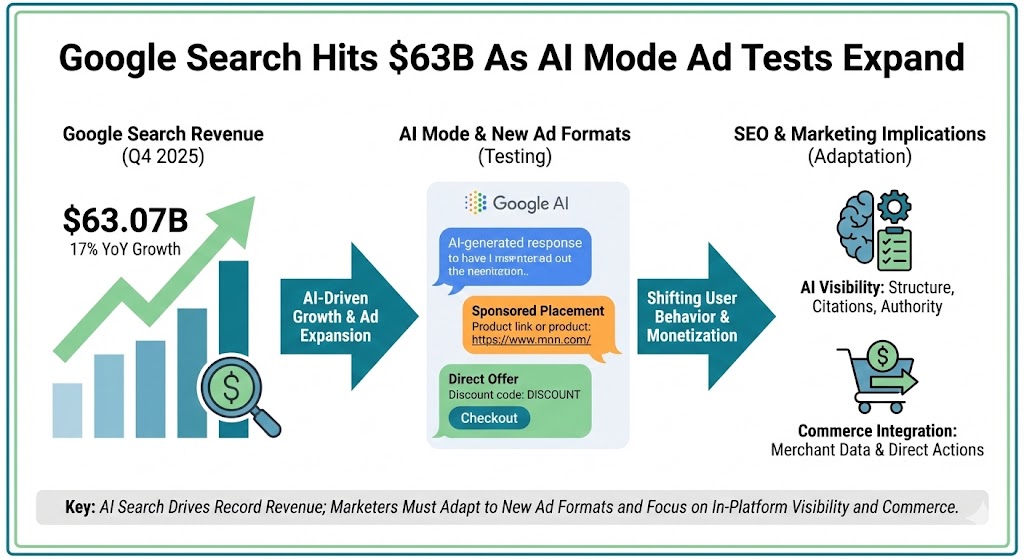
Alphabet reported that Google Search revenue climbed 17% year over year to $63.07 billion in Q4 2025. At the same time, Google confirmed it is testing ads inside AI Mode, including sponsored placements below AI-generated answers and new “Direct Offers” for shoppers.
For marketers and SEO teams, the message is clear: AI search is no longer experimental. It’s becoming a primary revenue engine.
Search Revenue Accelerates As AI Usage Grows
Google Search and related advertising revenue reached $63.07 billion, up from $54.03 billion a year earlier. Growth accelerated each quarter through 2025, finishing at 17% in Q4.
CEO Sundar Pichai said AI features are directly increasing search usage and query depth.
According to Google, daily AI Mode queries per user in the U.S. have doubled since launch. Queries are now roughly three times longer than traditional searches, and many users ask follow-up questions within the same session.
Longer, conversational queries mean more intent signals and more opportunities for ads to appear.
Ads Begin Rolling Out Inside AI Mode
Google confirmed it is testing ads directly inside AI Mode.
Early formats include sponsored listings placed below AI-generated responses, clearly separated from organic answers. The company is also piloting “Direct Offers,” which allow merchants to surface exclusive discounts to users who appear ready to purchase.
Google is additionally testing checkout directly within AI Mode for select retailers, effectively turning AI answers into transaction-ready experiences.
For advertisers, this creates inventory on complex, high-intent searches that historically didn’t monetize well.
Chief Business Officer Philipp Schindler said Gemini’s intent understanding helps Google serve ads on longer, multi-step queries that were previously difficult to target.
AI Search Behavior Is Changing How People Query Google
AI Mode is shifting the structure of search itself.
Instead of short keyword queries, users increasingly type full questions or multi-part prompts. These conversational searches often generate follow-ups, comparisons, and deeper research in one session.
From an SEO perspective, this expands the number of informational and mid-funnel moments happening inside Google’s interface rather than across multiple website visits.
That creates new ad opportunities for Google, but also raises questions about referral traffic for publishers.
YouTube Ads Miss While Subscriptions Grow
YouTube ad revenue rose 9% to $11.38 billion but fell short of analyst expectations.
Google attributed the miss largely to election ad comparisons from the previous year. Executives also noted that YouTube Premium subscriptions reduce ad inventory, trading ad revenue for recurring subscription income.
While not directly tied to AI Mode, the shift shows how Google is diversifying monetization beyond traditional ads.
What This Means For SEO, LLM Visibility, And Google AI Overviews
Google’s results highlight an important trend: more discovery and decision-making are happening inside Google surfaces such as AI Mode and AI Overviews.
If users complete research, comparisons, and purchases without leaving Google, website traffic may not scale alongside query growth.
For publishers and brands, visibility inside AI answers, citations, and featured placements becomes just as important as traditional rankings.
That means focusing on:
• clear structured content • strong entity signals and brand mentions • product feeds and merchant data for shopping • authoritative pages that can be cited in AI responses
Search is evolving from ten blue links into an AI-assisted interface, and monetization is being built directly into that layer.
The Bigger Picture
Google’s Search business just crossed $63 billion for the quarter, and AI Mode is already contributing new engagement and ad inventory.
From Google’s perspective, AI expands search activity rather than cannibalizing it. Whether that expansion translates into more traffic for websites remains an open question.
What’s certain is that AI search monetization is here. Marketers should expect continued ad experiments, deeper commerce integrations, and more user actions happening directly inside Google’s ecosystem.